Showing posts with label christoph waltz. Show all posts

Saturday, April 23, 2011

WATER FOR ELEPHANTS Review


"Water for Elephants" (2011)

Francis Lawrence's "Water for Elephants" (he previously directed "I Am Legend" and "Constantine," so how he came to something so classic is a mystery) is a sweeping romance in an extravagant setting with a trio of engaging characters--and an elephant--at its center. The film answers burning questions about two of the main actors, Robert Pattinson and Christoph Waltz. First, we walk into this film wondering if, as a leading man, Pattinson will be able to escape his pale-faced glitter vampire of "Twilight" and play a man named--gasp!--Jacob, ironically enough. The answer? He pulls it off and does just fine alongside the elegant as always Reese Witherspoon as his romantic counterpart.

The bigger question answered, however, is whether Christoph Waltz's Oscar win for "Inglourious Basterds" was a fluke. The talented actor proves with resounding confidence that it was indeed no fluke, and Waltz has again been provided with a contradictory and complicated character he can really sink his teeth into. It was as if the role was tailor made for him.

He plays August, a circus owner and ring leader who rules his microcosm of a society within the Benzini Bros. Circus with an iron fist. Much like the twisted Nazi he played in Tarantino's "Inglourious Basterds," Waltz plays August as both childlike and sadistic, amiable and murderous, and in every single scene he carries these traits with him. August relishes in being able to control others, including his own wife Marlena (Reese Witherspoon), but loses control of himself far too often exploding into violent fits of rage. Again Waltz is the scene-stealer and elevates this period piece melodrama into something unexpectedly impressive.

Based off the best-selling novel by Sara Gruen, the story is told through a flashback of Jacob as an old man (played by Hal Holbrook). It's 1931, and just as he's about to take his final veterinary exam at Cornell University, Jacob finds out his parents have died forcing him to hit the road. And, what are the chances, the first train that passes by which he decides to jump onto just happens to be a traveling circus show. Jacob gets taken in and starts doing small work for the circus until he meets Marlena and her ill show horse. After nearly getting thrown out by August after Jacob made the executive decision to put down Marlena's horse--and therefore the circus' main attraction--he decides to keep him on as a vet.

In the era of the Great Depression, times are hard and jobs are few. The film's atmosphere does a good job of capturing the period's desperate feel interlacing it with the carefree but reckless circus atmosphere full of shenanigans, animals, drinking and not without some dissension, too. The allusions to the social and political undercurrents of the time are enough to where they give the overarching story some weight and insight. The circus is also bursting with color and vivacity captured thoroughly in the cinematography when not observing the darker, murkier underbelly such as life upon the train in between shows.

Most important to the story is the blossoming--yet forbidden--romance between Jacob and August's wife, Marlena. The interplay between these three characters is engaging and harrowing enough to keep us caring for how it inevitably turns out for the main couple. Witherspoon's Marlena is a character not brave enough to leave her husband when she should've but also smart enough not to upset his ill temper. She is a lovely but smothered centerpiece to the circus, a glowing vision of a female equestrian bareback rider.

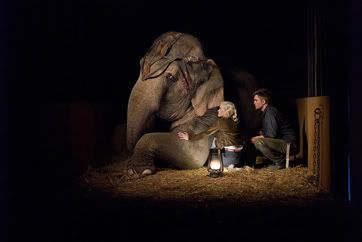
Also important is the beautiful performing elephant Rosie who becomes the circus' main attraction. The scenes where characters engage with her have heart and a natural sweetness to them that comes from any moment of people working closely with intelligent animals. The contrasting moments of animal cruelty are as hard to watch as you could imagine. We care for Rosie because she's charming and full of personality as much as any movie animal in recent memory.

Monday, March 8, 2010

"The Hurt Locker" Triumphs At A Lackluster Oscar Night


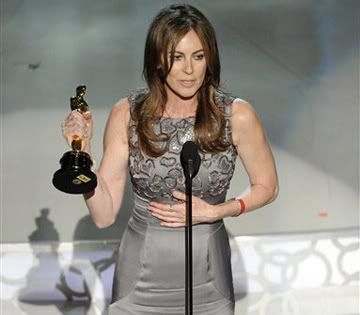
It was a night for "The Hurt Locker" at the 82nd Annual Academy Awards as Kathryn Bigelow made history becoming the first woman to ever win Best Director. Other wins for her film included Best Original Screenplay, a category where it beat out Quentin Tarantino's "Inglourious Basterds," Best Sound Mixing, Sound Editing and Best Editing, which all added up to a Best Picture win.

Barbara Streisand took great honor in announcing the winner for Best Director as if she already knew the name inside the envelope. With a dramatic pause before announcing the name, she said, "Well, the time has come." It was the ceremony's biggest moment as Bigelow earned herself not only a standing ovation but a place in Oscar history.

"The Hurt Locker" lead the pack with its six wins followed by "Avatar" with four and "Precious," "Crazy Heart" and "Up" each with two. As expected, "Avatar" took mostly technical awards including Best Cinematography, Art Direction and Visual Effects. "Up" won for Best Animated Feature and its score by Michael Giacchino. "Crazy Heart" took its honors for Best Original Song and, of course, Jeff Bridges for Best Actor as he, too, garnered a standing ovation. Mo'Nique got herself one, as well, for her Best Supporting Actress win for "Precious."

The second win for "Precious" came with arguably the night's biggest upset. "Up in the Air" got zero love as it lost to "Precious" for Best Adapted Screenplay. This, however, brought about a rather moving speech from screenwriter Geoffrey Fletcher.

And speaking of upsets, the Best Foreign Language Film category just keeps getting more unpredictable. Neither "The White Ribbon" nor "A Prophet" won as the award went to Argentina's "The Secret in their Eyes."

This wasn't the only strange happening throughout the evening's ceremony, though, which proved to be a long slog that lacked entertainment and was riddled with technical faults. But it was the the draw of "Avatar" lovers that boosted the number of viewers for this year's telecast even with its flaws.

Steve Martin and Alec Baldwin as hosts could've been something really special, but their opening monologue, which had them playing off each other's riffs, was surprisingly less amusing than originally expected.

There was an effort to cut down the ceremony's time, but it still clocked in at 3-and-a-half hours and included some unnecessary fluff that should've been removed.

One major downside with having 10 Best Picture nominees was that we were forced to watch extended clips from not 5 but 10 films, and these really dragged. Another accessory to the night was the new way in which the nominees for Best Actor and Actress were presented. Esteemed colleagues lined up on stage and praised the work of each nominee they worked with, but no time limit was set on these speeches. They became long-winded, especially at this point in the night when it was hitting past the 3-hour mark with the four big awards left. Just get on with it already! Had these come sooner and perhaps been scattered throughout the night, they could've been more tolerable.

In accepting her Best Actress award for "The Blind Side," Sandra Bullock became the first and only one of the night to cry. She had a nice speech prepared giving her deepest thanks to all the other nominees, and, as a bonus, she even told Meryl Streep what a good kisser she was referring to their moment at an earlier award show. Bullock earned herself a standing ovation as many people were pulling for her to win. She knew it and certainly dressed for the occasion.

So how long did the Meryl Streep vs. Sandra Bullock hype hold up? Not at all. Instead, the night's drama came from an unexpectedly small source. When the film "Music by Prudence" won for Best Documentary Short, there was a bizarre discrepancy as to who deserved the credit enough to take acceptance. It turned into an interrupting Kanye-inspired speech that proved to be the strangest moment of the night.

Well, maybe except for when Ben Stiller showed up in Avatar-inspired garb to present Best Makeup.

Strange, too, was the appearance of Taylor Lautner and Kristen Stewart presenting a completely irrelevant montage to horror movies. It was like the Academy's way of telling filmmakers to start making some better horror films, so the genre could make its way back into the award circuit. Saving this montage was a hilarious spoof beforehand of "Paranormal Activity" put on by the hosts.

The tribute to John Hughes was a touching moment as his literal actor "children" came walking out on stage after a montage that reminded us just how good all those classic teenage movies were. Likewise, the In Memoriam sequence had nice musical accompaniment by James Taylor. That is until they forgot to include Farrah Fawcett. Oops!

The appreciative length of the clips for acting made up for the fact that there were no clips for the Best Cinematography category. And, my question: What about any performances for Best Original Song? I like when those are brought to the stage. Instead, we received a horrifying tribute to the Best Score nominees that temporarily transformed the evening into an episode of "So You Think You Can Dance." After seeing that, I honestly would've preferred to watch Neil Patrick Harris dance and sing in a tuxedo again.

By the time Tom Hanks strolled out onto the stage to reveal "The Hurt Locker" as Best Picture, time was short and he ripped open the envelope without any delay for suspense. But, then again, it was getting really tiresome by that time anyway.

Hanks did take time to make a rather poignant observation. The last time the Academy included 10 Best Picture nominees was in 1943. In that year we were at war, and "Casablanca" took home the top prize. Now, 67 years later, we're at war, and "The Hurt Locker" triumphed. Striking, isn't it? I think we have a classic on our hands.

Out of the 21 categories in which I placed predictions, 17 of those were correct. That's not too shabby, right?

Check out the complete list of winners for the 2010 Oscars.

Saturday, January 23, 2010

The Actors Speak


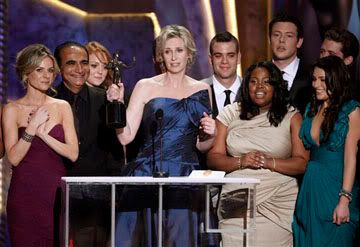
The 16th Annual Screen Actors Guild Awards was yet another award show with some not-so-surprising results. But, before we begin, I must note that "Glee" won for Outstanding Performance by an Ensemble in a Comedy Series, and it was perfect.

Christoph Waltz and Mo'Nique walked away with the award for Outstanding Performance by a Male Actor in a Supporting Role and Outstanding Performance by a Female Actor in a Supporting Role, respectively. No surprise there, and they're both well on their way to Oscar gold. The interesting thing to note about Mo'Nique's win, however, is that she was, for the first time, up against Diane Kruger of "Inglourious Basterds," and she even beat her.

Sandra Bullock was awarded Outstanding Performance by a Female Actor in a Leading Role for her work in "The Blind Side," and she beat some huge competition like Helen Mirren for "The Last Station," Gabourey Sidibe for "Precious," Carey Mulligan for "An Education," and Meryl Streep for "Julie & Julia." Yes, Bullock's win infuriates me. Do I have room to talk, though? Perhaps not, considering that I haven't seen "The Blind Side." In any case, I just feel like her win is a giveaway. And this win does mean that she, too, is well on her way to an Oscar win.

Jeff Bridges continued his winning streak, as well, for his performance in "Crazy Heart" for a win in the category of Outstanding Performance by a Male Actor in a Leading Performance. He is a secured lock for the Oscar.

The one surprise of the night came with the winner of Outstanding Performance by a Cast in a Motion Picture which was awarded to the cast of "Inglourious Basterds." The expected winner was "Precious," but Quentin Tarantino's WWII masterpiece came out on top. What does this mean for its chances at some more Oscar nominations and wins? I think its chances just got a well-deserved boost. And why, why, why was the cast of "Nine" nominated over "Up in the Air?"

For a full list of nominees and winners, including those for television, go here.

Saturday, August 22, 2009

Tarantino Rewrites History

Inglourious Basterds


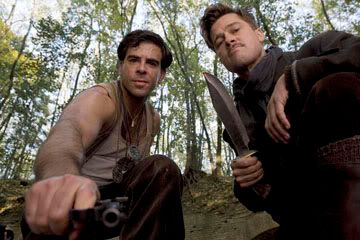
As Lt. Aldo Raine (Brad Pitt) holds his bloody knife and cuts a Nazi symbol into the forehead of Col. Hans Landa (Cristophe Waltz) in the film's final frame, he mutters to himself, "This might just be my masterpiece." And with a self-assured confidence we've come to expect from writer/director Quentin Tarantino, there is no doubt that he speaks for his own boldly audacious and wickedly fantastical war movie, "Inglourious Basterds." With this latest film of his, he once again demonstrates that he is a director of his own accord and provides joyously freewheeling entertainment that will infuriate and startle some audiences. Most of all, though, Tarantino still holds on to his inexplicable ability to enthrall. Even with a gaudy 153-minute running time, there is never a dull moment. From start to finish this is Tarantino at the top of his classic form, and it's a dramatically exuberant celebration of filmmaking.

This isn't a Hollywood war epic starring Brad Pitt (whose part isn't even that significant) as some of the promotions are making it out to be. European in its style and design, this film holds all of the Tarantino signatures such as the sequences of lengthy dialogue and eruptions of bloody violence. "Basterds" isn't so much about war as it is about the movies. Tarantino has reimagined WWII and has spun it into his own twisted fairy tale, making the war conclude the way he sees most fit, and that is through the infinite power of cinema. Endlessly referential, both reflexively and culturally, the movie includes Samuel L. Jackson voiceovers, a David Bowie song on the soundtrack, and even music recycled from the "Kill Bill" films. Even the title is an homage to the 1978 B-movie, "The Inglorious Bastards." It is, however, no remake, and it's Tarantino through and through as he infuses his love for movies into his own work. And so it's rightfully fitting that the key location of the film is a movie theater.

The opening of "Basterds" focuses on a French Jewish woman named Soshanna (Mélanie Laurent) who witnesses her family's slaughter by the hands of the SS under the control of Col. Hans Landa, "the Jew Hunter." In the movie's first chapter (it is divided into five chapters, the first being titled, "Once Upon a Time...In Nazi-Occupied France"), which is brilliant on its own, Christophe Waltz plays Landa with a strangeness like no Nazi ever before to be represented onscreen. He's well-mannered yet sinister but also equally absurd. He's the absolute forefront of the cast of colorful players to fill the screen. Soshanna flees to Paris where she runs a movie theater and gets approached by a Nazi war hero, Frederick Zoller (Daniel Bruhl), who convinces Joseph Goebells to hold the premiere of the movie "Nation's Pride," which glorifies Zoller's exploits. The premiere will consist of an audience full of Nazis not limited to Adolf Hitler (Martin Wuttke) himself. Soshanna fulfills a tale of revenge as she becomes a femme fatale donning plump red lipstick and a curvy red dress. And having to play her as a woman always undercover, Mélanie Laurent is a marvel as she conveys a wide range of emotions, the terror and horror, beneath a composed surface.

And then there are the Basterds led by the smooth-talking Southern boy, Lt. Aldo Raine, who is in the business for killing Nazis. He stands before his comrades demanding from them 100 Nazi scalps. Among the bunch is "the Bear Jew" (Eli Roth). It's funny to note that Eli Roth, the man behind the "Hostel" torture-porn films, plays the brute of a man who gets extreme pleasure out of beating Nazis with a baseball bat. The separate story of these Basterds eventually collides with that of Soshanna along with the British high command (Mike Myers in an unrecognizable cameo) and another woman, a German movie star-turned-Allied spy named Bridget von Hammersmark (Diane Krueger), who appears in a prolonged tavern scene that is reminiscent of the conversations in "Pulp Fiction." It all comes full circle during the climactic end when the draw of moviegoing plays a role in ending the Third Reich.

Quentin Tarantino films defy description and have the knack to grow on you because you feel there's something to them, something that requires a second or third viewing. "Inglourious Basterds" is another one of those films. So, is this Tarantino's best yet? I'll never say. And how can you? He is a director of unexpected delights, one who consistently brings something new yet familiar to the table. Here, he uses clichés from war movies and other genres only to then explode apart those clichés to remind us just how awful WWII was. This is like nothing else you'll see in theaters this year. In what other movie can you watch Hitler take multiple gunshots to the face?