Showing posts with label daniel radcliffe. Show all posts

Thursday, October 24, 2013

KILL YOUR DARLINGS Review


Be careful, you are not in Wonderland.
I've heard the strange madness long growing in your soul.
But you are fortunate in your ignorance, in your isolation.
You, who have suffered find where love hides, give, share, lose,
Lest we die unbloomed.

Played by the versatile Daniel Radcliffe, who has officially escaped the bounds of his Harry Potter history, a young Allen Ginsberg recites this poem aboard a stolen boat with fellow ignitors of the Beat Generation, Jack Kerouac (Jack Huston) and Lucien Carr (Dane DeHaan). As much as the film is about these radicals, also including William Burroughs (Ben Foster), it's also a film about the secrets and desires that fuel the need to break away from the typical, to escape rhyme and meter, the status quo. For Ginsberg, that was as much about coming into his writing as it was coming into his sexuality.

The story is as much about Ginsberg as it is about the mysterious, seductive and alluring Lucien Carr who Ginsberg becomes fixated on. Lucien would eventually break from the group and demand his name be removed from "Howl and Other Poems" to whom Ginsberg dedicated it. The plot pivots around a scandalous murder, of Lucien's mentor and predator, David Kammerer (Michael C. Hall) who becomes frighteningly obsessed with Lucien throughout their arrangement of schoolwork in exchange for sex. Lucien was struggling with his sexuality, teasing Ginsberg, but accustomed to men like him having to lurk in the shadows, denying their true selves. This interplay between expression, sexuality and creating a movement is where John Krokidas' debut feature is most interesting.

The editing matches the trippy, freewheeling style of the Beats but also brings the film into misshapen tonal confusion. But again, the film's saving grace is the sordid romantic entanglement between Radcliffe's Ginsberg and DeHaan's Lucien. The former's yearning for the latter is expertly conceived, and it's how "Kill Your Darlings" transcends its subject material, capturing the fledgling state of any budding creative, a freshman at a prolific college where only the world stands before him.

Friday, July 15, 2011

HARRY POTTER AND THE DEATHLY HALLOWS: PART 2 Review


"Harry Potter and the Deathly Hallows: Part 2" (2011)

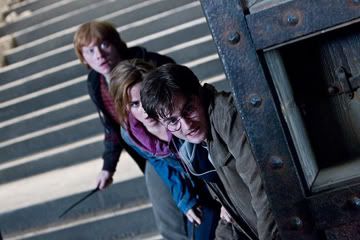
Harry, Ron and Hermoine (Daniel Radcliffe, Rupert Grint and Emma Watson) return home to Hogwarts in "Harry Potter and the Deathly Hallows: Part 2," the phenomenal conclusion to the longest running and most profitable movie franchise of all time. It's storytelling that has defined a generation and spanned an entire decade, and this is a more than fitting and immensely satisfying ending for The End -- an enormously important moment in pop culture.

The decision to split the final installment of J.K. Rowling's literary epic is announced even clearer here than in "Part 1" as the right choice. This is the shortest "Harry Potter" installment but packs in the most action perhaps of all other seven films combined creating for a grand finale. It works as a great contrast to the slower more atmospheric tone of "Part 1." Director David Yates and screenwriter Steve Kloves have been in perfect harmony ever since the sixth installment, and since then they have made "Harry Potter" films that just keep getting better. The remarkable thing is that "Part 2" far surpasses the rest as the best yet; it's emotionally wrenching, visually thrilling and offers up payoffs that cannot be matched working as a graceful homecoming for the series.

The continued hunt for the seven Horcruxes -- which each contain pieces of Lord Voldemort's soul that must be destroyed -- lead our three heroes back to the place where it all began. This gives us a chance to think back to 2001's "The Sorcerer's Stone" where all the plucky, bright and anxious energy has now turned to a darker, richer palette of dread and gloom as the siege on Hogwarts begins. Yates and Kloves reprise themes and characters we haven't seen for some time but certainly have not forgotten. Even the brilliant score from Alexandre Desplat rings with reminiscence of "Harry Potter" movies past.

When the familiar faces of Professor McGonagall (Maggie Smith) and Neville Longbottom (Matthew Lewis) appear to us, it elicits an adrenaline rush of joy in signaling that everyone has come together again reunited as one against a formidable force of evil. The battle at Hogwarts is expertly staged and choreographed with some of the best visual effects placed within real world, human situations you'll ever experience on screen. Before we even arrive there, Harry, Ron and Hermoine have to break into Gringotts Banks guarded by stoic goblins and a fire-breathing dragon. It's a most ingenious and harrowing scene where the feeling of time running out and Death Eaters close on the heels of our beloved trio is ever so palpable.

The acting is, as we've come to know, solid across the board. How could it not be? These actors have been with their characters for so long. Extra room for bravado is given to Daniel Radcliffe as the Boy Who Lived, Alan Rickman as Severus Snape and -- for the first time -- Ralph Fiennes as the seething, slit-nosed Lord Voldemort. Fiennes is more expressive about his fury and agony toward Harry Potter encapsulating what we well know is at stake. Rickman's mysterious Snape is fully established, and the realization of his connection to Harry -- as seen in memories through peering into the Pensieve -- is beautiful and tragic.

It's the finish this saga deserves going out with a blast of authentic movie magic full of tension, awe and mortality. After the claps of thunderous destruction, howls of terror and triumph and swirls of smoke and debris, the dust settles and there stand Harry, Ron and Hermoine after all this time. My, how they've grown. It's a perfectly executed moment of absolute silence that occurs just before the interpretation of Rowling's famed epilogue. They exchange glances but no words simply because none are needed.

Beyond all the exhilaration of how good "Part 2" turned out to be, there's always the other side. That is, the deep underlying bittersweet sorrow of knowing that the end of this tale about witchcraft and wizardry -- teaching us so much about courage, friendship, getting older and taking responsibility -- represents, too, the end of a childhood that has shaped us as readers and moviegoers and one that will leave a lasting impression on us for years to come.

My review of Harry Potter and the Deathly Hallows: Part 1

Friday, November 19, 2010


"Harry Potter and the Deathly Hallows: Part 1" (2010)

When I first heard that "Harry Potter and the Deathly Hallows," the conclusion to J.K. Rowling's modern literary classic, was going to be split into two movies, I was worried it was all about the money. It thankfully turns out, however, that it was really all about the story. The choice for a split in this final installment is an artistic one, and it seems only fitting now after having seen "Part 1." Director David Yates, who directed the fifth and sixth installments, has skillfully guided us through a string of "Harry Potter" films that are consistently excellent.

In this most emotionally and cinematically rewarding installment yet, there's a sense of melancholy for the impending end, which arrives next year with "Part 2," as Yates steers us into a more serious, elegant and meditative film about characters we have grown to love and care for, those we have watched since they were children and who are now intelligent young adults taking on the world outside the walls of Hogwarts School of Witchcraft and Wizardry.

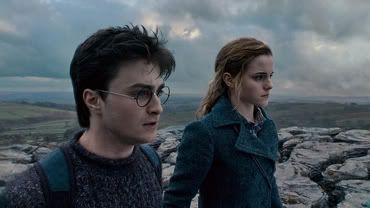
This is the furthest departure from any "Harry Potter" films that have come before. We receive but a glimpse of Hogwarts, and Harry (Daniel Radcliffe), Ron (Rupert Grint) and Hermoine (Emma Watson) are not there. There are no longer Quidditch matches, classes, uniforms, petty crushes or any sort of adult supervision or guidance--these are all things of the past for our trio. Cast out beyond the walls of Hogwarts, they are on their own separate mission to find the Horcruxes with which to destroy Lord Voldemort (Ralph Fiennes). Albus Dumbledore is dead and gone, and while the trio gets assistance early on from the likes of Hagrid (Robbie Coltrane) and Mad-Eye Moody (Brendan Gleeson), they mostly must remain on their own in order to ensure the safety of those close to them. Harry Potter is a human target with the Dark Lord's Death Eaters on the loose, so they decide it would be better to keep him in seclusion from others, which means traveling through vast wilderness and using Hermoine's endless resources to their advantage.

This drastic setting change is jarring at first but takes us to gorgeous landscapes that are captured by luscious cinematography from Eduardo Serra ("Girl with a Pearl Earring," "Blood Diamond"). The journey also takes them occasionally to the streets of London, which adds a shock of realism to what we've otherwise come to know as fantasy. The early portion of the movie wanders a bit, but it works considering the rather directionless nature of their journey at that point. We also wouldn't get some of the intimately detailed moments that we do if there wasn't this slight pause in the proceedings.

In one of the movie's most poignant moments, Ron has become fed up with waiting around for Horcruxes and storms off leaving Harry, and especially Hermoine, bewildered and lonely. In an effort to comfort Hermoine and lighten the mood, Harry wordlessly leads his friend in a dance inside their tent. This scene is not in the book, but it proves Yates has really come to understand not only these characters but the actors playing them, as well. A deviation from the text such as this comes as a welcome addition, an honestly tender and real moment marking the films and books as separate entities, but also a flourish of which Rowling would approve.

A lot of the older British cast is absent (Alan Rickman shows up only once as Severus Snape, and Helena Bonham Carter has one dastardly sequence as Bellatrix Lestrange), which leaves room for the three younger actors to really shine. Radcliffe, Grint and Watson all present their largest emotional range here than ever before. Their performances are accented with touchingly subtle nuances that were conspicuously absent before as the characters begin to struggle with each other as adults, and it's this elevation of feeling from them that makes this first part of the finale pack in the level of emotional grandeur that it does.

Tracking the adventure is the brilliant composer Alexandre Desplat, his first time working with "Harry Potter," whose score is haunting and bleak with touches of whimsy. This entry also uses stark silence to great effect most notably during both the opening and closing credits. A daunting chase sequence with Snatchers through the woods cuts out all music, too, as all we hear is the zapping of spells, the trampling of feet on the ground and heaving breaths.

Harry, Ron and Hermoine's infiltration into the Ministry of Magic is cleverly handled as is the telling of the story of the Deathly Hallows, which is presented with shadowy figures of animation that have a nice effect. The return of the house elf Dobby is also a welcome treat. Yates and screenwriter Steve Kloves have set their formula, which has become especially familiar to us since "Half-Blood Prince," to even greater effect here with a perfect blend of pathos and humor.

While each entry certainly has been darkening in tone and mood, things have now turned to pitch black. "Harry Potter and the Deathly Hallows: Part 1" is the slowest and saddest installment yet, beautiful and heartwrenching in its own right and a satisfying and standalone entry even when it ends at the midpoint acting as a stepping stone. "Part 1" braces its characters and its fans for the series' finish as we await with anxious suspense and a tinge of looming dread perhaps because we well know the next time is when we say goodbye.