Showing posts with label jake gyllenhaal. Show all posts

Saturday, April 2, 2011

SOURCE CODE Review


"Source Code" (2011)

It all starts with a man on a train. He wakes up unaware of where he is or how he got there. A woman sits across from him and seems to know him but isn't referring to him by the right name. Panicked, he goes into the bathroom and takes a look at his reflection only to see a face looking back at him that is not his own. Moments later the train explodes in flames, and Army pilot Colter Stevens (Jake Gyllenhaal) awakens again this time in a darkened capsule, something called the source code.

"Source Code" is this year's minimalist "Inception" where traversing dreamscapes is replaced with limited time traveling. Director Duncan Jones returns after his 2009 debut film "Moon"--which I personally thought was a rather stolid and stagnant film--this time with a more superior screenplay from writer Ben Ripley. Together they create a moving and enthralling science fiction thriller that becomes less about the accuracy of the science and much more about the believability and potency of the emotions. The level of complex observation of human nature found in what could've just been tightly-wound ticking time bomb entertainment is unexpectedly welcome and poignant.

In the film's first moments everything is laid out for us. The commuter train to Chicago upon which Colter found himself isn't, technically speaking, real. It did exist, but so did the explosion he experienced which killed everyone on-board. It was a terrorist attack, one to which Colter has been specially assigned to find and identify the bomber therefore preventing a more large-scale attack on the city.

He communicates with an Army scientist named Colleen Goodwin (Vera Farmiga) who helps him to understand his mission through the source code, which was invented by Dr. Rutledge (Jeffrey Wright) who has faith in his experiment. Through source code Colter is able to tap into the consciousness of a victim on the train--the one that resembles him most--while playing out the last eight minutes of the experience on that train before the explosion.

The film mostly consists of Colter's return trips into those last eight minutes. Each one is a little different than the last acting as impressions of what could happen on the train. Each time Colter enters consciousness, a pop can cracks open and fizzes, coffee spills on his shoe and the woman sitting across from him begins a conversation with, "So, I took your advice." The woman is Christina (Michelle Monaghan) who only knows the man Colter is portraying through their frequent trips on the train. No matter the variation of events, the immediacy and frantic urgency of the situation doesn't change. Every time Colter runs out of time before completing his mission, he's sent back in to do it all over again much like "Groundhog Day" where he remembers each previous time before.

The initial plot and vehicle of intrigue for "Source Code" is a contraption, and it's one that frustrates at first but then continually expands and evolves in the character's mind and our own. Suspension of disbelief with the science is necessary but not in the film's understanding and expression of human longing and desire. There's a depth to Jake Gyllenhaal's performance as Colter that gives us reason to believe that him falling in love with a fake projection of a real woman who has already died is actually possible.

Likewise, Michelle Monaghan is radiant and lovely finding room to breathe within a role that really only allows her to repeat lines and seem bewildered. Jeffrey Wright is effective as the man who essentially becomes the mad scientist of the operation while Vera Farmiga is absolutely convincing as a woman who shifts her perspective from severe disciplined operation to sympathy and compassion.

"Source Code" works hard and fast--like Colter at its center--doing a lot within a brisk 94 minutes. It shares an entire riveting journey inside crazy metaphysics but, even more, inside the fragility of the human condition with a thought-provoking and powerful grace note at its conclusion.

Saturday, November 27, 2010


"Love & Other Drugs" (2010)

"Love & Other Drugs" needs medication for its own case of schizophrenia. The movie's distractingly abrupt tonal shifts aren't enough, though, to ruin the romantic couple at its center. It's a romantic comedy, but it's set to the backdrop of something more, a smart and zippy satire about the corporate pharmaceutical world. It's a movie in the hands of the capable director Edward Zwick ("Defiance," "Blood Diamond," "The Last Samurai") who is stuck working with sketchy writing. There's never a satisfactory balance of the two elements, the love and the drugs, but Zwick still manages to bring out key scenes and give them a necessary weight against bland placebos within the screenplay. These scenes are weighted on the side of love which sways the entire movie to drop the drugs side almost completely. Had it been the other way around, this would've been a very different movie.

It is 1996, and Jamie (Jake Gyllenhaal) casually slides into the career of a pharmaceutical rep when he gets fired from his job selling electronics. It's not much of a change for him because he carries his same charismatic, carefree attitude to both jobs. His charm works wonders as he works as a salesman for the drug company Pfizer selling samples of Zoloft. He slips into doctor's offices by talking up--and occasionally sleeping with--the female receptionists and befriending doctors to begin his domination with Zoloft over his adversary, Trey Hannigan (Gabriel Macht), whose drug of choice is Prozac. Cheered on by his supervisor Bruce Winston (Oliver Platt), Jamie paves his way through this business of bribes, gratuities and sleazy relationships between doctors and their reps.

Getting close with one doctor, Stan Knight (Hank Azaria), gives Jamie the opportunity to meet one of his patients, Maggie Murdock (Anne Hathaway), and not only that but also a peek at her breast. Maggie notices, follows Jamie out to the parking lot scolding him for allowing her to expose herself to him and from there, Jamie is immediately entranced by her cold bitterness, asks her to coffee and their story as a couple unfolds from there.

The movie is at its best when scorching the screen. At the start of their relationship, all Maggie and Jamie want and need from each other is sex. And so, they are naked a lot and having sex, well, a lot. In these instances, the movie becomes the ideal modern R-rated romance. It's hot and steamy with two delightfully attractive leads. We love when they're together, and the most memorable moments come when they're romping around in bed. All of this raunchiness is never gratuitous because these characters' bodies speak for themselves, and the sex and nudity has meaning to it; this is the way they communicate upon first meeting.

As Maggie, Anne Hathaway is great. Maggie is only 26-years-old and dealing with the early stages of Parkinson's disease. Her way of controlling it on her own is to not let anyone get too attached to her, which is why Jamie is such a good choice for empty sex. Hathaway presents a range of vulnerability and strength in Maggie that is authentic and a very fine performance. Gyllenhaal's Jamie is not as complete but effective nonetheless alongside Maggie. Also admirable is Hathaway's openness to the movie's blunt sexuality. This could be considered her first mainstream adult role, another role that truly launches her into the limelight.

By the third act of "Love & Other Drugs," it does fall victim to tired rom-com tropes. In spite of this, we care too much about the two leads to let it become too bothersome. What is bothersome, however, is the supporting character of Jamie's obnoxious younger brother (Josh Gad) who brings a whole baggage of unnecessary subplot and comic relief with slapstick that gets too gross and ends up belonging in a lesser buddy movie. And though the drugs take a backseat by the second half, the introduction of Pfizer's Viagra is a winning addition since this really is a movie all about sex and sexiness.

Thursday, May 27, 2010


"Prince of Persia: The Sands of Time" (2010)

Strictly viewed as a video game adaptation, "Prince of Persia: The Sands of Time" succeeds just fine. The dagger is put to good use and integrated well into the story. You fill the dagger with magical sand, push a gem on the hilt and suddenly you are traveling a minute back in time. The effect looks cool with flowing, swirling gold sand. It doesn't happen frequently, though. But how could it? If you keep pushing the button, things get boring because nobody will die, and you'll run out of that sand anyway. The acrobatics are all there from the game, but again not as much as maybe we'd like. Even still, as far as video game adaptations go, it's better than the rest.

As far as being a movie on its own and trying to live up to the expectations of being the next "Pirates of the Caribbean" franchise as a Jerry Bruckheimer production based on something hokey (this time not an amusement park ride), it fails in every respect and had me wincing in embarrassment. The movie is helmed by director Mike Newell who tackled "Harry Potter and the Goblet of Fire" with more ease than he does here. He can't find his way around an action sequence without it being completely mind-boggling and disorienting. The CGI gets in the way in most instances as Prince Dastan (Jake Gyllenhaal) flips around disposing of his enemies. The enemies also all look the same, all turbaned in some way either shooting arrows or throwing knives. The color palette is brown, tan, gold and maybe some variations of that. The movie is the same all the way through, a rollercoaster ride without any drops, and it's downright ugly not only in its look but style.

Jakes Gyllenhaal plays Dastan how he should and adds nothing else to it. He's rightfully buffed up sporting long hair and Persian robes and garb. He cracks his one-liners, has his smart remarks, gets angry at enemies and charms the lady but all of it feels mandatory, never organic. Nothing about "Prince of Persia" is such. There's the Alamutian princess Tarmina (Gemma Arterton) who takes her job of protecting her city of Alamut and the magical dagger seriously. When she and Dastan embark on their quest together after realizing their motives turn out to be the same—of course they do—they bicker, just as they're supposed to do, and then they gradually—as if simply by their circumstances—fall in love, just as they're supposed to do. Nothing additional is created by either of these actors to aid the flatness of their characters. There's no chemistry, no fun, no wit, no charm. And at least let there be an ounce of sex appeal. Gyllenhaal goes shirtless only once briefly; all that working out for nothing. And that kiss the two leads finally share is painfully lame.

The villain is played by Ben Kingsley who played a more menacing villain, who turned out to not actually be a villain, in "Shutter Island" earlier this year. He wears black eyeliner, so that makes him scarier. He is Navim, Dastan's uncle who calls for the attack on the city of Alamut. Reasons for the attack are muddled, mixed around, jumbled, spun, twisted and turned, and while there are about three fake villains and one additional assassin villain who resembles Lord Voldemort, it is Navim who is the bad guy. Just so we're clear. I didn't give anything away; Kingsley is the one on the movie poster, not the others.

The magical dagger becomes important in that, if put in the wrong hands, it can end the world and destroy all of mankind. Even with such an imposing sense of doom, nothing about Dastan and Tarmina's journey escalates to any sort of importance or epic scale. There's falling, there's yelling and shouting, running and fleeing, but to what ultimate purpose? The journey is surprisingly boring for all that's going on, and in this sense the movie comes off as desperate. The excitement and emotion picks up for a moment during a big underground set piece, but even that is lackluster.

And you can't forget the obligatory character of comic relief. This time it's Alfred Molina as Sheik Amar, a wild-eyed Persian with a fetish for racing ostriches, finding gold and evading taxes. When this guy gives the most charisma out of everyone in the movie combined, you know you're in trouble. "Prince of Persia: The Sands of Time" is not the next "Pirates"-like franchise. When meant to be light blockbuster entertainment such as that, it doesn't work when Molina is honestly the best you get. The rest is a self-serious trudge through the desert.

Thursday, May 6, 2010


Archive: "Zodiac" (2007)

David Fincher's ("Se7en," "Fight Club") "Zodiac" takes place over a sprawling couple of decades through the late 60s and the early 80s. Along the way, little reminders are given between just about every scene to remind the viewers how much time has passed by. It can get a little complicated at times, but this is complicated business being dealt with here; the confusion comes with the territory, and there's no backing out. The otherwise nameless Zodiac killer terrorized San Francisco citizens, and also taunted the police and reporters who were out to catch him. The ominous killer left the San Francisco Chronicle editorial letters describing each and every one of his kills, some of which may not have even been his own. He also sent four cryptograms along with these letters; only one of these four secret messages to this day has been solved. All of these small details make resonant the fact that this story is entirely real, and it makes you really hope that Zodiac is still not out there somewhere.

"Zodiac" is not about the actual Zodiac killer and the way he thinks or why he does what he does. The script of the movie does not revolve around the monster in discussion, but rather revolves around the actual talking that's being done; it sure is a lot of talking. It's about the public's fascination with this serial killer, and why people become so obsessed to begin with. This point holds strong because we're seeing this movie, and by doing so, we ourselves are becoming just as involved as the people on the screen. We are puzzled, horrified, tantalized, and drawn to the extreme edge of suspense throughout the entire endeavor. It's in this big way that the movie packs a certain emotional punch that normal "whodunits" really cannot ever possibly conceive. It's more than just a detective thriller, and David Fincher even jumps genres between scenes to keep the experience compelling.

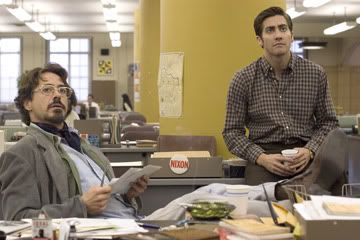
Inside the crowded offices, the meetings, and the police stations, we meet the main people involved in the Zodiac case. Paul Avery (Robert Downey Jr.) is a head writer for the San Francisco Chronicle, and he is the one publishing the most stories about the Zodiac killer. He is admired and "loomed-over" by Robert Graysmith (Jake Gyllenhaal), a cartoonist for the San Francisco Chronicle. Graysmith is merely a cartoonist, and when he tries to get involved with the Zodiac case, he is simply reminded that he has a deadline to meet and is shooed away. Lastly, there's Inspector Dave Toschi (Mark Ruffalo) who is on the other end of the spectrum as a detective who gets quickly involved with the case; he is quirky and enjoys animal crackers whenever he has a crime scene to be at.

There are countless other people involved in the search for the Zodiac killer, but these are the main ones to name. These certain people are worth mentioning because they're played by great actors who all give excellent performances. Jake Gyllenhaal shines as the innocent bystander who becomes the most involved out of anybody, and eventually writes the novel about Zodiac. Mark Ruffalo is exceptional, as well, playing a character whose mood noticeably shifts as he is at times ready to strangle the reporters getting in the way. Then there's Robert Downey Jr. who is pitch-perfect as a man who gets eventually tired of the Zodiac business and completely drops out; he is an alcoholic and a drug addict. He is hysterical because he so casually plays a character that makes everybody else around him so uncomfortable.

Following the extremely paranoid process of finding the killer becomes almost a comedy during some parts, which brings up David Fincher's ability to genre-hop within the confines of one movie. Although short, the small insights we're given into the Zodiac's numerous killings keep us haunted. One scene in particular involves a woman unknowingly being tormented by Zodiac on the side of the road when her car breaks down. This woman and her baby hitch a ride with the killer, and she becomes suspicious of his intentions. The Zodiac then nonchalantly states, "Before I kill you, I'm going to throw your baby out the window." Each one of these similar scenes is just as bone-chilling, and there's almost a sense of relief when the focus is brought back onto the reporters and the investigators.

Just when it seems things are heating up, the trail goes cold. Four years later, Robert Graysmith is basically the only person left interested in the Zodiac case. This big shift in the movie that divides it into two parts is what makes "Zodiac" feel so lengthy. That's not to say that it isn't lengthy because running at just over 2-and-a-half hours, the movie really demands your attention for quite some time. At a certain point, you can't help but wonder if all of the previous investigating was really worth showing. There is a dull spot, and some of the information shown earlier starts to feel a bit extraneous and unnecessary, which means that perhaps the movie could've been cut down to save some time. The real meat of the story comes along when Jake Gyllenhaal's character takes control, revealing the only real-life suspect known in the Zodiac case.

The biggest complaint I've heard about "Zodiac" is concerning the ending. It has been called inconclusive and unsatisfying, but I disagree with both of these statements. People who don't appreciate the ending really must not have appreciated the rest of the movie. At the end of it all, one should be realizing that it certainly is not about the solution but rather all about the process involved with trying to get to a solution. The ending only gives off the illusion of being inconclusive due to the fact that the movie is based on a real case, which is still unsolved to this day. I found the entire experience to be extraordinarily satisfying overall. Before the credits roll, facts on the real-life Zodiac case are displayed to further remind us that everything we just witnessed is based on something that really happened and something that was really obsessed over this much.