

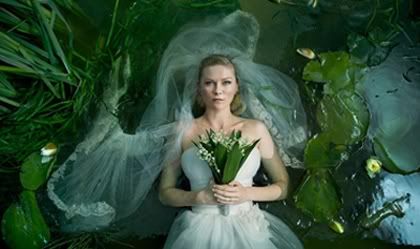
A woman screams embracing her child while collapsing onto the putting green of a golf course. Electricity gets absorbed out of the end of a telephone pole -- and another woman's fingers. That same woman wears an extravagant wedding dress running from vines of entanglement grasping her legs. She's then on her back floating down a clear river holding a bouquet of white flowers. Two planets, one Earth and another ominous blue mass, circle by each other and collide. These haunting portraits at the end of the world open as a prologue to Lars von Trier's "Melancholia," a cruel yet beautiful look at the end of the world.
The Danish director's latest film is the solution to
the violent and revolting "Antichrist." It works as a counterpart to
that -- dealing with depictions of depression and fear -- but also as a nice
counterpart to Malick's "The Tree of Life" in its grandiose themes
contemplating the nature of the universe. Von Trier's signature style is in
full swing with the repeated use of music from Wagner's "Tristan und
Isolde" encapsulating on the filmmaker's classical techniques. Though, he
still remains frustrating, eccentric, provocative and highly demanding of his
viewers with unconventional narrative and painful moments to endure. What makes
"Melancholia" worth enduring -- yes, enduring because a von Trier
film couldn't be labeled as entertaining -- is his symphony of emotions that climbs
to a resounding crescendo of aesthetic prowess blending hard-edged realism and
breathtaking romanticism.
The film is split into two parts which focus on each
female lead, Kirsten Dunst (who deservedly won Best Actress at this year's
Cannes Film Festival for her powerful work) and Charlotte Gainsbourg. They play
sisters in the film, Justine and Claire respectively. The first part is titled
"Justine" after Dunst's character who celebrates her marriage at a
swanky and luxurious wedding reception. The reception is held at a wildly
expensive estate which sits at the water's edge complete with horse stables and
an 18-hole golf course. It's owned by Claire's pompous husband, John (Kiefer
Sutherland) who feels entitled to remind Justine the price of her party. Said
party serves as von Trier's canvas to present the worst in human behavior.
The long evening unravels in a hectic string of brash
acting out, embarrassing encounters and, finally, Justine giving up on the idea
of marriage before it has even begun. Much to the worried bewilderment of the
groom (Alexander Skarsgard), the evening turns into everyone's worst nightmare,
the most horrific wedding party you could ever imagine having the misfortune of
attending. Justine completely shuts down due to a history of crippling
depression that rids her life of any future happiness. Von Trier emphasizes the
triviality of the exchanges made in the night's progression -- for example,
Justine leaves her new husband's bed to have rough sex in a sand trap
-- because meanwhile, the earth is about to end. The wedding guests,
however, seem completely unaware, and it makes their actions all the more
absurd.
This impending doom is merely referenced in the film's
first part because it is then later focused on during the second part titled
"Claire." Claire's practicality and responsibility outshines
Justine's flighty and reckless self-indulgence in part one, but come time in
the second part to face the catastrophe, Justine's bleak fatalism proves a more
meaningful response than Claire's instinctive anxiousness.
The film's title "Melancholia" refers to the
planet hurdling toward Earth. It also, not coincidentally, is the name of a mental
condition from Freud described as, "a profoundly painful dejection,
cessation of interest in the outside world and a loss of the capacity to
love." It could be labeled as exactly what Justine suffers from, most
exemplified in the film's second half. This metaphorical link between a cosmic,
cataclysmic end to life and a state of deep depression is audacious but
nonetheless astonishing. And whether the film is about the actual end of the
world or more so life, death and coping with mental illness, von Trier manages
a lasting impression you won't soon forget.




 Posts
Posts

