Showing posts with label robert zemeckis. Show all posts

Sunday, November 11, 2012

FLIGHT Review


Robert Zemeckis hasn't directed a live-action movie since "Cast Away," so how perfect that 12 years later he's at the helm of "Flight" whose centerpiece is a harrowing 20-minute airplane crash sequence. Nothing tops the FedEx flight disaster in the 2000 Tom Hanks vehicle, but this certainly comes close in its heart-pounding detail and claustrophobic point-of-view placing us right in the cockpit. After escaping stormy weather and turbulence, the plane suffers a mechanical failure sending it into an irreversible nose dive. The fear evoked in the lead flight attendant (Tamara Tunie) and young co-pilot (Brian Geraghty) is a contrast to the calm, level-headed demeanor of pilot Whip Whitacker (Denzel Washington) who rolls the aircraft upside-down to maintain its altitude in a gut-instinct decision.

Hours prior to this very flight, we see Whip hungover in a hotel room. Beer and liquor bottles scatter the room, and he fights on the phone with his ex-wife while a naked woman dresses beside the bed. To jolt himself back to life from his grogginess, he sniffs two lines of cocaine and throws on his dark aviator sunglasses to portray a man completely in control. It's a facade, though, as Whip is a man who's completely lost control, and playing this tortured soul gives Denzel Washington his most hypnotic and powerful dramatic performance in years. And Zemeckis, who recently turned his efforts exclusively toward stop-motion animation ("Beowulf," "The Polar Express"), hasn't lost the ability to draw performances from great actors.

Whip glides the plane with 102 passengers on board into a crash-landing in a vacant field holding nothing but a small church. Only six die in the crash, and to those who don't know Whip personally, he's hailed as a hero. No other pilot could've landed the plane the way he did, and crash simulators following the event prove this. The fact remains, however, that Whip was intoxicated. An investigation from a federal organization goes underway with Whip under close scrutiny. The film, against expectation, is smart in not devolving into mere procedural. Instead, it continues as a brooding and intense character study with phenomenal supporting turns to accompany.

Retreating to seclusion at his grandfather's farm, Whip dumps all remaining alcohol in his possession. He realizes the plane crash was his wake-up call; his opportunity to turn his life around. When his union representative (Bruce Greenwood) and lawyer (Don Cheadle) turn up, however, with the bad news of Whip's toxicology report, whether Whip can stay above the influence of his past behavior or continue his downward spiral comes into question. During his stay in the hospital, Whip meets a drug-addicted woman named Nicole (Kelly Reilly); just when you think it'll be him who saves her, she attends AA on her own, and her disappointment in Whip trumps her ability to help him.

And if John Goodman is to be nominated this year, it should be for his role here (over "Argo") as Whip's drug guru, Harling Mays, who channels the Dude from "The Big Lebowski." He arrives at a crucial moment when Whip is held overnight in a hotel room before the morning of his hearing. In only two scenes, he steals the show injecting the movie with dark humor. Likewise, Melissa Leo commands the screen during another pivotal single scene. A bold claim can be made for ensemble of the year here.

"Flight" is about a man battling his inner demons, and the screenplay from "Real Steel" scribe John Gatins doesn't tell us how to view, or judge, Whip. The film nears perfection, but then backs off at the last minute. It gives Whip the easy option, the nicely wrapped epilogue. Such tumultuous proceedings should've been left more open-ended, not so easily solvable; give Denzel Washington's acting more credit. His impending Oscar nomination proves it.


Sunday, March 21, 2010

Archive: 'Beowulf'

Movie Review
Beowulf (2007)


I just love this melding of school literature and a major motion picture. Upon first hearing about "Beowulf," I figured it would be a pile of crap, but I would see it anyway just to poke fun at the thrilling memories of trudging through the Old English epic poem in English class a year back. Ah, yes. Well, I couldn't have been any more wrong, and it just so happens that this is actually one of the most exciting times you'll have in a theater right now. It's hilarious how this centuries-old poem has been kicked into high-gear and transformed into one awesomely kickass action movie. I think even Mrs. Ladd would be proud. Good ol' Beo!

Director Robet Zemeckis uses the same motion-capture here that he used in "The Polar Express," except back then it looked pretty surreal. Although still slightly eerie, things have definitely changed because this time around, the style of animation looks more realistic and absolutely stunning. And the movie looks like it was specifically made for 3-D with plenty of things flying out at the screen towards you. I saw it in IMAX 3-D, and it was loud, exciting, eye-popping, and insanely entertaining. If you plan on seeing it, do yourself the favor of seeing it in 3-D; most theaters are offering it that way, and it's really the best way to experience it.

Plot summary is like reviewing for a test on Beowulf because it's actually quite faithful to the original poem with familiar names and places. It takes us to a land long ago where Danish king Hrothgar (Anthony Hopkins) is holding a celebration in the mead hall, a place where there are lots of women to fondle and mead to guzzle. Out in the distance, however, there is the monster named Grendel (Crispin Glover), who is known for hating joyous celebrations and therefore has a nasty habit of destroying mead halls. Grendel is conceived rather well, I thought, considering how the original poem would've intended for him to look. He's partially man, which is correct, but horrendously slimy and gross looking, also correct. King Hrothgar offers a reward to any man that can slay Grendel, even offering his younger queen wife (Robin Wright Penn).

And so arrives Beowulf (Ray Winstone) with his faithful friend Wiglaf (Brendan Gleeson) and other thanes to slaughter the beast, all boasting in manly robust talk. A man named Unferth (John Malkovich) questions Beowulf's abilities and mentions a swimming race Beowulf had with another man named Breka. This is humorous to me only because I distinctly remember Breka being briefly mentioned in the poem, and now in the movie, it's blown-up into an extended flashback showing that the reason Beowulf lost the race was because he was too busy splitting open and gouging the eyes out of sea monsters, all shown in gruesome detail with blood raining down on your 3-D glasses. Later on, Unferth even turns around and offers Beowulf a sword called Hrunting, also mentioned in the poem. So, it's faithfulness is definitely there; however, it's when Grendel's mother comes into the picture that some liberties are taken with the plot.

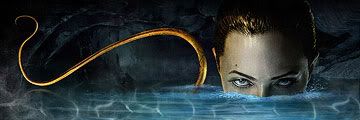
Yes, Angelina Jolie plays Grendel's mother, and she would not at all work in the context of the poem as she's supposed to be an ugly hag. In the way the movie wants to use Grendel's mother, though, Jolie couldn't be a more perfect match. When she first emerges from the pool in that single iconic scene, Grendel's mother is sexy, seductive, and tempting, covered in patches of gold to cover up her personals and even donning spike-heeled feet. And no, that's not actually Angelina Jolie's naked body you're looking at. Grendel's mom tempts Beowulf, adding needed intrigue to the story, and it really works out quite nicely. An innovative new layer is added to Beowulf's character, as well, which allows him to be not only a hero, but also a normally flawed man.

There are some unintentional laughs and occasional outbursts of snickering along the way, especially during a scene where Beowulf strips down completely naked to take on Grendel. Throughout the brutal manslaughter, Beowulf leaps around the mead hall with conveniently placed objects to cover himself. For the most part, though, people just sat and watched in silent awe. This was particularly noticeable during a final fight sequence against a giant fire-breathing dragon. Dare I say, FBD? This final fight's purpose, especially, strays far from the original epic, but this too ends up working out quite well with the rest of the movie's story.

Ray Winstone is fitting to Beowulf with his random outcries of triumphant phrases, reminiscent of "300," as this movie will probably appeal to the same audience. I actually liked this better than that for whatever reason; perhaps it's my English class connection. The movie is also bordering between its PG-13 rating and an R-rating, and it likely would've obtained the latter had it not been animated.

If you're looking for something fun to see in theaters right now, this is by far your best bet; just slap on those 3-D glasses and enjoy the rush. However weird I feel saying it, "Beowulf" is a really great movie.

Sunday, November 8, 2009

Flat Rendition Of A Christmas Classic

Disney's A Christmas Carol


Robert Zemeckis has done this once before. As he did with "The Polar Express," using his photo-realistic, motion-capture animation technique, he has adapted a holiday story for not just the big screen, but the really big screen: IMAX. And this time, 3-D. Much like he proved with the surprisingly adept "Beowulf," Zemeckis certainly knows how to put 3-D to good use. The thing with his "A Christmas Carol," corporately labeled as a Disney production, is that the animation is better, and yes, the 3-D is wondrous. The look of real actors being animated comes off much less creepy here than it did in "The Polar Express," but even so, that was a better film. The issue is that this time Zemeckis is adapting the timeless 1838 story by Charles Dickens. All the trimmings of Victorian yuletide cheer are there, but the emotional feeling of being a classic just isn't.

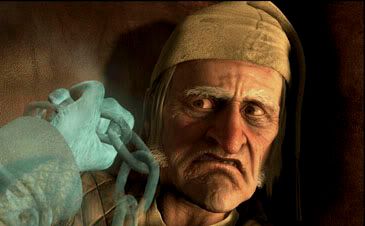
This is a premise we all know, so it's not worth repeating, but here's a basic outline: Ebenezer Scrooge (Jim Carrey) is a bitter old man whose business partner, Jacob Marley (Gary Oldman), died on Christmas Eve. He therefore hates Christmas, and with his stooped back, drooping skin, and pale eyes, he loathes everything about the holiday. He is visited by the Ghosts of Christmas Past, Present, and Future, all distinct and all teaching Scrooge things about himself he may have never even realized before. Majority of the dialogue throughout the film is directly lifted from the original story, and to that extent this adaptation pays rightful tribute to Dickens. Zemeckis stays true to Dickens' most potent and finest themes, and with such comes a rather dark tone, one that focuses on moral disparity and even death. In this instance the movie can be eerie and even downright scary, which means that this is one definitely not for the youngest kids.

There's no denying that Zemeckis' "A Christmas Carol" is visually splendid with sequences swirling with magic and a rendering of 19th century London that is seamless and gorgeous. And yet it feels like Zemeckis gets a little carried away. This isn't meant to be the Christmas Carol roller coaster ride, and perhaps there simply wasn't enough material to work with. Between all of the exuberantly-designed chase and action sequences, the real narrative, the appearance of each ghost, almost become the backdrop to the thrill-ride. It gets tiring after a while, especially when there is so much to offer with Zemeckis' vision of these ghosts. The Ghost of Christmas Past is exceptional with just a face in a lit candle, whispering and flickering.

Jim Carrey pulls his weight, voicing not only Scrooge but also the three ghosts. Gary Oldman does the voices of Bob Cratchit, Tiny Tim, and Marley. Deep beneath the layers of animation is Carrey playing Scrooge quite well as he does a good job of playing it straight without any flairs or goofiness. The expressions of the CGI characters are now more fully-realized with thanks to technological advancements. Scrooge is no caricature with Carrey giving him the perfect dose of remorse and melancholy.

While Zemeckis works hard to stick with Dickens' sentiments, one must really wonder at the end of viewing "A Christmas Carol" if another adaptation was really necessary. It's a sight to behold and certainly will get viewers promptly in the mood for the holiday season (which perhaps is the primary goal), but the desired emotional level of connection is never reached. The plight of Tiny Tim is there in all of its sadness, but I just didn't find myself in sympathy as much as I felt I should've. Observing Scrooge's personal transformation becomes like viewing it from afar, and the endeavor feels ultimately removed and sadly soulless.