Showing posts with label tom hanks. Show all posts

Tuesday, December 10, 2013

SAVING MR. BANKS Review


There's an inherent problem with director John Lee Hancock's "Saving Mr. Banks," and it occurs within the first few scenes and continues happening over and over again. After being introduced to the film's star, the always excellent Emma Thompson, we flash back to a young girl in the early 1900s living with her family in Australia. Thompson plays prickly author P.L. Travers who penned the series of "Mary Poppins" books upon which Disney's widely lauded 1964 film is based. The young girl in the flashback is Travers, but instead of lightly shading in this real life woman's childhood, the screenplay from Kelly Marcel and Sue Smith decides to bludgeon viewers over the head with backstory.

Travers is flown in from London to the Happiest Place on Earth, where she meets the one and only Walt Disney (Tom Hanks). All she has to do is sign the contract that gives Disney the licensing rights to her Mary Poppins, but the surly, unruly author quickly proves it won't be that easy. Thompson lights up the screen, landing quips and snappy barbs with panache. She's a treat to behold and registers enough pain to give insight as to why she's making working with her so difficult.

The parallel story running with this is Travers' troubled childhood with her reckless, alcoholic father (Colin Farrell). These flashbacks come at an alarming frequency and occur whenever the main storyline starts to get interesting, rendering all sense of drama completely moot. The flashbacks unnecessarily take up half the running time and don't give Thompson enough credit as an actress. She isn't given nearly enough opportunity to read into her own character's backstory without the presence of head-banging obviousness.

"Saving Mr. Banks" is at its most fun and works as mainstream entertainment in the rehearsal rooms with writer Don DaGradi (Bradley Whitford) and clever lyricists Robert and Richard Sherman played by B.J. Novak and Jason Schwarzman, respectively. It's delightful watching the men work and tip-toe their way around dealing with Travers' demands, staying true to their own vision and keeping her happy. And of course whenever Tom Hanks appears onscreen, it's -- spit-spot! -- as good as can be.

But the sappy awards contendor also boils down to pure self-indulgence. The appeal of looking back on Disney's most valued property only goes so far, running on the fumes of its nostalgia and proving that, once and for all, perhaps the company does a bit too much sugar-coating.

Saturday, October 12, 2013

CAPTAIN PHILLIPS Review


"Captain Phillips" is very much a Paul Greengrass movie, and it's very much a Tom Hanks movie. This  makes it a certified awards movie. But is it a great movie? Not so fast.

It's hard to imagine anyone else at the helm of this film, the true life story of Somali pirates hijacking an American cargo ship in 2009, the first act of its kind in two hundred years. It is real world recreation and documentation of a tragic event as was Greengrass' "United 93" in 2006. It also bears resemblance to Kathryn Bigelow's "Zero Dark Thirty," a moment in American history that defined a world in flux and one person's turmoil at the center of it.

As Captain Richard Phillips prepares to embark on the MV Maersk Alabama to travel around the potentially dangerous horn of Africa, he talks with his wife (Catherine Keener) about a changing world, a landscape his son has to grow up in. Cut to a team of Somalians whose own world is in economic ruin as they set off to plunder millions from the cargo ship. Instead of plumbing any real world complexities, Greengrass sticks to the facts taking a very businesslike approach. It's a perfectly calculated dramatization of a real life incident with clear depiction of the "what" without the intrigue of the "why." Even with all that shaky cam to get a rise out of viewers, it still strangely feels once-removed.

Making preparations on the ship, Captain Phillips is calm and regimented, careful and professional. And when an ominous, fast-approaching blip appears on his ship's radar, he keeps his cool and gently affirms to his crew they might be entering a troubling situation. And when any bemoaning arises, he knows exactly when to firm up. Watching Tom Hanks melt into the role is absorbing in the film's early stages and affirms his movie-star presence, anchoring the proceedings. When the Somali pirates make their way aboard the ship, led by the determined Muse (Barkhad Abdi), Phillips maintains his levelheadedness, reasoning and negotiating with the attackers while keeping as much understanding as he can muster.

It's when Phillips gets taken hostage into the ship's lifeboat that the film pigeon-holes itself into a pressure cooker of tension and impending violence. The camera holed up inside this cramped space creates intense claustrophobia and startling immediacy. Refusing to surrender when the Navy descends on him and his team, Barkhad Abdi gives a commanding first-time performance as Muse. Waiting for the inevitable outcome, however, goes on for nearly too long, and it becomes apparent there simply isn't enough content to justify the 134-minute running time.

It all comes back to Tom Hanks whose performance should be recognized by the academy. The last ten minutes of "Captain Phillips" is what people will leave talking about, a moment of wrenching emotional clarity. Phillips, the ordinary man who came out the other end of a tragic event as a hero is still completely human and can finally break down, evacuating all of his bottled up fear and vulnerability. It feels more than earned; it's just too bad we had to wait so long to receive such greatness.

Saturday, November 3, 2012

CLOUD ATLAS Review


"Cloud Atlas" is inherently polarizing in its very nature. Either you get swept up in its soaring, outlandish vision, or you don't. It's a film easy to dismiss but equally as easy to get caught up in its undeniable power and ambition. From Andy and Lana Wachowski (who arguably haven't made a decent movie since "The Matrix" and maybe "The Matrix Reloaded") and Tom Tykwer, behind the one-hit wonder "Run Lola Run," these three set out to make the epic, visionary mind-bender of the year. And to their credit, they've done exactly that.

The movie is based on the seemingly impossible to adapt 2004 novel from David Mitchell, which tells six different stories spanning between the mid-19th century and well beyond the year 2144. The movie adaptation casts the same group of actors playing different characters within each story. The main players are Tom Hanks, Halle Berry, Hugo Weaving, Jim Sturgess, Ben Whishaw and Jim Broadbent who all, in some cases, are not even recognizable in the role they play. Supporting them are Hugh Grant and Susan Surandon. Sometimes the actors are the centerpiece of their story, other times they're a background figure. Each story opens with a larger exposition to give some context, each serving as their own single vignette. Once introduced, however, they weave together cutting back and forth between each other with a very specific rhythm.

The success in the storytelling comes from the way the six stories, and the main roles within, work together as they spill over and ripple through the narratives. I can't imagine the road map the Wachowskis and Tykwer must've created to pull this off. Now, I could go into detail about the premise of each timeline, but it would be an effort in vain. The point is the complex tapestry of feelings that is ultimately created, how particular themes so clearly resonates freely into the next frame. The filmmakers definitely touch on something political -- big oil destroying a nation -- but I won't get into that here. Themes of freedom, justice, liberation, truth, love, loss, good and evil all perfectly sync up in the thematic telling of each story, and it has a wondrous effect. We're never set on a character for long, but in the way certain roles represent others in a different timeline, similar emotions carry over. An escape, a romantic interest, a painful death -- there's always a link. Repeated passages, phrases and one similarly-shaped birth mark command repeated viewings to follow what I can only assume are endless correlations between the six stories.

If this all seems very general, that's because it is. "Cloud Atlas" works at its best when looking at the bigger picture. It's in the details where the movie starts to fall apart. The portrayals are caricature, cartoonish even, but there's no lack in color and texture. For example, the 2144 storyline takes place in Seoul, Korea and forces actors to wear makeup making them appear more Asian. (Except for stoic and stunning Korean actress Doona Bae.) It's a weird effect, especially Jim Sturgess' use of an accent. The other future storyline has Tom Hanks and Halle Berry speaking in a strange, broken language that's nearly laughable -- not to mention almost impossible to understand. But again, those are the nit-picky details. When watching "Cloud Atlas," an overall feeling emerges, a grandiose idea of the recurring moralities of human nature, no matter when or where, or what lifetime -- history repeats itself. I urge you to see it. It's certainly not for everyone, but it also very well might be just for you.

Monday, January 23, 2012

EXTREMELY LOUD AND INCREDIBLY CLOSE Review


I don't understand all the criticism toward Stephen Daldry's "Extremely Loud and Incredibly Close." We need to get past it being another movie about 9/11. Yes, it takes place directly after what young Oskar calls "the worst day," but the movie is about much more than that specific tragedy in our history. It's about how people cope with tragedy in general, how to deal with loss and grief -- and yes, in this example, how to view a city after such devastation. In that, Daldry succeeds in crafting something memorable. Through tricks in cinematography and vibrant art direction, he creates an original portrait of New York City. From the sights and sounds that disturb the rapid senses of Oskar to a miniature photography technique that makes the city look like a toyland, the movie is bravely quirky. This doesn't serve as a hindrance to the very human story at its center but instead wonderfully matches the quirkiness of Jonathan Safran Foer's 2005 bestselling novel upon which the movie is based.

The biggest gamble was deciding who to cast as the precocious young boy, Oskar Schell. It's an unusual role that must carry the whole movie, and thankfully Thomas Horn absolutely does the job. The 14-year-old newcomer is a powerhouse getting inside the whirling head of Oskar with ease. He's perhaps autistic, could have Asperger's syndrome, but he's crazy intelligent and knows facts on just about anything. He's inspired by his inventive father, Thomas (Tom Hanks), who fuels his son's imagination with what they call reconnaissance expeditions. He urges Oskar out of his comfort zone, out of his phobia of going into the world to talk to people. The remarkable young actor dominates every scene showing Oskar as insufferable, erratic, eccentric and tiresome spouting off crazed rants.

After his father is killed in 9/11, Oskar comes across a key in his untouched closet and immediately becomes obsessed with it. He believes his father left the key for him so he could find the lock that it opens. The key came in an envelope with the name "Black" scribbled on it, and so Oskar concocts his own expedition to journey all across the city finding every person with that last name. While Oskar goes out every day on his venture, there's a rift between him and his mother (Sandra Bullock) because it's clear who he was closer with. This makes it increasingly difficult for his mother, and the explosive fights between them are gut-wrenching.

Oskar's first stop on his journey ends up leaving the most lasting impression. He knocks on the door of Abby Black (Viola Davis) who lets him inside and hears his story. She tries her best to help him but doesn't know what to do. Oskar's social skills don't even allow him to realize he's witnessing a marital crisis between Abby and her husband (Jeffrey Wright). Davis and Wright are superb here in subtle implication.

Oskar soon makes a friend, a mysterious old man referred to only as the Renter (Max von Sydow). He has moved in with Oskar's grandmother, cannot or will not speak, communicates only through the words "yes" and "no" tattooed on his palms or through written notes and has agreed to help Oskar find the lock. He is a reassuring companion for Oskar much like his father was. Von Sydow is brilliant even while wordless with soulful gazes and sly gestures that bring a wealth of meaning.

If Oskar's journey sounds preposterous, that's because it probably is. In that sense it plays a bit like a fairy tale, and maybe that's not the whimsical approach people want to the 9/11 tragedy. For me, it wins by wearing symbolism on its sleeve finding the key to unlocking the answer as to why anything cruel or irrational happens in the world. Best of all, among all the heartbreaking and intimate exchanges, it ends on an uplifting spirit, one of hope and rejuvenation. That's a fine message for over a decade later.

Thursday, July 1, 2010


"Toy Story 3" (2010)

Let me begin by saying that "Toy Story 3" does not, by any means, need to be seen in the 3-D format because this is, like all Pixar features, a movie that succeeds in the simplest form of popular entertainment with emotionally engaging storytelling. No extra visual flourishes required. Traditional 2-D works just fine as it did with last year's "Up" and leaves the vibrant array of colors just as vibrant as they're meant to be.

This is a story spanning back to 1995's "Toy Story" and 1999's "Toy Story 2," and the third installment of the series is fittingly more mature as it has grown up with not only the Pixar team but the viewers of the original "Toy Story." Fifteen years later, we're all older now, and yet watching the bond and interaction between these seemingly inanimate hunks of plastic is still just as engaging as it was and now even more so because of what the filmmakers, led by director Lee Unkrich (co-director of "Finding Nemo" and "Toy Story 2"), have achieved in terms of evoking a rich sense of nostalgia. Not only does "Toy Story 3" meet all expectations set by the previous installments, it exceeds them tremendously by completing perhaps one of the best trilogies ever made.

This is Pixar's masterpiece. It's even better than "Ratatouille," "Up" and even better than what I previously hailed as their masterpiece, "WALL-E." The reason it soars above all others is because it is so humbled. While entirely playful and fun, it's almost nonchalantly cutting into something much deeper than what it appears, a feeling that does not so much strike you as it does arise naturally.

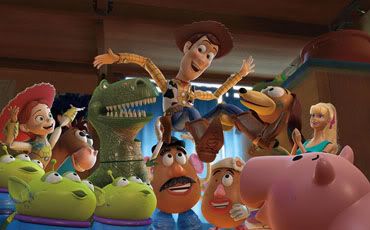
The movie's opening is a tease as we watch Woody (Tom Hanks), Jesse (Joan Cusack) and their faithful horse Bullseye chase after the evil Mr. and Mrs. Potato Head (Don Rickles and Estelle Harris) with the help of Buzz Lightyear (Tim Allen). It's a western setting, a runaway train, not a child's bedroom like we're used to, and it's a little startling to see at first. Then enters the giant spacecraft modeled after Hamm (John Ratzenberger) and a giant form of Rex (Wallace Shawn) when things get a little crazy. Soon we realize we're watching the inside of a childhood imagination, and not just any child but Andy. You see, however, it's an old recording because Andy is 17-years-old and now preparing to head off to college. Such a beginning is motivated with a salute to making believe and sets the stage for the theme of the entire "Toy Story" franchise as it comes full circle.

The gang worries about never being played with again and their consequential fate as Andy moves out. Will he take them with him, will they be stowed away in the attic or, worst of all, will they be put in a garbage bag for trash? Woody tries to get everyone's hopes up while knowing quite well that Andy has moved on from his old, childhood things. His mom influences him to sort out his belongings leaving Woody to be put in the box marked for college while the others get put in a bag for the attic. Andy's mom mistakes the bag for trash, though, sending Woody's pals to the curb. After a narrow escape, the reunited gang winds up at a local daycare center as a batch of donated toys. In just this sequence alone, a situation is presented that anyone can relate with, parents, teens and children alike.

They arrive at the seemingly pleasant Sunnyside Daycare, and the toys there are led by a pink teddy bear who smells of strawberries, Lots-o'-Huggin' Bear (Ned Beatty), one of those characters who is just a little too cordial upon first greeting. He's actually a morally misconstrued monster, and the gang gets stuck being played with by toddlers who are anything but playful. From here it turns into an all-out prison break movie, and it really is just as good as any live-action adventure movie out there. The dark underbelly of something more sinister throughout their escape is no accident. And while part thriller and part horror, best of all it's laugh-out-loud hilarious and easily Pixar's funniest movie to date. When Barbie (Jodi Benson) meets a Michael Keaton-voiced Ken is comedic gold on its own accord.

Visually it is not only stellar in its animation but also great to look at in terms of the way it is shot. Lighting, shading and angles are all taken into great consideration and looks like, yes, any of the best live-action cinematography out there right now.

"Toy Story 3" boasts the most impeccable timing and pacing as the 103-minute running time just whizzes by, and I actually found myself wanting it to last longer. The credits may leave audiences on a silly note, the film's final frame before is a beautifully sentimental tear-jerker. Here is a movie so brilliant about generational ties, loyalty, friendship, growing up, letting go and holding on to what matters most that you'll be amazed at how easily they bring it all together. You'll be hard-pressed to find a more perfectly satisfying movie not only this summer but this entire year.

Sunday, March 21, 2010

Archive: 'Charlie Wilson's War'

Movie Review
Charlie Wilson's War (2007)


This sure has been a great year for movies. But what "Charlie Wilson's War" has over the other movies this Oscar season is that it's appealing and pure entertainment for the adult crowd. This is the type of movie you go to see after a dinner out, enjoy while you're watching it, and then pretty much forget about it after you go see it. Not to say that the movie isn't good, though, because it certainly is; it's just not great. It's a perfectly breezy, fast-paced political satire that's more of a hoot than one would expect and hits all the right marks without diving into anything too deep.

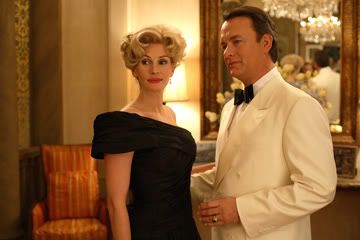
Directed by Mike Nichols with a screenplay by Aaron Sorkin, this is the true story of Texas congressman Charlie Wilson (Tom Hanks) in the 1980s who single-handedly helped to end the Cold War. He's a good ol' boy with a personal life that isn't perfect, but everybody loves him, which is why he keeps getting reelected again and again. He has an office full of voluptuous young women (who are also very smart) at his every call, and he's never without a drink in his hand. It's as if Charlie Wilson stumbled upon the career move of his life on accident when he initially decides to double the budget for Afghanistan's defense against the Soviets.

When we first meet Charlie, he's sitting in a hot tub in Las Vegas surrounded by a bunch of naked Playboy women and cocaine usage. While sitting there, he witnesses some Dan Rather footage on the adjacent TV about the situation in Afghanistan. After his first sudden reaction, the wheels really start turning when Joanne Herring (Julia Roberts), a rich Houston socialite, gives him a call and opens his eyes to what's really happening. He has always taken an interest in her, and they casually sleep around together. While he's soaking in her bath tub, she tells him about the Afghans needing weapons to shoot down the Soviet helicopters, and since Charlie is on the Defense Appropriations Subcommittee, he would ideally be the man to help. The problem is that they need to get the weapons from somewhere else. The solution is to use Soviet weapons left in the hands of the Israelis and transfer them through Pakistan to the Afghans.

To aid him in his covert arms plan, he finds the only helpful person in the CIA: Gust Avrakotos (Philip Seymour Hoffman). This pot-bellied, hard-hitting guy full of resentment is just the man for the job. After a planned visit with the president of Pakistan, General Zia, meetings with a few other men, and the help of a friendly belly dancer, Charlie Wilson pulls off the deal. He eventually raises the funding for Afghanistan from a useless $5 million to a whopping $1 billion, all done in secret. The whole ordeal is done so frivolously, it makes you wonder if politics really can be this fun. It's also amazing how so much information actually fits into a 97-minute movie that's basically comprised of one semi-comic scene after another. Talk about an easy history lesson.

With three excellent performances under his belt, it's going to be tough to choose which one to recognize Philip Seymour Hoffman for this year. He steals every scene he's in, whether he's hitting on Joanne or exploding in rage and breaking a window. This isn't Tom Hanks' best performance, but it's still pretty good, as he gets a chance to be somebody we've never seen him as before. He has a good time with the role, being sexier, sleazier, and more wry, creating a person we immediately like. Julia Roberts isn't even in the movie very much, which is actually a shame because the relationship between her and Charlie could've been fleshed-out a bit more. Although somewhat of a letdown, she's still enjoyable to watch. And then there's "Enchanted"'s Amy Adams, who's as charming as ever, playing Charlie Wilson's assistant. She keeps him in line, keeping track of his schedule, and admiring him all the way.

"Charlie Wilson's War" has an underlying wit of irony about it in that we wonder if Charlie Wilson's commitment to his cause was truly intentional. The audience also realizes that although all of what Charlie did looked good at the time, it opened the bag for all that is happening now with the war in Iraq. The "freedom fighters" in Afghanistan became the Taliban, using those same weapons against us, and things only escalated from there. There's a message on the fact that it didn't end where the movie ends. Charlie had a right for what he did, that's for sure, but he wanted plans for reconstruction that Congress didn't follow. As he quotes at the end, "We fucked up the end game."

Saturday, May 16, 2009

Rome Is Gonna Blow!

Angels & Demons:
3 out of 4

In my review of 2006's "The Da Vinci Code," I remarked that it was painfully lukewarm, a novel-to-screen adaptation that fell flat on its face. It lacked any spark, excitement, or anything relating to that of emotion. Thank goodness, then, that director Ron Howard learned his lesson in time for his adaptation of "Angels & Demons," the novel that Dan Brown actually wrote before "The Da Vinci Code." As a movie, it's marketed to be a sequel to the 2006 dud, and rightfully so because it's relievedly better than its predecessor. Howard ditches the leadenness and pumps this sequel with hectic energy, letting the 140-minute running time zip by surprisingly fast. And as added bonuses, Tom Hanks ditched his awful hairstyle of previously, and there's no more Audrey Tautou being awkward and out of her element.

Harvard professor and symbolist Robert Langdon (Tom Hanks) is back and gets recruited by a representative of the Catholic Church to help a crisis occurring at the Vatican. No hard feelings about basically debauching their entire belief system in Langdon's last outing. The Pope has died, and the College of Cardinals has been gathered in order to choose the Pope's successor. The problem is that the preferati, the favorites to be elected, have all been kidnapped, and behind it all is a very old, secret society, the Illuminati, that is seeking revenge on the Catholic Church from the days when it used to persecute thinkers of science. Earlier, a gorgeous and capable scientist named Vittoria Vetra (Ayelet Zurer) was working with something called anti-matter, a substance that does very special stuff and has something to do with the moment of creation, or something really epic like that. Anyway, it got stolen from the lab and is now being used alongside the Illuminati threats. Each kidnapped preferati will each be executed individually at 8, 9, 10, and 11 p.m. And then at midnight, the capsule containing the anti-matter will run out of battery and blow all of the Vatican to smithereens.

Got all that? Great. OK, so, what does all of this have to do with Robert Langdon? Well, he has knowledge of Illuminati symbols that leads him and his team on a wild goose chase through Rome looking for certain clues, statues, symbols, anything, that could lead to the next location. Langdon has uncanny luck as he's never wrong, never misses a step, and spews out his knowledge so fast that we as an audience barely have time to catch it. We just have to take his word for it that he's right. Turns out he is 100% of the time. Perfect. Potential sexual tension between Langdon and Vittoria? No time for it. All she can do is nod, agree, follow him around, and translate some Latin. Howard has taken the laborious movements of "The Da Vinci Code" and kicked it into breakneck speed, which is what makes this sequel work.

Langford gets assistance from the faithful Camerlengo (Ewan McGregor), the short-fused Swiss Guard commander (Stellan Skarsgård), and the head Cardinal Strauss (Armin Mueller-Stahl), all of whom hold expressions that shift to make it unclear at times whether they're good, bad, or who the hell knows, maybe both. All of these supporting characters are meant to lead the audience astray as to knowing which side is the most morally sound one to choose.

The twists are bountiful, especially at the movie's climax, to get the full feeling of being an over-exploded, self-serious blockbuster, which it entirely is. It's totally preposterous, too, but it might as well be. Ron Howard knows this, and he keeps it cruising right along with an effectively pounding score from Hans Zimmer. The production values are through the roof, and there are some splendid sequences including a nerve-racking escape out of the Vatican archives from a sealed-off library after the oxygen supply has been cut off. Oh, and there's something to be said about the commingling of science and religion. "Angels & Demons" glosses over that, however, and doesn't make any bold statements on the matter because, really, why bother?