Showing posts with label geoffrey rush. Show all posts

Sunday, May 22, 2011

PIRATES OF THE CARIBBEAN: ON STRANGER TIDES Review


"Pirates of the Caribbean: On Stranger Tides" (2011)

"Pirates of the Caribbean: On Stranger Tides" is what you'd expect from a fourth installment of the swashbuckling franchise: unnecessary overindulgence. It's more of the same with funny accents and high seas exploration. Gone, however, are the convoluted and confusing storylines and twists of the first three "Pirates." Its one saving grace is the more streamlined nature of the journey, the goal being to find the Fountain of Youth. In searching for such a relic, it's as if the movie itself is crying out to audiences in hopes this cash cow enterprise can stay eternally youthful. But we cannot ignore the simple truth. The movie without a doubt was motivated as a summer blockbuster cash-grab. In that sense alone the production of this fourthquel, now helmed by director of Rob Marshall, never even should've set sail.

The movie being just fine as opposed to flat-out bad is almost worse. You can tell everyone is simply cashing in as opposed to putting in some effort to make something worthwhile because they know, no matter what they make and if it has "Pirates of the Caribbean" slapped on it, people are going to see it. Hence the box office returns we've already seen. There's no vivacity or energy here like there were in past sequels. At least those bloated and jumbled messes had that going for them; there certainly wasn't a lack of trying.

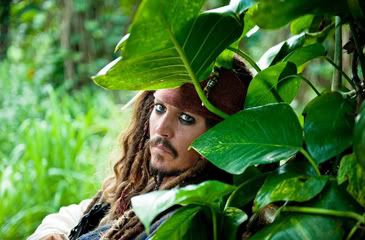
The dead weight of Keira Knightley and Orlando Bloom with their non-pirate characters have been removed leaving only Johnny Depp's still plucky Captain Jack Sparrow and the newly introduced Penélope Cruz as the sensual Angelica to keep things afloat. Luckily their personalities are big enough to manifest into their own supporting characters. Depp is still intermittently humorous, but he lacks the zaniness I remember. His jokes and wisecracks feel tired, and even when Keith Richards shows up as he did before in a brief cameo as Sparrow's dad, whatever coolness there was before just isn't anymore. Cruz is a welcome addition, however, as she brings her same fiery flair which she does to most of her roles. She's essentially a spiritual successor to the role Knightley previously filled.

Jack Sparrow and Angelica are a fair match for each other, and they team up for the expedition to the Fountain of Youth sometimes on the same side, sometimes not. Geoffrey Rush looking old and nasty--almost distractingly so--returns as Captain Barbossa sent by King George to find the fountain. Meanwhile, Blackbeard (Ian McShane) is also after the fountain commandeering a ship upon which Sparrow and Angelica both travel. Ian McShane and Geoffrey Rush are two veteran actors, durable and reliable, and they both play up the pirate charades and make it work.

For having the subtitle of "On Stranger Tides," not much about their adventure is very strange. It's actually the least strange, supernatural and fantastical of the series. Sure, Blackbeard's ship has zombies--and zombies are so in right now--but the skeletons were actually a lot better. I'm surprised to be saying this, but I wish there were more CGI creations like the endless waterfall of "At World's End" or the crazy tentacles of "Dead Man's Chest." It's not all bad, though. There are man-eating mermaids that tantalize with seduction and then attack with ferocious gnashing teeth and hisses. The one mermaid we officially meet is named Syrena (Astrid Berges-Frisbey), and a weird romance forms between her and an actor who looks a little too much like a younger version of Orlando Bloom. The romance is of zero consequence to the rest of the story.

Beyond the mermaids, however, everything else is rather humdrum. Lots of talking, but nothing getting said, and lots of clashing swords but of no real end result. The whole affair has a been there, done that feel to it that's impossible to deny. Oh, and don't forget to stay until after the credits and then give yourself a big face palm when things are inevitably set up for a fifth entry.

My review of Pirates of the Caribbean: At World's End

Sunday, February 13, 2011

2011 BAFTA Winners


Today's announcement of the 2011 BAFTA winners continued the reign of "The King's Speech" in this final stretch of the awards season. It makes sense, though. A grandly British film received the top awards winning not only Best Film but Outstanding British Film, as well, from the British Film Academy nonetheless.

When "Speech" took Outstanding British Film over the likes of "127 Hours" and "Another Year," I began thinking maybe "The Social Network" could win Best Film because I honestly didn't think "Speech" would take both. But alas, it did.

The surprise came with a Best Director win for David Fincher over Tom Hooper. Does this have any effect on the Oscar outcome, however? As much as I would like to hope so, I think Tom Hooper's DGA win still locks in his Oscar win even though he did not receive the BAFTA win.

"The King's Speech" also dominated the acting awards aside from Natalie Portman in "Black Swan" for Best Actress. Colin Firth's win for Best Actor will go on to an Oscar win, but I'm having a hard time believing Geoffrey Rush for Best Supporting Actor and Helena Bonham Carter for Best Supporting Actress are going to make an upset over the "Fighter" front-runners of Christian Bale and Melissa Leo.

"True Grit" received some love for Best Cinematography, a win I think will be repeated at the Oscars. It's about time Roger Deakins gets an Oscar after his many, many nominations.

The "Harry Potter" films received a nice, worthy honor for Outstanding British Contribution to Cinema. I mean, with a total of eight films all of rather high quality--that's an accomplishment in itself.

Full list of the 2011 BAFTA winners.

And we're just two weeks away from the 83rd Annual Academy Awards! Until then, everybody.

Monday, December 27, 2010

THE KING'S SPEECH Review


"The King's Speech" (2010)

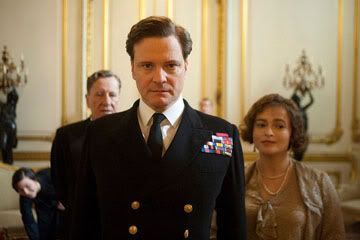
I still believe Colin Firth deserved an Oscar for his role in last year's "A Single Man." This role in Tom Hooper's "The King's Speech," however, as the stammering King George VI is just as worthy. It's time for Firth to receive his Oscar now with two outstanding and memorable performances two years in a row. As in another film this holiday season, "The Fighter," we follow a real life person who needs to find his voice. He doesn't just need a family to listen, though; his entire country relies on his voice for reassurance in a time of need, a time when Britain is on the eve of war with Germany in 1939.

We begin with a man named Albert (Colin Firth), the Duke of York, before he is crowned king. It's 1925, and he is required to address the public at the British Empire Exhibition. He chokes on his words delivering a stuttering mess full of painful silences and stammering outbursts, a condition of speech he has lived with for as long as he can remember. It's only apparent now because of the public speaking demands of his royal position, and so he begins desperately seeking help from speech therapists. His wife (Helena Bonham Carter) thankfully stumbles upon a new possibility: a failed Australian actor named Lionel Logue (Geoffrey Rush) who takes his speech therapy practice very seriously. Geoffrey Rush delivers the film's other outstanding performance as the eccentric, expressive, clever and well-humored Logue.

The film is greatly about the give-and-take, lifelong relationship that forms between Albert, referred to as "Bertie" in the speech therapy sessions by the insistent Logue, and Logue himself. Logue realizes the only way to properly instruct as a therapist to royalty is to lower him to the same level. It's a method Albert finds deplorable at first but warms up to only upon realizing it's getting him the results he wants. He's beginning to speak better. These two roles are extremely well written from screenwriter David Seidler, and they work best when sparring with each other. Albert's sessions with Logue are the lively highlights especially during a scene where Logue suggests Albert shout vulgarities to get his words out, a scene that inappropriately earned the film its R rating. But this isn't the place to rant about the MPAA.

The need for Albert to get rid of his stammer gets elevated with more urgency as the stresses of the monarchy unfold. Albert's father, George V (Michael Gambon), frowns upon the dawn of radio technology forcing monarchs to place themselves into the living rooms of their people. Also because it prevents his preferred son from properly taking the thrown with security. The other son is Edward (Guy Pearce) who does take the thrown after the untimely death of George V but only briefly. He's in love with Wallis Simpson (Eve Best), an American woman twice divorced. She would not be accepted into royalty, so Edward's only choice is to flee. This leaves Albert to become King George VI.

This places pressure on both Albert as king and Logue now as a king's therapist, and through the interplay of their growing relationship against the ominous threat of the wider sphere where Hitler is gaining power in Germany, the film becomes a fascinating blend of personal drama and historical period piece, one about friendship, loyalty and bravery, thanks to deft direction from Tom Hooper ("The Damned United," HBO's "John Adams").

A rich supporting cast fleshes out the strength of the two leads including Michael Gambon and Guy Pearce as part of Albert's royal family and even Timothy Spall as Winston Churchill. Helena Bonham Carter is also magnificent as Albert's loving and sympathetic wife. We're used to seeing her in such dastardly roles as in the "Harry Potter" films, but here she is quite the opposite and quite lovely.

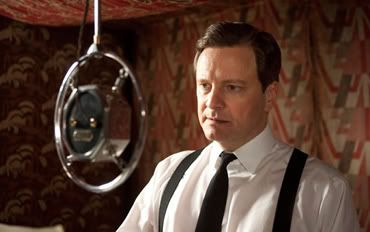
Cinematographer Danny Cohen captures the scenes in an interesting way with tight, narrow framing which is unique for a lush and historically accurate period piece. Best is when the frame is filled with Albert's horrified, sweaty face placed before a radio microphone, the red flashing light reflecting off his skin. This arrives when he must deliver his first wartime speech, the pivotal moment to all of which "The King's Speech" builds up. Hooper expertly handles this final scene which escalates in tension as composer Alexandre Desplat uses the grandeur of Beethoven's Seventh Symphony.

In this moment we absolutely feel the nerve-racking and pulse-pounding anxiety right there with Albert, a moment that boasts a walloping emotional impact. "The King's Speech" is about speech in two senses of the word. King George VI had to learn to control his speech in order to give the most importance speech of his lifetime.