Showing posts with label tom hooper. Show all posts

Friday, December 28, 2012

LES MISERABLES Review


Eyes ablaze with pain and torment, Anne Hathaway delivers the moment of the year as the fallen ill mother-turned-prostitute Fantine in her solo musical number "I Dreamed a Dream." Her eyes puffy and red with tears streaming down her face, the camera doesn't shy away from a tight close-up during her entire song not backing away from the agony and sorrow she puts on display.

It's not just her song, though, as all of Tom Hooper's "Les Miserables" is full of musical numbers equal in emotional potency to match Hathaway's Oscar-demanding powerhouse. Samantha Barks is devastating as Eponine, the sad, lonesome girl raised on the streets with her "Own My Own." Fantine's blond princess of a daughter, Cosette (Amanda Seyfried), croons like a songbird to her lover, Marius (Eddie Redmayne), and adoptive father Jean Valjean (Hugh Jackman) who's gone through life running from his criminal past. There's no better show tune front man than Jackman because in such a commanding role, he nails it. He is the forward momentum holding the narrative strings of "Les Miserables" together. Every soaring note or growl of anger from him is alive with vivacity.

Russell Crowe plays the man in pursuit, Javert, who grows tiresome chasing Valjean but never falters. His "Stars" is Crowe's best display of his unconventional vocal performance, much like Amanda Seyfried's fluttering vibrato as Cosette. And one mustn't forget Eddie Redmayne's Marius who absolutely earns his star-making role with his heartbreaking "Empty Chairs at Empty Tables" as he laments for his fallen comrades. Oscar should take note. And rousing all these distinct voices together in a glorious finish to the film's first act is "One Day More," a symphony of vocal collaboration over the orchestra.

Playing in humor and mischief is the ideally cast Sacha Baron Cohen and Helena Bonham Carter with their rendition of "Master of the House." Plastered in make-up and funny costumes, they look like they just walked over from the set of "Sweeney Todd: The Demon Barber of Fleet Street," which, by the way, "Les Miserables" is the triumphant musical Hollywood has been waiting for since then.

The film is, of course, based off the 1980s musical smash hit which is based off Victor Hugo's massive 1862 novel about Paris students staging a government uprising in 1832. It's a lot of narrative, and not a very clean one at that. Too many main players, a lot of convolution. So, it's the music that must shine, and shine it does with Tom Hooper's impeccable direction. At just over 2-and-a-half hours, the movie actually moves along quite briskly cramming in an abundance of plot. The bold decision to have his actors sing live on set is also a testament to Hooper's direction with a bold decision that well pays off. In such a style, you witness as emotion overcomes the actors' faces and voices in every musical number. It's sacrificing a perfect sound for something more raw.

Interspersing between close up shots of powerful singing are shots we've come to know from Hooper and "The King's Speech" cinematographer Danny Cohen. Full of high canted angles and large backdrops against tiny figures, it's those tall shots or close-ups, nothing in between. It gives "Les Miserables" a theatricality of both intimacy and grandeur, the perfect combination for treating such a musical. The adaptation isn't perfect (how could it be?), but it's full of astounding performances with actors pouring out their souls in song. Do you hear the people sing? You should.

Monday, February 28, 2011

83rd Annual Academy Awards Recap


Christian Bale, Natalie Portman, Melissa Leo and Colin Firth pose with their statuettes.

The king ruled at the 83rd Annual Academy Awards last night, an Oscar telecast that I found to be a breezy and relaxed delight.

"The King's Speech" won early in the evening for David Seidler in Best Original Screenplay, but it did not take over the evening until the very end with the film winning Best Actor for Colin Firth, Best Director for Tom Hooper and, the final prize, Best Picture as presented by Stephen Spielberg who went on to make a poignant observation: the films that didn't win still rank among some of the very best films in memory. How's that for bursting the "King's Speech" bubble?

The Best Picture win, that was expected. Best Actor, of course. Even Best Original Screenplay was a pretty solid win. But that Best Director win is what gets me. Sure I predicted Tom Hooper as taking the prize, but in my heart I was still hoping for David Fincher. It would've created the Best Picture/Best Director split many were predicting, but such was not the case.

And while "The King's Speech" won its four awards for Picture, Director, Original Screenplay and Actor, "Inception" had its redemption--for Christopher Nolan's snub, of course--with a tie. Its four wins were all technical winning both Sound Mixing and Editing, Visual Effects and a surprise win over Roger Deakins for "True Grit" in the category of Cinematography. The last one was a deserving win for cinematographer Wally Pfister, though Roger Deakins is still overdue for his Oscar.

Following close behind was "The Social Network" with three wins for Best Adapted Screenplay for Aaron Sorkin, Best Score for Trent Reznor and Atticus Ross and Best Editing. Usually the winner of Best Editing goes on to win Best Picture. Yeah, but not when it loses the Best Director race. Behind "The Social Network" was "The Fighter," "Toy Story 3" and "Alice in Wonderland" all tied with two.

As for our hosts, I was pleased. Anne Hathaway and James Franco kicked things off with a tribute to a few of the films nominated for Best Picture, Alec Baldwin and Morgan Freeman cameos included. It was a hilarious start to a not as hilarious opening monologue that consisted of shout-outs to Franco's grandmother and Hathaway's mom. It oozed just a tad too much cuteness but was nicely offset by Hathaway announcing, "It was a great year for lesbians!"

While they weren't as funny or charming as I had anticipated--or as presented by their opening bit--Hathaway and Franco still delivered and did a commendable job.

Hathaway probably could have hosted by herself as Franco wasn't providing much support as it seemed he was channeling his character from "Pineapple Express" most of the time; yeah, he acted high. Hathaway made up for it with her radiance and smiling personality which turned into a few too many giggling fits, but who can blame her? She was clearly psyched about hosting. More than Franco, at least, who instead was scripted to make a crack about his nomination--and Hathaway's lack of one--during their opening monologue.

Franco also appeared in drag at one point while Hathaway got to sing a humorous solo bashing actor Hugh Jackman. But, best of all? Right at the start they joked about why they were selected to host in the first place: they're young and hip! According to the ratings, the academy will not be going this path again. Better with sticking to what they know, but even so, a bold choice for this year.

The stage looked nice, especially when it was lit up with scenes and sets from movies past. This was showcased during the technical award presentations which were each preceded with a bit of a history lesson about the Oscars. This history lesson then got ramped up a notch when Billy Crystal made a surprise appearance about halfway through the show--receiving a standing ovation--and talked about previous host Bob Hope who then appeared in a strange beyond the grave holograph image addressing the audience.

This wasn't quite as strange, though, as the musical selection of "Smile" for Celine Dion to sing during the In Memoriam montage. What was there to smile about?

In terms of the awards, the night actually hinted at unpredictability at first with a win for "Alice in Wonderland" over "The King's Speech" in Art Direction and the Cinematography win for "Inception" over "True Grit." Such predictability faded instantly, though, once the other awards got underway.

Hailee Steinfeld of "True Grit" failed to upset as Melissa Leo of "The Fighter" won for Best Supporting Actress. The award was presented by Kirk Douglas whose speech was slurred due to his stroke but still managed to receive perhaps more laughs than even our hosts by delaying reading the winner. Leo then proceeded to have the flat-out most exuberant acceptance speech of the evening to the point of her accidentally letting a nearly uncensored F-bomb fly.

Shortly following this was a win for Leo's "Fighter" co-star Christian Bale who, as expected, took Best Supporting Actor. He made a quip about Leo's F-bomb but also said he's dropped a few of those himself in the past. Well, I'm sure he has.

I thought Aaron Sorkin would have one of the better speeches for his Best Adapted Screenplay win, but he was bizarrely played off early by the orchestra and therefore overshadowed by David Seilder for Best Original Screenplay who made a kindhearted note about stutterers everywhere who indeed have a voice. Likewise, Hooper's win for Director provided us with a nice anecdote about his mother.

"Inside Job" won Best Documentary over "Exit Through the Gift Shop," though Justin Timberlake--during his presenting bit with Mila Kunis--jokingly claimed he was the famed British graffiti artist, Banksy.

"Toy Story 3" inevitably won Best Animated Feature while Denmark's "In a Better World" won Best Foreign Film, a win that might be considered an upset but who really knows about that category anymore.

After announcing the Best Makeup nominees, the last one being "The Wolfman," presenter Cate Blanchett flatly stated "that's gross" before announcing the winner. That movie winning an Academy Award? Gross indeed. Not nearly as gross, though, as "Alice in Wonderland" winning two awards for Best Costume and Art Direction.

There was unexpected excitement in one of the shorts categories as the winner of Best Live Action Short turned out to be a graduate student of the NYU film program who wish he had gotten a haircut.

Later in the evening, Franco noted that it was the year of the movie musical. Hathaway reminded him it certainly wasn't, but alas, we were then shown scenes from last year's movies auto-tuned into songs. A ridiculous moment, sure, but I thought it was an amusing bit.

I also welcomed the return of the Best Song performances after their absence last year along with a live orchestra playing each Best Score nominee.

The night's best speeches fittingly came at the end. Jeff Bridges introduced each Best Actress nominee while appearing to just be hitting on them, which led to Natalie Portman's win for "Black Swan." Her speech was wonderfully teary-eyed and her walk to the stage created the loudest and warmest audience reaction.

Sandra Bullock then gave funny introductions to each Best Actor nominee, and Colin Firth's speech for his "King's Speech" win charmed while he held back his urge to dance.

The night consisted of two lovely Best Picture nominee montages even though the second one, which preceded the announcement of Best Picture, was set to King George VI's speech from "The King's Speech" and became too obvious in essentially narrating the film's own win considering how that award turned out. The first montage opened the show playing to the rendition of "In the Hall of the Mountain King" from "The Social Network," a nice touch.

Closing the show was a random but nonetheless rather moving PS-22 Staten Island Chorus singing "Over the Rainbow" with all the night's winners walking forward to meet them on stage and join in singing.

From what I'm understanding, many considered last night's Oscar telecast to be awful, especially Roger Ebert who tweeted it was the worst he'd ever seen. I thought it was fine, and I was entertained. It may not have been the liveliest I've seen, but it was pleasant and, as for the awards, there was a nice spread of the honor. Best yet, it clipped along at a reasonable pace clocking in at just under the 3-and-a-half hour mark.

I'm just glad this lengthy awards season is finally at its end. It was an interesting one and a backslide for the academy in awarding "The King's Speech" over "The Social Network." Last night undid everything the win for "Crash" had done since 2005. It's now as if the wins for "No Country for Old Men" and "The Hurt Locker" never existed during the academy's brief period of lining up with the critics.

But enough about the Oscars; here's to the coming year in film. Let's get started.

Of the 21 categories I predicted, I got 19 of them correct.

Complete list of the 83rd Annual Academy Award winners

Sunday, February 13, 2011

2011 BAFTA Winners


Today's announcement of the 2011 BAFTA winners continued the reign of "The King's Speech" in this final stretch of the awards season. It makes sense, though. A grandly British film received the top awards winning not only Best Film but Outstanding British Film, as well, from the British Film Academy nonetheless.

When "Speech" took Outstanding British Film over the likes of "127 Hours" and "Another Year," I began thinking maybe "The Social Network" could win Best Film because I honestly didn't think "Speech" would take both. But alas, it did.

The surprise came with a Best Director win for David Fincher over Tom Hooper. Does this have any effect on the Oscar outcome, however? As much as I would like to hope so, I think Tom Hooper's DGA win still locks in his Oscar win even though he did not receive the BAFTA win.

"The King's Speech" also dominated the acting awards aside from Natalie Portman in "Black Swan" for Best Actress. Colin Firth's win for Best Actor will go on to an Oscar win, but I'm having a hard time believing Geoffrey Rush for Best Supporting Actor and Helena Bonham Carter for Best Supporting Actress are going to make an upset over the "Fighter" front-runners of Christian Bale and Melissa Leo.

"True Grit" received some love for Best Cinematography, a win I think will be repeated at the Oscars. It's about time Roger Deakins gets an Oscar after his many, many nominations.

The "Harry Potter" films received a nice, worthy honor for Outstanding British Contribution to Cinema. I mean, with a total of eight films all of rather high quality--that's an accomplishment in itself.

Full list of the 2011 BAFTA winners.

And we're just two weeks away from the 83rd Annual Academy Awards! Until then, everybody.

Sunday, January 30, 2011

17th Annual SAG Award Winners


Colin Firth accepting his SAG for Best Actor

Last night's 17th Annual Screen Actors Guild Awards ended with the definitive sound of the Oscar chances for "The Social Network" going out the window. The awards climate has now significantly changed.

First, here's a look at the winners:

Best Actor - Colin Firth, "The King's Speech"

Best Actress - Natalie Portman, "Black Swan"

Best Supporting Actor - Christian Bale, "The Fighter"

Best Supporting Actress - Melissa Leo, "The Fighter"

Best Ensemble Cast - "The King's Speech"

All of these wins were obvious except for the last one. "The King's Speech" taking Best Ensemble Cast last night was the equivalent of it winning Best Picture considering the current upswing that movie is experiencing right now.

Within the past few weeks, "The King's Speech" garnered a win from the Producers Guild of America, a harbinger of the Best Picture recipient. This was not enough evidence to push "The Social Network" aside, though, which before that had been sweeping the awards.

Then came Oscar nominations where "The King's Speech" reigned with 12 awards total trumping "The Social Network" with only 8 nominations. Number of nominations doesn't always guarantee victory, so this still wasn't a total concern.

Even more recently, however, Tom Hooper made an upset by winning the Directors Guild of America award for "The King's Speech" over David Fincher for "The Social Network." While people were considering David Fincher might still take Best Director if "The King's Speech" won Best Picture, that thinking was immediately dashed with this announcement.

All of this combined with last night's SAG win makes "The King's Speech" the new frontrunner of the Oscar race. It's amazing that just a few weeks can change the race like that, and now comes the time the predictions all shift back to what was originally considered--all the way back in October and November--the academy favorite.

Though I don't agree with it as I'm one of those who believe "The Social Network" is the best film of the year, it does make sense. David Fincher's Facebook movie is cold and hip, and it's not a movie the academy can easily get behind; we were just blinded by all of its critical acclaim. The academy is a different crowd than who was awarding it at the Golden Globes and the Critics' Choice.

A heartwarming and lightly humorous period piece about how an unlikely king overcame his crippling speech impediment to go on and lead his country? Sounds like an Academy Award Best Picture winner to me, as much as I hate to admit it.

Check here for a full list of 17th Annual Screen Actors Guild Awards winners.

Monday, December 27, 2010

THE KING'S SPEECH Review


"The King's Speech" (2010)

I still believe Colin Firth deserved an Oscar for his role in last year's "A Single Man." This role in Tom Hooper's "The King's Speech," however, as the stammering King George VI is just as worthy. It's time for Firth to receive his Oscar now with two outstanding and memorable performances two years in a row. As in another film this holiday season, "The Fighter," we follow a real life person who needs to find his voice. He doesn't just need a family to listen, though; his entire country relies on his voice for reassurance in a time of need, a time when Britain is on the eve of war with Germany in 1939.

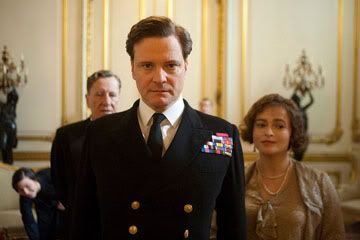
We begin with a man named Albert (Colin Firth), the Duke of York, before he is crowned king. It's 1925, and he is required to address the public at the British Empire Exhibition. He chokes on his words delivering a stuttering mess full of painful silences and stammering outbursts, a condition of speech he has lived with for as long as he can remember. It's only apparent now because of the public speaking demands of his royal position, and so he begins desperately seeking help from speech therapists. His wife (Helena Bonham Carter) thankfully stumbles upon a new possibility: a failed Australian actor named Lionel Logue (Geoffrey Rush) who takes his speech therapy practice very seriously. Geoffrey Rush delivers the film's other outstanding performance as the eccentric, expressive, clever and well-humored Logue.

The film is greatly about the give-and-take, lifelong relationship that forms between Albert, referred to as "Bertie" in the speech therapy sessions by the insistent Logue, and Logue himself. Logue realizes the only way to properly instruct as a therapist to royalty is to lower him to the same level. It's a method Albert finds deplorable at first but warms up to only upon realizing it's getting him the results he wants. He's beginning to speak better. These two roles are extremely well written from screenwriter David Seidler, and they work best when sparring with each other. Albert's sessions with Logue are the lively highlights especially during a scene where Logue suggests Albert shout vulgarities to get his words out, a scene that inappropriately earned the film its R rating. But this isn't the place to rant about the MPAA.

The need for Albert to get rid of his stammer gets elevated with more urgency as the stresses of the monarchy unfold. Albert's father, George V (Michael Gambon), frowns upon the dawn of radio technology forcing monarchs to place themselves into the living rooms of their people. Also because it prevents his preferred son from properly taking the thrown with security. The other son is Edward (Guy Pearce) who does take the thrown after the untimely death of George V but only briefly. He's in love with Wallis Simpson (Eve Best), an American woman twice divorced. She would not be accepted into royalty, so Edward's only choice is to flee. This leaves Albert to become King George VI.

This places pressure on both Albert as king and Logue now as a king's therapist, and through the interplay of their growing relationship against the ominous threat of the wider sphere where Hitler is gaining power in Germany, the film becomes a fascinating blend of personal drama and historical period piece, one about friendship, loyalty and bravery, thanks to deft direction from Tom Hooper ("The Damned United," HBO's "John Adams").

A rich supporting cast fleshes out the strength of the two leads including Michael Gambon and Guy Pearce as part of Albert's royal family and even Timothy Spall as Winston Churchill. Helena Bonham Carter is also magnificent as Albert's loving and sympathetic wife. We're used to seeing her in such dastardly roles as in the "Harry Potter" films, but here she is quite the opposite and quite lovely.

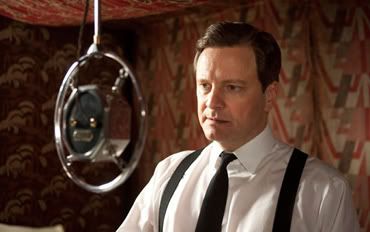
Cinematographer Danny Cohen captures the scenes in an interesting way with tight, narrow framing which is unique for a lush and historically accurate period piece. Best is when the frame is filled with Albert's horrified, sweaty face placed before a radio microphone, the red flashing light reflecting off his skin. This arrives when he must deliver his first wartime speech, the pivotal moment to all of which "The King's Speech" builds up. Hooper expertly handles this final scene which escalates in tension as composer Alexandre Desplat uses the grandeur of Beethoven's Seventh Symphony.

In this moment we absolutely feel the nerve-racking and pulse-pounding anxiety right there with Albert, a moment that boasts a walloping emotional impact. "The King's Speech" is about speech in two senses of the word. King George VI had to learn to control his speech in order to give the most importance speech of his lifetime.