Showing posts with label kate winslet. Show all posts

Wednesday, March 10, 2010

Archive: 'The Reader'

Movie Review
The Reader (2008)


Kate Winslet's astounding Oscar-worthy performance is what makes "The Reader" the experience that it is. She plays Hanna Schmitz, a 30-year-old woman who has an affair with a 15-year-old boy named Michael (David Kross) in the 1950s in Germany. She finds Michael sick on the cold, wet streets one day and decides to care for him back at her apartment. The encounter turns to that of a sexual kind, and many similar encounters continue days after. Hanna doesn't necessarily show any genuine outward love towards Michael as she repeatedly refers to him simply as "kid." Michael doesn't mind, however, as he's enthralled with the feeling of sexuality. It's all that they are in those times together, anyway, just the two of them naked together. To comment on the fact that this relationship is blatantly wrong would be to undermine the rest of the film. There's still a lot to be confronted with on the moral compass.

Director Stephen Daldry and screenwriter David Hare, who worked on the Best Picture nominee "The Hours" together, create a story that is told in distinct halves and held together by a delicate string of flashbacks. Many other movies about Nazis and the Holocaust were released this holiday season such as "Valkyrie," "Defiance," and "Good," but it would appear that this one is the most affectionately personal. This movie merely uses the context of Nazis as a backdrop to observe an inner conflict that is of all human nature. Most of all, the movie addresses guilt. Legal guilt, yes, but more importantly, moral. There's focus on not so much Hanna's guilt, which doesn't fully arise due to an explained ignorance of her situation, but more so the guilt held by the now adult Michael Berg (Ralph Fiennes). Eight years after Hanna disappeared from her apartment, Michael as a law student witnessed her on trial as a convicted Nazi prison guard. Upon the discovery of a certain secret regarding Hanna, Michael decides to withhold it. While the secret doesn't forgive Hanna's guilt, it could've radically changed both of their lives.

Michael and Hanna's encounters involved not only sex but also books. "Reading first," she would always tell him as she loved being read to by Michael. As an adult, Michael lives a divorced life in isolation. He begins recording himself reading books and then mails them to Hanna in jail. This act of kindness continues the juggling act Michael still faces with his own conscious. Michael visits with a Jewish woman living in New York (Lena Olin) near the film's end, and it's a scene that exemplifies the feeling of German guilt. The woman sits facing Michael absolutely outraged and expects that Michael wants understanding for Hanna. That, however, isn't the case as he is merely searching for closure for himself.

It's strange to me to see how this movie has been receiving more negative reviews from critics; however, there is one aspect of the movie they agree on, and that is the quality of Kate Winslet here. The emotional impact of "The Reader" comes right back around to her, and she is who the movie solely relies on. That's, however, not to disregard the fine nuances brought by Fiennes. But, without such a performance by Winslet, this story would have no personal effect and no point in being brought to the screen. It's her provocation of this woman, Hanna, which creates such a fascinating movie.


Archive: 'Revolutionary Road'

Movie Review
Revolutionary Road (2008)


Just as Sam Mendes dissected the suffocation of 90s suburbia in the Best Picture winner "American Beauty," he does just the same to 50s suburbia in his latest film, "Revolutionary Road." Even with his clinical perspective on his subjects, these characters are no less fully fleshed-out people. We are set to observe a marriage, and as a result, two lives, in crisis. In an era of conformity, the Wheelers are living what then was considered the American Dream. It's this fantasy, however, that ultimately destroys them. Marvelously adapted by Justin Haythe from the novel by Richard Yates, this is the story of a generation on the brink of a revelation. The movie takes place in 1955, and with Yates having written the book in 1961, he knew the key differences between the 50s and the 60s. The material resonates with relevancy for today as people still betray who they really are for the sake of society's expectations. This is dark, powerful stuff and certainly not a feel-good motion picture. For every bit as it is devastating, though, it's equally rewarding, and it rewards in the ways of a fine tragedy.

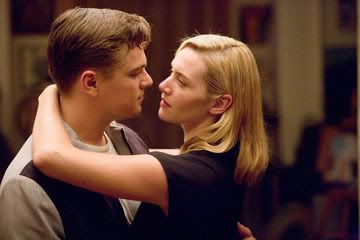
From the moment we see April (Kate Winslet) and Frank Wheeler (Leonardo DiCaprio) meet at a party and share their first dance together, we know these two promising young people are doomed. They get married and move into a quaint, white house in the suburbs. They have two kids and settle down for good. Frank heads off to work every morning getting off the train with every other family man, all of them unloading off the station platform wearing gray hats and gray suits heading to the same office job that holds no significant meaning to any of them. April stays at home with the kids tending to them, the housework, and dinner. This isn't the life they had planned when they first met. Before they had spoken about their ambitions and had decided they each wanted to be unique and distinct. Once married, they failed to remain on the same page.

One day out of desperation, April suggests a fantastical idea to Frank about the possibility of them moving to Paris. They both agree it sounds wonderful. April can find a job as a secretary over there because they pay a whole lot more, and Frank can finally quit his dead-end job he hates and discover what he truly wants to do. Frank and April visit their neighbors, Milly (Kathryn Hahn) and Shep (David Harbour), to share with them the news, and while casually accepting to the Wheelers' faces, the couple shares a private moment afterward. They are entirely taken aback and practically disturbed by the Wheelers' decision, and as a result, they nearly confront their own frustration with conformity. And then, in a moment, just like that, it passes, and they resign their thoughts and slump back into delusion. It's painfully frustrating to witness.

Frank then gets a promotion at his job and gets offered a large pay raise. He's tempted to give up the idea of Paris completely because, he figures, isn't it quite possible to live the same life of open possibility here? Soon thereafter, April finds out she's pregnant with their third child. So much for breaking away. Earlier on, April is visited by her neighbor, Helen Givings (Kathy Bates), a suburbanite who epitomizes what April loathes. She wants the Wheelers to meet her son, John (Michael Shannon), who's in a mental institution. He joins them for dinner one night and, while labeled as somebody who's insane, he reveals more truths about their delusional way of living than ever confronted before. He's not insane but merely just a few years ahead of his time. He's the one who gets it. Michael Shannon gives a dynamite performance in his few scenes, and he carries some of the film's most important lines. He commends Frank for not only realizing the emptiness of suburban life but also the hopelessness.

This is the reunion of Kate Winslet and Leonardo DiCaprio since their time in "Titanic" together, but don't expect the same lavish romance. They spend most of the movie having frighteningly explosive arguments. These two are magnificent, and their familiarity with each other is apparent as they work off each other's energy. Their astounding performances present deeply realized and flawed individuals who have an underlying affection that gets torn in two by a further widening emotional fracture. It's hard to place the blame, which makes it nearly impossible to understand both sides at once. DiCaprio fully embodies a man brought down by his own ambitions. Winslet proves yet again that she is one of the finest actresses of our time. Consider a scene where Winslet plays April making breakfast for her husband the morning after a massive fight. He's oblivious to the turmoil festering behind her fake smile. Winslet plays the part with brilliant undertones.

Gorgeous cinematography from Roger Deakins, who won for his work in "There Will Be Blood," and a hauntingly subtle score from Thomas Newman brings the whole sad experience together into something so beautiful and wrenching. All April and Frank Wheeler are looking for is a way to be let free, but within the confines of the world they find themselves in, such a possibility becomes utterly impossible. "Revolutionary Road" has the makings of a Best Picture nominee, and I really would've liked to have seen it make the list this year. I really would've.