Showing posts with label leonardo dicaprio. Show all posts

Friday, December 27, 2013

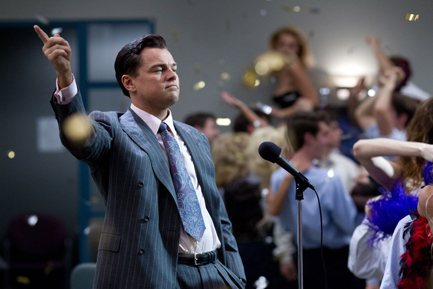
THE WOLF OF WALL STREET Review


Martin Scorsese's whoopin' and hollerin' "The Wolf of Wall Street" has a lot in common with David O. Russell's zany and freewheeling "American Hustle." They both deserved more time in the editing room, two overlong sagas that have been hotly anticipated by critics and will both be lauded by the Academy. Maybe I missed the boat. With Scorsese's "Wolf," we have a two-hour-and-fifty-nine-minute film chock full of scenes that could've been trimmed by minutes. Add those minutes up, and it's the running time audiences should've been spared. Adapted by screenwriter Terence Winter ("Boardwalk Empire," "The Sopranos,"), the story of Wall Street master swindler and money laundering expert who started his own firm at age 22 and went on to screw over millions is no sprawling epic. It's filmed as an unrelenting barrage of excess, hopped up on the cocaine and quaaludes Jordan Belfort (Leonardo DiCaprio) takes for breakfast and the rest of these guys put into their system to stay numb to their sins -- didn't I make a similar drug reference to "American Hustle"'s style? I digress.

It's a parade of debauchery. Cocaine, the outlawed prescription pill quaaludes, booze, parties, more booze, bikini-clad strippers, more quaaludes, topless hookers, bottomless hookers, Leonardo DiCaprio's sinfully gleeful Jordan Belfort banging his hot wife (Margot Robbie) on a literal bed of money. OK, OK, we get it. This guy's rich, has no regard for any of the victims piling up in the wake of his success and is choosing to completely ignore his inevitable capture and downfall, and instead he soldiers on with reckless abandon. Ninety minutes later, we're still looking at the same guy. Smart move to have the film narrated by Belfort and make it from his perspective, which turns the film into a (very dark) comedy. Otherwise we'd blow our brains out.

There's no denying that DiCaprio's performance here is the craziest he's done and arguably his going-all-out, over-the-top barbaric best. Belfort, obsessed with a reality of himself that could only possibly remain temporary, is cut from the same cloth of DiCaprio's Gatsby earlier this year. Just hopped up on coke. He drives a white Lamborghini, lives in a beautiful mansion, fuels his mind on a cocktail of drugs, commands his office like the leader of a clan and carelessly drunk-pilots his helicopter which otherwise rests perched atop his extravagant yacht.

There are a number of great scenes. The film's best is actually its quietest moment when Belfort sits face-to-face meeting the very FBI agent (Kyle Chandler) trying to take him down. Watch the conversation weave against Belfort's favor and his expression morph when he realizes it's not going his way. The polar opposite is a scene where Jonah Hill's Donnie Azoff, in a performance that's like a whacked-out version of his Oscar-nominated turn in "Moneyball," takes aged lemmon quaaludes with his co-conspirator Belfort. They slam a fistful of pills, rendering them rolling on the ground useless, slurring their speech and hardly in control of their motor skills. It's slapstick absurdity, and it's an unsettling riot.

Matthew McConaughey (still thin from "Dallas Buyers Club") drops by in two early scenes and steals the show, showing a young, eager, not yet tainted Belfort the ropes of brokering, mandating he masturbate two times a day in order to stay sharp. Later, when the seasoned Belfort shouts in a microphone to his crowded, rowdy room of sleazy brokers eager like a room full of horny frat boys, the movie is firing on all cylinders.

It's pop-pop, bang-bang, non-stop all the time in "Wolf." Keeping that momentum up drains an audience who's awaiting an outcome other than the bitterly predictable. Go out with something for us to gnaw on, mull over about the depravity and dark underbelly of the American dream, of the get rich quick mentality. The live-wire energy is there and never not boring, and it's a grandiose display of sensationalism and crass capitalism, but in the end, what's it all for?

Saturday, May 11, 2013

THE GREAT GATSBY Review


In its exuberant excess -- a signature style of Baz Luhrmann that he brings to a culmination here of pure flash, glitz and glam -- the director, perhaps unconsciously, evokes the same distant observation of that very excess F. Scott Fitzgerald described in his novel. It's not so much a classic adaptation than it is, mirroring the world Gatsby inhabits, a perfectly over-the-top display of crass indulgence. The fact that Lurhmann's audacious film is so grossly decked out in bells and whistles is more fitting than unnecessary in capturing the spirit of Fitzgerald's masterpiece: the over-the-top parties, the roaring 20s sensibilities and, most of all, the aching despair at the center of it all.

"The Great Gatsby" is also probably the only movie this year that will use 3D to proper effect. Luhrmann and cinematographer Simon Duggan put artistry in their use of the technology to soar above Manhattan, over the city and back into the illustrious mansions, twirling in and out of Gatsby's extraordinary parties. It creates an entirely sensory space, a highly stylized vision and nearly picturesque world where every scene is a perfectly choreographed dance. We open on a black-and-white Gatsby logo that pulses into golden life and zooms in on the infamous green light, the light upon which Jay Gatsby (Leonardo DiCaprio) gazes from his palace on East Egg across the bay into West Egg wherein lives the desired Daisy Buchanan (Carey Mulligan).

Next door to Gatsby is the curious and wide-eyed Nick Carraway (Tobey Maguire) who moves to town to become a writer but ends up in the bonds business. He goes across the bay to visit his cousin Daisy and meets her husband Tom, (Joel Edgerton) who almost openly is having an affair with another woman, Myrtle (Isla Fisher), while the couple's friend, Jordan (Elizabeth Debicki), watches everything through a lens of close scrutiny and awareness. She also has information on the illusive Gatsby about which rumors swirl and has peaked Nick's immediate interest. Nick soon receives a personal invite from Gatsby to one of his big bashes to which everyone else in town just shows up. And it's not just any bash; it's the biggest bash in town.

The first Gatsby party awashes the audience in shimmering decorations, flowing champagne, and dancing and music galore. It's the pinnacle of booming decadence, Lurhmann gleefully throwing money into his grand production as if he himself is the Gatsby of filmmaking. The party scenes are dizzying and reminiscent of the zaniness of "Moulin Rouge!" highlighted, of course, by the film's largely promoted soundtrack that lives up to the hype. Flappers bust out to the beats of Jay-Z while the late-party hangover -- deflated decorations and discarded bottles covering the floors -- is set to a somber, crooning Florence Welch.

The introduction of Gatsby is the idealistic movie star moment. Panning up, we see a man smiling knowingly, sly and so confident, holding up a glass of champagne, fireworks over his head. It's bombastic, so very Baz and so fitting for introducing such a character -- and only Leonardo DiCaprio could've pulled off the role. It's hard to picture anyone else bringing potent vulnerability to such a famed literary character. He also looks as if he stepped out of a time machine from his days of "Titanic."

The core of the film is the ill-fated romance between Jay Gatsby, the powerhouse, and Daisy Buchanan, the delicate flower. Set to the anthem of Lana Del Rey's "Young & Beautiful," the high point of the film's robust soundtrack and score, we watch this superficial, material-driven world come crumbling down within the dark side of the American dream, the beautiful and tragic world that it is. And in the daring director's ability to capture that exact essence, that pointed feeling of wasteful extravagance, he succeeds immensely.

Tuesday, January 8, 2013

DJANGO UNCHAINED Review


It's late at night somewhere in Texas when a carriage rolls up to two slave traders transporting their merchandise. A giant molar bobs on a spring atop the carriage owned by German dentist-turned-bounty hunter Dr. King Schultz (Christoph Waltz). He's eerily polite with a demeanor that's both charming and off-putting and shows he can turn lethal at the drop of a hat when, once the slave traders turn hostile, he guns them down without hesitation. Waltz turns in another excellently charismatic and unpredictable performance after his star-making turn as a lunatic Nazi in "Inglourious Basterds." It may feel a bit familiar, like a good guy version of the aforementioned character, but when an actor delivers lines of Quentin Tarantino's dialogue as well as he does, why hire anybody else? He brings lightning to the writer and director's penned wordplay.

Schultz recruits a slave named Django (Jamie Foxx) from the traders who will be able to identify one of his bounties. He may kill men for money, but he's a man of the law. Released from servitude by Schultz, Django first flaunts his freedom by wearing a gaudy blue garment of his own choosing -- but quickly learns how to take true advantage of his freedom. Feeling responsible for Django's fate, Schultz offers to team up for the winter helping him collect his bounties. Their first adventure takes them to a plantation run by Big Daddy (Don Johnson) who seems despicable but is only a mild evil compared to the horrors to come when the two take on the kingpin of the slave world.

Tarantino proves with "Django Unchained" that "Inglourious Basterds" was no artistic fluke. He's at it again, rewriting history and delivering long overdue justice. He punished the Nazis in a twisted vision of World War II, and now he dishes out sweet vengeance on the entire slavery institution circa 1858. This is the awards season alternative to Steven Spielberg's "Lincoln." Tarantino is recklessly irresponsible, fearless and totally in control, a risk-taker who's a film crusader of our times. He's styled "Django" into a spaghetti Western and blaxploitation hybrid complete with drastic camera zooms and a clamorous soundtrack. He addresses the ugly nightmare of slavery head-on with a tightrope balancing act of tragedy, farce and an absolute seriousness toward his own playfulness. It's a knock-out, a dynamite display of pure cinematic craftsmanship that we can only expect from Tarantino, a distinctly singular creative voice in the medium.

H also knows how to savor a scene, letting his actors really chew on the sumptuous dialogue. Sequences of insanely sustained tension cultivate in the film's latter half which takes Schultz and Django to Candy Land, a sprawling Mississippi plantation run by a human abomination named Calvin Candie (Leonardo DiCaprio).  He's gleefully sadistic, a soulless tycoon whose favorite recreation is pitting two slaves against each other in a fight to the death. Our two heroes must enter Candie's lair in order to rescue Django's wife, Broomhilda (Kerry Washington), the real crux of the film's storyline.

DiCaprio is insidious as Candie giving the facade of Southern hospitality a horrifying aftertaste. Another instance of inspired casting comes in the form of Candie's house slave Stephen, a smiling old servant played by Samuel L. Jackson. At first you can't help but chuckle at his appearance, but once Stephen's conniving ways come to fruition, you suddenly can't picture anybody else in the role.

It all leads to a showdown reminiscent of the Showdown at House of Blue Leaves from "Kill Bill Vol. 1" except instead of the Crazy 88s, we get a crazy band of rifle-toting Southern racists. And in very much the same vein as the "Kill Bill" saga, "Django" is at its core an epic revenge tale, and there's no better filmmaker for the job. Jamie Foxx as Django, in an otherwise restrained and stoic role, gets to finally wave his flag of victory against his captors, and it's triumphant giving Foxx the best performance of his career.

This is also arguably Tarantino's funniest movie to date, especially with a scene involving a pseudo-Ku Klux Klan mob whining over the eye holes in their masks being poorly cut. In every waft of spontaneity, no scene ever feels out of place either. From start to bloody finish, it really is a delirious pleasure -- even better than "Inglourious," more spirited and outlandish -- the most audaciously entertaining movie of 2012.

Saturday, November 12, 2011

J. EDGAR Review


"J. Edgar" (2011)

"J. Edgar" should've been one of the best films of the year. There's no reason for it not to be, but here it is -- an epic missed opportunity that turns what could've been a riveting drama about one of America's most controversial figures into a long, ponderous mess of a movie. All the elements were there and ready for something great, too. It's directed by Clint Eastwood ("Million Dollar Baby," "Changeling") from a screenplay by Dustin Lance Black ("Milk") with Leonardo DiCaprio in the lead role as J. Edgar Hoover.

Clint Eastwood is a master of mood, and here is no exception. The issue, however, is how noncommittal he is on the subject. When ambitiously tackling such a man of history -- one who was powerful and hated but never understood -- you have to pull out the stops. Eastwood doesn't. He puts all the pieces in place but never engages them fully. We're left with something stolid and stagnant, not a juicy biopic as we might have expected. It's still respectable and sophisticated entertainment because Eastwood is incapable of making something not watchable. But the disappointment cannot be ignored, the feeling that whatever opinion you may draw about J. Edgar, neither side is with any conviction here.

And while Eastwood's direction and Dustin Lance Black's script falter, the acting stands tall. Leonardo DiCaprio disappears within the exterior of a conflicted and unruly man. Hoover ruled the Federal Bureau of Investigation like a mad bulldog from 1935 until his death in 1972. Nobody dared cross him even though he schemed and blackmailed without shame -- this includes a cruel, anonymous letter to Martin Luther King, Jr. After seemingly playing the same character in both "Shutter Island" and "Inception" last year, it's richly satisfying to watch DiCaprio successfully transform himself, an acting feat that could no doubt earn him a Best Actor nomination or even win.

Armie Hammer of "The Social Network" plays Hoover's FBI associate director and life-long companion, Clyde Tolson. It's remarkable to note that Hammer, a relative newcomer since his breakout last year, holds his ground next to DiCaprio and -- in some instances -- even outshines him. Both actors, however, are hampered by layers of distracting prosthetic aging makeup.

Tolson is Edgar's dark secret, and a majority of Black's screenplay is purposely speculative about their relationship. And while an important aspect of the man's life, Black takes the easy way out. Sure Hoover was terrible and did some terrible things -- but he was gay. And while he bases most of the film around Hoover's repressed homosexuality, he also uses it as reasoning for his hidden evils and paranoia about commies and radicals. His sexuality is not the only reason -- that's too simple, and even with DiCaprio's performance this tactic threatens to make Hoover one-dimensional, which he's certainly not. 

Scenes between Hoover and Tolson are nuanced and the film's best. In a most wrenching scene, Hoover's mother Annie (played with stern severity by Judi Dench) calculates what's going on between her son and Tolson. "I'd rather have a dead son than a daffodil," she says. The effectiveness of these moments, though, point to the film's greater downfall. Every gay man of that generation was repressed and struggling with something profound -- that's no mystery. So let's focus on what made Hoover different than the rest of those men.

Friday, July 16, 2010


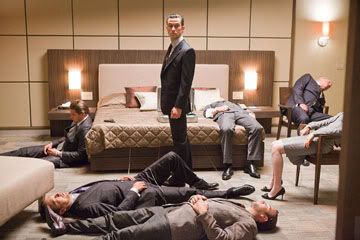
"Inception" (2010)

"Inception" is the film that will finally give Christopher Nolan the Oscar nominations for Best Picture and Best Director he has for so long deserved. Or at least it should be. This is a supremely intelligent work of art delving into the dreams of reality and the reality of dreams like no other movie in recent memory. And it comes from Nolan, one of the most talented storytellers working in cinema today, in the form of the biggest movie event of the summer. As a combination of "The Matrix," Charlie Kaufman's "Synecdoche, New York" and James Bond, the movie has the narrative puzzlement of "Memento" with the grand, epic scale of "The Dark Knight." Nolan dreams larger than life, and best of all, he succeeds.

Consider the feeling you get after jolting awake from an intense dream that feels all too real. That's how leaving "Inception" feels with your heart racing, head spinning and nerves jangled. Fitting, then, that the movie is about understanding dreams and the process of creating a reality within them. This concept opens up a labyrinth of possibilities, and Nolan navigates these possibilities with complete control through a screenplay that supposedly took him 10 years to complete. The film is impervious to spoilers because it's almost impossible to describe in words, and any details that might give anything away would not and elicit confusion instead.

If there's any movie out there that needs to be seen to be believed, this is it. With an ending so powerful prompting one of the most diverse audience reactions I've experienced, you will need to take a moment to set yourself back in the real world once the credits roll. There is no possible way to fully comprehend it upon a first viewing, but you can immediately appreciate its grandeur warranting multiple viewings. Prepare to have your mind twisted, turned inside out and then completely blown because this 148 minutes is more than worth the effort.

Cobb (Leonardo DiCaprio) describes how an idea is the most resilient parasite and that an idea planted in the mind is a seed that can grow to change the course of a life. He is a skilled professional hired by corporations to infiltrate the subconscious of others to steal their ideas, a practice known as extraction. Cobb, though, is hired by a wealthy corporate man, Saito (Ken Watanabe), to do just the opposite. The job requires Cobb to perform an experimental procedure called inception where he will plant an idea deep into the mind of a young billionaire, Robert Fischer Jr. (Cillian Murphy), an idea that will eradicate a corporation that rivals Saito's. All Cobb wants to do is to be able to go back home as a free man. After a terrible accident he was forced to remove himself from his family, but completing this job would allow him to return. It's a job he can't refuse and a job he vows will be his last.

A meeting with his father-in-law, Miles (Michael Caine), leads Cobb to discover his new architect for the job, Ariadne (Ellen Page), who is a smart and promising student and a genius when it comes to building and replicating spaces. As a test of her ability, Cobb has her sketch a maze in under a minute, but what Ariadne will sketch for the job is much more elaborate and fully realized. She must create a space within Fischer's dreams that is a deceptive maze, and this is all described to her by Cobb as they sit at an outdoor café in Paris. His discussion with her about fabricating environments within a dream while navigating and manipulating them is Nolan's way of teaching the audience how to follow along. In one of the film's most impressive sequences, the interior of a dream is introduced as the environment around Cobb and Ariadne starts dismantling itself and shattering all around them in a gorgeous slow motion effect. The cityscape lifts into the sky and literally folds onto itself.

They assemble a team to begin the infiltration process which includes Cobb's close associate, Arthur (Joseph Gordon-Levitt), a disguise master named Eames (Tom Hardy) and Yusuf (Dileep Rao) whose concoction of a sedative will allow the participants to stay asleep during their extensive inception. You see, they eventually dive into four levels of dreaming which means the plot is at one point simultaneously dealing with five layers of reality. You heard that right. Five layers. Yet it never becomes muddled or too disorienting--of course it has to be disorienting at least a little bit--as it progresses with a forward momentum that reaches the breaking point of intensity. It is accented with a pounding and brassy musical score by Hans Zimmer echoing that of "The Dark Knight."

Physics and time are altered as they descend deeper into the layers. Seconds in the first layer of a dream are minutes in the following layer which then descend to what could be hours, days or even weeks. This allows for visual flourishes that are downright awe-inspiring in many instances. When a van carrying our heroes tumbles down an incline, this places the second layer Arthur in the midst of a gunfire showdown in a rotating hotel hallway. When this same van gets launched off the edge of a bridge, gravity in this second layer ceases to be.

The special effects have a mind-bending effect not only in looking great but also in making sense with the circumstances of the dreams. Scenes from the movie's trailers which seemed illogical make wondrous sense once in context such as sceneries tilting and shifting right before your eyes, a freight train barreling down a busy street and crumbling buildings in a dilapidated state of limbo, the result of death in a dream while under Yusuf's strong sedative.

All of the performances in "Inception" are superb. Leo DiCaprio is impressive carrying a brooding weight with his role of Cobb who, unbeknown to his colleagues, has performed inception once before with devastating results. Marion Cotillard is fantastic as always playing Cobb's tender yet sorrowfully vicious wife, Mal, who perpetually invades whatever dream Cobb occupies because guilt from his past keeps her locked in his subconscious like a prisoner. Cotillard's presence has a saddening love that lingers in the scenes between Mal and Cobb.

As Ellen Page's first adult role, she fits in seamlessly, and I can't help but hope this is the start of a new trend for her because it's refreshing to witness. Also notable is Joseph Gordon-Levitt whose shining moment arrives when he solely wrestles with a batch of floating sleeping bodies.

The brilliance of "Inception" is the way it fits huge metaphysical ambition reflecting one's own sense of a dreamscape into an action Hollywood blockbuster structure without one hiccup. It makes the chase sequences and other conventions of the action genre feel like something wholly original all over again. With "The Dark Knight," Nolan reinvented the superhero movie. I think now he may have just reinvented, well, the standards of explosive commercial entertainment. He said his film is what Hollywood blockbusters should all strive to be. I couldn't agree more.

Wednesday, March 10, 2010

Archive: 'Body Of Lies'

Movie Review
Body of Lies (2008)


"Body of Lies" is a terrible title not only because it sounds like a porno but also just because it's a bad name for a movie about terrorists, secrets of the CIA, and espionage action. It's far too generic, but it turns out that the movie itself is equally so. This latest from director Ridley Scott is a very slight offering and a large step backwards from last year's "American Gangster." The movie feels a year behind the times yet again dealing with our post-9/11 world. I guess the multiplex could handle yet another sharply edited thriller about the Middle East and U.S. occupation there, but there's honestly nothing here that we haven't already seen in many other movies. Whatever themes Scott is spewing about the war in Iraq, we've all heard it before.

Roger Ferris (Leonardo DiCaprio) is a CIA operative who has become close to Middle Eastern royalties and uses these connections and his ability to speak Arabic to infiltrate potential terrorist threats. He's a puppet to a man named Ed Hoffman (Russell Crowe), a middle-aged CIA veteran who spends his days sitting in front of his laptop and on the phone in the convenience of his home in the suburbs or in his office in Langley, VA. He tracks all of Ferris' movements and basically commits evil when he believes he's helping for the good. The interplay between DiCaprio and Crowe as these characters could've and should've been a lot more, but there's something lost in between because most of their scenes together aren't even face-to-face. They are remarkably flat even when there's a sense they're trying to light up the screen. Despite their best efforts, it seems that it's just poor writing that is holding them back. It's slyly comical, though, to see a fat, graying Crowe peering over his glasses spitting out folksy lines of smugness. He controls everything in Iraq while attending to his everyday life loading his kids into the minivan or eating some Goldfish crackers on the sideline of his daughter's soccer game. DiCaprio, however, appears to yet again just be putting on his same hero face over again.

The plot is mostly formulaic, and the movie masks this fact by becoming unnecessarily intricate and difficult to follow. As things continue to unravel, it only turns more conventional, detached, and surprisingly unemotional. There's a romance between Ferris and a Jordanian nurse that feels tacked on to give the character of Ferris a little more depth; it also works as a mere plot contrivance. The first hour feels widely unfocused and is quite a hodgepodge of a mess until one interesting twist arises that should've cropped up earlier. It involves Ferris devising a scheme to invent a terrorist group in order to lure out the real terrorists. From here, the movie tightens up for the end but never really delivers a satisfying punch. It feels as if Ridley Scott thinks he's made a movie more important than it actually is.

The biggest problem "Body of Lies" presents is that it has shockingly found a way to be a movie about torture and terrorism that's boring and dull. Isn't it wrong that the concerns with Middle Eastern political intervention and terrorism have been summed up into a lifeless action thriller? Here's a movie that could've sparked some interest because Ridley Scott has no less created something that is slick, looks good, and has quality production values, but, where's the sense of urgent conviction? It's tired, and it's tiring to watch.

Archive: 'Revolutionary Road'

Movie Review
Revolutionary Road (2008)


Just as Sam Mendes dissected the suffocation of 90s suburbia in the Best Picture winner "American Beauty," he does just the same to 50s suburbia in his latest film, "Revolutionary Road." Even with his clinical perspective on his subjects, these characters are no less fully fleshed-out people. We are set to observe a marriage, and as a result, two lives, in crisis. In an era of conformity, the Wheelers are living what then was considered the American Dream. It's this fantasy, however, that ultimately destroys them. Marvelously adapted by Justin Haythe from the novel by Richard Yates, this is the story of a generation on the brink of a revelation. The movie takes place in 1955, and with Yates having written the book in 1961, he knew the key differences between the 50s and the 60s. The material resonates with relevancy for today as people still betray who they really are for the sake of society's expectations. This is dark, powerful stuff and certainly not a feel-good motion picture. For every bit as it is devastating, though, it's equally rewarding, and it rewards in the ways of a fine tragedy.

From the moment we see April (Kate Winslet) and Frank Wheeler (Leonardo DiCaprio) meet at a party and share their first dance together, we know these two promising young people are doomed. They get married and move into a quaint, white house in the suburbs. They have two kids and settle down for good. Frank heads off to work every morning getting off the train with every other family man, all of them unloading off the station platform wearing gray hats and gray suits heading to the same office job that holds no significant meaning to any of them. April stays at home with the kids tending to them, the housework, and dinner. This isn't the life they had planned when they first met. Before they had spoken about their ambitions and had decided they each wanted to be unique and distinct. Once married, they failed to remain on the same page.

One day out of desperation, April suggests a fantastical idea to Frank about the possibility of them moving to Paris. They both agree it sounds wonderful. April can find a job as a secretary over there because they pay a whole lot more, and Frank can finally quit his dead-end job he hates and discover what he truly wants to do. Frank and April visit their neighbors, Milly (Kathryn Hahn) and Shep (David Harbour), to share with them the news, and while casually accepting to the Wheelers' faces, the couple shares a private moment afterward. They are entirely taken aback and practically disturbed by the Wheelers' decision, and as a result, they nearly confront their own frustration with conformity. And then, in a moment, just like that, it passes, and they resign their thoughts and slump back into delusion. It's painfully frustrating to witness.

Frank then gets a promotion at his job and gets offered a large pay raise. He's tempted to give up the idea of Paris completely because, he figures, isn't it quite possible to live the same life of open possibility here? Soon thereafter, April finds out she's pregnant with their third child. So much for breaking away. Earlier on, April is visited by her neighbor, Helen Givings (Kathy Bates), a suburbanite who epitomizes what April loathes. She wants the Wheelers to meet her son, John (Michael Shannon), who's in a mental institution. He joins them for dinner one night and, while labeled as somebody who's insane, he reveals more truths about their delusional way of living than ever confronted before. He's not insane but merely just a few years ahead of his time. He's the one who gets it. Michael Shannon gives a dynamite performance in his few scenes, and he carries some of the film's most important lines. He commends Frank for not only realizing the emptiness of suburban life but also the hopelessness.

This is the reunion of Kate Winslet and Leonardo DiCaprio since their time in "Titanic" together, but don't expect the same lavish romance. They spend most of the movie having frighteningly explosive arguments. These two are magnificent, and their familiarity with each other is apparent as they work off each other's energy. Their astounding performances present deeply realized and flawed individuals who have an underlying affection that gets torn in two by a further widening emotional fracture. It's hard to place the blame, which makes it nearly impossible to understand both sides at once. DiCaprio fully embodies a man brought down by his own ambitions. Winslet proves yet again that she is one of the finest actresses of our time. Consider a scene where Winslet plays April making breakfast for her husband the morning after a massive fight. He's oblivious to the turmoil festering behind her fake smile. Winslet plays the part with brilliant undertones.

Gorgeous cinematography from Roger Deakins, who won for his work in "There Will Be Blood," and a hauntingly subtle score from Thomas Newman brings the whole sad experience together into something so beautiful and wrenching. All April and Frank Wheeler are looking for is a way to be let free, but within the confines of the world they find themselves in, such a possibility becomes utterly impossible. "Revolutionary Road" has the makings of a Best Picture nominee, and I really would've liked to have seen it make the list this year. I really would've.

Saturday, February 20, 2010

This Island Is No Vacation

Movie Review
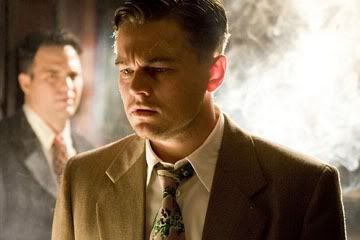
Shutter Island (2010)


What we see here is a master at work but also having fun at the same time. Just take note of the cameo. It's like Martin Scorsese is throwing us a little treat, a hint to the fact that even he isn't taking this all too seriously. He's having fun with us, and we better be ready and willing to go along for the psychologically thrilling and exhausting ride. Even when Scorsese is playing with us, he's masterful. No, his latest film, "Shutter Island," is not perfect. But even when not at perfection, Scorsese is a master at the craft and knows how to make a compelling motion picture. His love for filmmaking and for cinema in general is apparent throughout the movie's lengthy running time, quite like Quentin Tarantino's latest work, "Inglourious Basterds." Both present a history that is changed and unreliable, and they both are inspired by endless genres and older works. Martin Scorsese knows how to make a film, so let him have his fun, and "Shutter Island" is it. It's dark and delirious, a waking nightmare, and I, for one, loved it.

The year is 1954, and U.S. marshal Teddy Daniels (Leonardo DiCaprio) is on his way to the fog-covered, doom-and-gloom-promising Shutter Island with his partner, Chuck Aule (Mark Ruffalo). The island is home to a prison for the criminally insane with a ward that used to be a fort in the Civil War. In other words, there's nothing inviting about this place, and the horrifyingly pounding score at the film's opening confirms this notion without question. The two have been assigned to a case of a missing patient, a woman named Rachel (Emily Mortimer) who is guilty of killing her three children. It appears impossible to leave the island alive as it is surrounded by cliffs of jagged rocks. To the prison's director, Dr. Cawley (Ben Kingsley), it would seem that Rachel just evaporated through the walls.

Adapted from a novel by Dennis Lehane, the story is simple enough upon first glance. But the trick is that there's something awfully terrifying about this island. There's something hidden amongst the endlessly heavy walls of gray concrete, and Teddy becomes obsessed with finding out just exactly what it is. The investigation hits a dead-end when the two marshals meet Dr. Naehring (an ever-menacing Max von Sydow) who gives the vibe of being a co-conspirator with Dr. Cawley. Just what could they be hiding in this place? Teddy becomes entrapped by his own involvement and investment to the island as he delves into motives beyond himself.

DiCaprio gives a deeply felt and haunting performance as a man torn between his memories and the reality of what is happening to people on the island. Teddy comes across people who could either be ghosts of his past, a trick of the imagination, or mere people who remind him of his own trauma. We receive glimpses into Teddy's history, his involvement in liberating a Nazi camp, along with the life he had with his wife (Michelle Williams) before she died tragically in a fire. They're presented in dreams, hallucinations, and flashbacks, and they're vibrant and beautiful even in their horror. As a hurricane brews with strong winds and sweeping trees, so brews the hurricane inside Teddy's mind. His partner is not nearly as involved, but he cares for his partner. "You OK, boss?" he frequently asks of him. Meanwhile, a visit with a patient named George Noyce (Jackie Earle Haley of "Watchmen" and "Little Children") and an encounter with a different Rachel (Patricia Clarkson of "Lars and the Real Girl") send Teddy deeper into the downward spiral of confusion, frustration, and madness.

Every performance here is sublime, no matter how minor the role. The singular scene with Patricia Clarkson is arguably the film's most emotionally potent, and Kingsley never fails to have a glimmer of menace even behind the kindest eyes. This film is all about atmosphere and the tone, that feel of film noir, the pulpy complexity and dramatization of it all. The key is the mystery, following along only with the instinct of your senses, of what you see, hear, and ultimately feel. The movie is an extremely sensory experience, and in the same vein, a surprisingly emotional one, too. It becomes nearly stressful, but only in the best way a movie can transfix and transport you.

Scorsese deals with some weighty themes in "Shutter Island," and even here he continues to explore the aspects of human nature that have intrigued him in his other films. The question becomes the clarity of the dividing line between what is considered to be sane or insane and the violence that may come with such. Is it ever justifiable? Nothing is ever what it seems even up to the film's final frame. To speak of the ending would be pointless. Some may like it while others may detest it. For me, I think it works, and it makes sense with the narrative that unfolds. And, best of all, it makes you want to go out and see it again.

Monday, December 28, 2009

Christopher Nolan Back In Form


The newly released second trailer for Christopher Nolan's "Inception," starring Leonardo DiCaprio, doesn't give any more insight as to what the movie is actually about. It does, however, make me all the more anxious for summer 2010 when this mind-bending action-thriller is slated for release. It's nice to see Nolan returning to his style of "Memento" for a nice departure from Gotham City.

Apple has the trailer, and you can watch it here.