Showing posts with label laura linney. Show all posts

Wednesday, April 28, 2010


Archive: "Jindabyne" (2007)

"Jindabyne," titled for the lakeside city where the movie takes place, is based on the short story "So Much Water So Close to Home" by Raymond Carver, and Australian director Ray Lawrence has transformed the story into a movie that is uniquely Australian in its themes, ideas, and setting. The camera sweeps over the sometimes ominous landscape, full of flowing rivers, tall mountain peaks, and barren lands. The cinematography is quite beautiful, and so is the acting that comes along with the rest of the film.

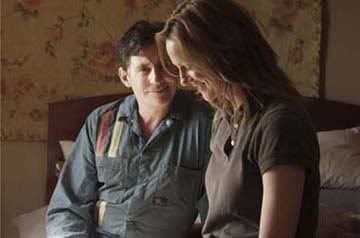
Claire (Laura Linney) is an American wife of an Australian fisherman, Stewart (Gabriel Byrne); their troubles as a couple are surrounded by neighbors, friends, and family who also have troubles of their own. They both have the usual small-time jobs you would find in a small town like Jindabyne, Claire working as a clerk in a drugstore, and Stewart running a gas station. They have an unexplained patch of history in their marriage where Claire got ill and left because she wasn't able to care for their only son. Like many other aspects of their relationship, this is never really explained.

The only highlight in Stewart's year is going on a big, annual fishing trip with three other buddies at some river deep in a remote national park. While there, they stumble across the dead body of an Aboriginal woman. The immediate response of the group of men is never shown or understood, and they decide to not let this be an interruption to their fishing trip and that they'll take care of it once they get home. Once they tell the police about it, however, they, and the public of the small town, can't understand how the men could've continued to fish there. The last person to find out is Stewart's husband, Claire, which puts a strain on her understanding of her husband's actions.

The movie presents Claire's side of the argument with the most clarity; she returns back to the subject over and over again, pressing her husband further on the issue. It's an attempt to get a grip on the matter, to find out if she's living with a heartless man, and to find some way to make amends with the entire ordeal. This performance is left in the very capable hands of Laura Linney, who is the powerful center of this tale of lost morality. It's best to keep your eye on her very emotional and taut performance because it's by far the most admirable factor among the rest of the film's sometimes slow-moving and unfocused feel.

This best feature, along with the other central performances, gets somewhat lost in the murk of other extraneous elements of the plot. The filmmakers seem to have a lot to say about race, religion, abortion, mental illness, middle age, and community life. The fact that the woman in the water is Aboriginal brings up the race factor and the question of whether or not the men would've acted quicker had she been white. The movie gets weighed down by these extra factors, which all seem heavy-handed.

Also interesting to note is that the movie sometimes even feels like a thriller. There is always the murderer of the young woman lurking about, and there are plenty of scenes that lend themselves to make the viewers believe that something bad is going to happen. Also something to note is that although meant to be a character study, some of the most important aspects of these characters are left not fleshed-out.

"Jindabyne" is an intelligent, finely observant, and haunting portrait of a small town torn apart by the rage that surrounds a tragedy. It's a peculiar film; one that is very bleak, quiet, and in this subdued tone, tells a fractured story about humanity and the occasional struggle in finding it. And the movie's ending, too, is just a wry enough of a conclusion that brings everything full circle with just the right amount of karma.

Sunday, April 4, 2010


Archive: "The Nanny Diaries" (2007)

Call up the nannies because it's time for a night on the town! And what not a better way to spend the evening than to see a nearly-there chick flick that is just a little too vanilla for anybody's taste buds to get anything from? Why exactly was I seeing "The Nannie Diaries" to begin with? Well, only because my three favorite people are in it: Scarlett Johansson, Laura Linney, and Chris Evans. It's too bad I now prefer to see them in their own respective movies. Evans is whatever and just a bit too much of a nice guy for his own good, and Johansson seems out of place aside from her wit that gives her the ability to look like she knows it's nothing special. Linney, on the other hand, feels a step above as she surprisingly steps out of a screenplay that tries to limit her character, and she further proves to be a flexible actress.

The movie uses inventive visual quirks, which turn out to be its best aspect as the story itself is entirely superficial. Annie Braddock (Scarlett Johansson) strives to be an anthropologist, and in the opening and best scene, we are shown the dioramas in the Museum of Natural History presenting different cultures around the world, which then lead up to the Upper East Side of New York City, the most hostile culture of all. Here's a culture where the mothers don't have jobs and yet still don't have enough time, and the husbands are completely out of the picture. And that's where the nanny comes in. Annie accidentally gets hired by one of the said exhibits, Mrs. X (Laura Linney), who bumps into her at Central Park and mishears Annie state her name and hears Nanny instead. She immediately assumes Annie is indeed a nanny, believes she would want to work for her, swoops her up, and relentlessly refers to her as Nanny from there on.

The little boy Annie has to look after is named Grayer, and as one would expect, he doesn't like her at first. Mrs. X has his son on a strict soy diet and wants Annie to speak French with him each day so he can get into an Ivy League elementary school. Well, of course Grayer doesn't like this along with Annie, and so, of course, the rules get broken. And as one would expect again, she begins to grow on the kid. Keep in mind, however, the job is still awful. It's a 24/7 duty, her room is dingy, the rules are strict, the demands are great, there's lots of manipulation, and there's even a teddy spy cam. And as much as Annie wants to ditch the job, the attachment to the kid makes it all the harder to leave.

The nannying world Annie is experiencing is like an alternate universe, and she only has three contacts to the outside world. Her mother doesn't even know about Annie's nannying and thinks she has her own apartment and a real job; her NYU best friend (Alicia Keys) frowns upon Annie's choice but still supports her all the way; and there's the neighbor who Annie refers to as the Harvard Hottie (Chris Evans), but Mrs. X says he's off-limits because relationships only get in the way. Departing from the outside world, though, there's still Mr. X (Paul Giamatti). He's a jerk of a workaholic and has known affairs with businesswomen, yet Mrs. X acts purposely naive and clings to him. Annie not only has to care for Grayer, but she also feels involved with the Xes troubled marriage.

Moments of sweetness and humor are few and far between as the movie mostly resorts to sit-com antics, which makes the overall plot development entirely scattered and uneven. The progression is predictable and bland, and the fact that Annie eventually rises up over her employees and teaches a lesson to all those other nanny owners is no surprise. The revelation made by the end, especially, feels too contrived because we knew it was coming all along. The other problem is that the movie stoops to exaggerated stereotypes of the upper class when it actually had the potential to be a snappier satire. There's a constant voice over by Johansson throughout, and Annie's anthropological view on life goes well with narration; it's clever and effective in the way the entire movie is told as if it were a scientific case study, but in the end, it isn't enough.

There are some noted similarities between "The Nanny Diaries" and "The Devil Wears Prada" as both were beach reads written by women and then adapted into movies, and both deal with the snooty, feminine upper class of Manhattan and the college grads that have to deal with it. I haven't seen the latter movie, but from what I've heard about it and with the lackluster quality of this wannabe that I have now seen, I think it's about time I sit down to enjoy some evil Meryl Streep. Sorry Scarlett, maybe next time.

Sunday, March 21, 2010

Archive: 'The Savages'

Movie Review
The Savages (2007)


Here is yet another one of the best films of the year. It's the story of two unhappy siblings who rejoin to take care of their estranged father, now suffering from vascular dementia, putting him in a nursing home where he will eventually pass away. Now, a premise like this immediately sounds dull and miserable, but it turns out that "The Savages" (fittingly titled after the family name) is terrific. What's so refreshing is its willingness to be real and tell it how it is. It's the opposite of charming and sharply unsentimental, dealing with the harsh realities of life, death, and what pulls us together in the end.

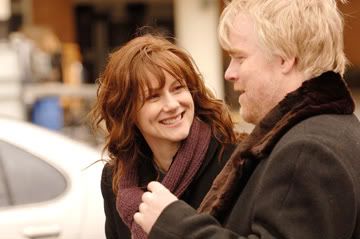
Jon (Philip Seymour Hoffman) is a college professor working in Buffalo, and Wendy (Laura Linney) is a struggling temp in New York City. Jon is consumed by his writing on a book about Brecht. Wendy spends the days in her office writing letters requesting grants so she can fund the play she's writing. Jon is allowing his girlfriend for three years to move back to Poland because he's too afraid to marry her. Wendy is sleeping with an older married man to keep her sex life alive even if she's more in love with the guy's dog. They are both disgruntled, in the midst of a middle-age mid-life crisis, and are forced to come together due to their elderly father, Lenny (Philip Bosco), who was found cussing out his ill girlfriend's caregiver by writing in feces on the bathroom wall.

Wendy receives the call of her father's early signs of dementia, and she drags a reluctant Jon along to fly to Arizona. Once there, they discover their father living with his same-age girlfriend, Doris, until she quickly passes. Wendy doesn't hesitate to take the dead woman's prescription painkillers. Having no place to live, Wendy and Jon fly Lenny back to Buffalo where they plan to put him into a nursing home; he is too far along in his condition to be able to handle just assisted living. Wendy feels like a terrible person for doing this to her father, but Jon believes its best. While temporarily housing together, the two of them argue over what establishment to keep him in, which leads from one tragically funny scene to another.

I just love Laura Linney. She and Philip Seymour Hoffman are in top form here. Linney is heartbreaking as Wendy, a woman who cherishes her cat and her symbolic ficus. She is desperate, aching, and painfully humorous in her attempts to make things better. Hoffman delivers another dynamite performance to go along with his two other big performances this year in "Before the Devil Knows You're Dead" and "Charlie Wilson's War," playing Jon, a worn-out guy who cries over his girlfriend's eggs, stuffing all of his emotion behind a nonchalant attitude that doesn't fool anybody. Even Bosco presents a convincing picture of an elder who has lost it, and yet not entirely, because he still can roll his eyes at his children's usual quarrels. There are so many refined nuances within these winning performances that make the movie what it is. It's so beautifully nuanced with acting so good that we see these actors playing real people, not just characters. We see traces of ourselves within them, as hard as that may be, with all of their flaws.

Writer and director Tamara Jenkins delivers her own nuances within the script, expressing realism without any frills, which makes it so endearing. The writing finds comfort and humor in small moments, which is really what life is all about. One scene, in particular, involves Jon throwing his back out during a game of tennis; he and Wendy come home to put him in a hanging neck brace that takes strain off his back. He looks hilarious, telling Wendy not to laugh, but while telling her, he's laughing himself. In times such as that, Linney and Hoffman truly make us believe the sibling dynamic underneath their relationship; it's superb. They both know what they're doing at every exact moment, playing off each other with great collaboration, and they do it with energy and are both very funny.

"The Savages" is a movie with uncommon appreciation for life just how it is. It's comedic without even lifting a finger and contains genuinely dark humor with just the right bittersweet taste to make you either want to laugh or cry. This is a movie that shows us the paths in life we must travel, crappy as they may be, and the people that are created at the end of them.