Showing posts with label philip seymour hoffman. Show all posts

Wednesday, September 19, 2012

THE MASTER Review


Instead of the belching fire, raging fury of blood and thunder and a climax ending with the phrase "I'm finished" in Paul Thomas Anderson's "There Will Be Blood," here's the latest from the acclaimed writer-director, "The Master," which is no less intense but a more quiet, intimate and ultimately maddening picture. A lot of the hype surrounding this film suggests it will be a true-to-life tale of the founding of Scientology and an exposé on L. Ron Hubbard. Those looking for something along those lines, turn back now. Hubbard's rise is merely the foundation upon which Anderson has constructed a towering, twisted metaphor for American life, power and history, much in the way he used Upton Sinclair's "Oil!" as the jumping point for 2008's "Blood." Unlike that film, however, this is a more cerebral, speculative and confounding experience with a narrative trajectory that gets further deconstructed as it moves forward.

We open at the conclusion of World War II. Freddie (Joaquin Phoenix) served in the Navy, and after some post-war psychoanalysis is certifiably a mess. When shown Rorschach ink blotches, he only sees genitalia and mumbles answers about his mother's presence in a psych ward somewhere. And while he finds work as a portrait photographer in a department store and later as a worker in a cabbage field, his only real ability and interest is making potent yet dangerous cocktails out of paint thinner, dark room materials and household cleaners. This drifter walks along a pier one night and like a twinkling alluring light in the distance, there is a party boat docked with an amiable crowd aboard, and Freddie doesn't think twice about sneaking inside. He awakes the next morning after drunkenly passing out to meet Lancaster Dodd (Philip Seymour Hoffman), a resolute man of clear thought and diction. Dodd sees an interest in Freddie and speaks to him as a father figure. "You will be my protege and my guinea pig," Dodd tells him.

So begins the fascinating and complex character study of contrast on Lancaster Dodd and Freddie the drifter. Their dynamic is introduced in Dodd's first "processing" session with Freddie, a sort of mental time travel, a hypnosis and search for past trauma that could trace back even millions -- or trillions -- of years. This "process" is the basis of Dodd's pseudo-religious, therapeutic cult known as the Cause. From here, Freddie's relationship with Dodd goes from pining son to devout follower to bitter cynic all with psycho-sexual undercurrents that are hard to read and uneasy to digest.

The performances that craft these characters from Hoffman and Phoenix are nothing short of brilliant. Phoenix gives Freddie a feral, hunched over demeanor with a crazed manic energy that, after Phoenix's public breakdown and bizarre quasi-documentary "I'm Still Here," feels only fitting for the actor and gives him career-best work. A scene in which a locked-up and hand-cuffed Freddie kicks and shatters a jail cell toilet right off the wall marks a shocking ferocity, a lucid contrast to Hoffman's Dodd who only shows flashes of his inner rage against doubters of the Cause. This includes his own son, Val (Jesse Plemons), who's convinced his father is making his religion up as he goes along. The opposite of this is Dodd's wife, Peggy (Amy Adams), who's pregnant and displays a motherly, wholesome feminine quality to perfectly accent Dodd's Cause. What the public doesn't see is a headstrong woman clawing at perfection. Even the masters have their masters, and Adams -- in a performance which will be recognized come award time -- shows Peggy's terrifying will in a private moment with her husband.

What's impossible to ignore about "The Master" is Paul Thomas Anderson's absolute command of the cinematic form. It's enough to keep any movie connoisseur completely enthralled with impeccable direction, mesmerizing and gorgeous 65mm (projected 70mm in select theaters) cinematography from Mihai Malaimare, Jr. (a Frances Ford Coppola favorite), which marks the first time cinematographer Roger Elswit hasn't worked on an Anderson film, and another unnerving and mind-bending score from Jonny Greenwood. It's all very much what we've come to expect from a masterful filmmaker, but then something happens that we don't expect.

As the film's narrative begins delving into dream states and Freddie's memories, the third act begins to strangely misshapen. A curious lack of development without a truly dramatic turn is what keeps Paul Thomas Anderson's latest film from reaching the greatness of his previous work. While perhaps eliciting a tinge of disappointment, this is in no way a misstep for the writer-director. I admire its contentious themes and lauded aesthetic elements, but an absence of riveting storytelling kept me from falling in love.

Tuesday, October 11, 2011

THE IDES OF MARCH Review


"The Ides of March" (2011)

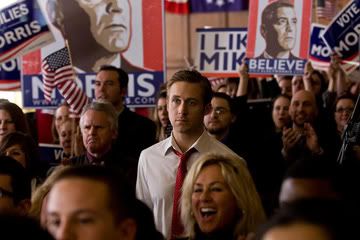
The fourth feature directed by George Clooney (following "Confessions of a Dangerous Mind," "Good Night, and Good Luck" and "Leatherheads"), "The Ides of March" provides us with knowledge a lot of us may already know: the current climate of American politics leaves no room for idealism and dignity. It's a harsh and cynical look at the modern presidential campaign landscape, but it's also less about the candidates and more about the campaign managers working for them. There is scheming, backstabbing and lapses in loyalty aplenty, and it's all a riveting inside look at the men behind the faces we end up voting for.

The movie stars Ryan Gosling playing another rather introverted character. It's a much different character than "Drive," but his focus and intensity remains the same. Just when we think we have him figured out, he surprises us with a twist of action. He plays Stephen Meyers, a press secretary for Pennsylvania Gov. Mike Morris (George Clooney) during a presidential primary in Ohio, which acts as a pressure cooker for the proceedings. Perfectly cast, Clooney plays Mike Morris as an idealistic fictional Obama in 2008 candidate who is articulate and promising with a new kind of politics. Stephen works under Paul Zara (Phillip Seymour Hoffman in top form), a seasoned campaign manager for Morris. On the other side of the playing field is Tom Duffy (Paul Giamatti), the campaign manager for the opponent Pullman. All of these men, save for Stephen, are hardened realists who know exactly how to play their pieces on the board. Young professionals such as Stephen have yet learned how to check their values at the door.

The screenplay (adapted from Beau Willimon's play "Farragut North") co-written by Clooney, Willimon and Grant Heslov paired with Clooney's understated direction brings conversations and exchanges to the utmost importance. The title suggests a grand sweeping Shakespearian theme, but Clooney's goals are actually much simpler and straightforward and, in such, create an even greater impact. What Clooney strives to present may not be wholly profound, but it is pulpy and provocative. I don't think the screenplay sticks in the knife as deeply as Clooney hopes, but he still assembles an astonishingly powerful cast to navigate murky waters where the lines of political and emotional agenda get skewed.

A New York Times reporter played by Marisa Tomei represents manipulative media involvement in the campaign looking for the best scoop. A key conversation between her, Stephen and Paul early on shows where true loyalty lies along with the real perception of any campaign -- it always divulges into disappointment no matter who takes the title. At one point Stephen receives a call from Tom Duffy with a job offer to change sides. Motives here become unclear. Does Duffy actually want Stephen, or does the offer simply work as a ploy? Stephen is just opportunistic and looking out for his best interest revealing a surprising but subtle amorality. The real focus of the plot doesn't arrive, however, until a scandal surfaces around a luscious intern named Molly (Evan Rachel Wood). Stephen is handsome and suave, so he charms Molly into bed but in the process learns some unnerving information.

From here the film is tight, smart and swiftly paced showing us everything we've already come to know about how campaigns are really run in this country. It plays as if the pressure cooker finally goes over, and scenes flow with boiling urgency. The revelations keep us riveted but what keeps us engaged and interested is the toxic and malevolent atmosphere that Clooney expertly upholds. It's down and dirty stuff with men in pressed suits, and it's all the more disturbing considering the setting. "The Ides of March" works like a wrenching punch to the gut in the acceptance that sometimes politics is just about keeping a job.

Sunday, March 21, 2010

Archive: 'Before The Devil Knows You're Dead"

Movie Review
Before the Devil Knows You're Dead (2007)


"May you be in heaven half an hour...Before the devil knows you're dead."

The opening scene is of Philip Seymour Hoffman's character having rough vacation sex with his younger wife, played by Marisa Tomei. This isn't the only dirty thing you'll witness people doing throughout the course of this wrenching drama. "Before the Devil Knows You're Dead" is the latest film from 83-year-old director Sidney Lumet about a family's life torn into shambles after a jewel heist gone horribly awry. It's remarkable that after receiving the Lifetime Achievement Award three years ago, Lumet is still at the top of his game and making worthy movies such as this.

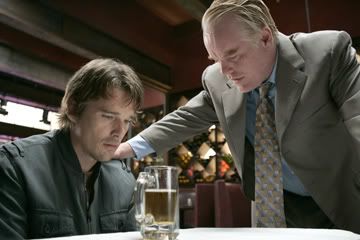
Hank (Ethan Hawke) and Andy (Philip Seymour Hoffman) are brothers, although you wouldn't know it from looking at them; you would have to observe the way they interact because you get the feeling they've shared some history together. Andy is a payroll executive at a Manhattan real estate office who acts tough with every hair slicked back into place; however, the marriage with his wife, Gina (Marisa Tomei), only has the appearance of being stable, and he has a bad drug addiction that leaves him strapped for cash. Hank works at the same office with Andy and is rundown, in a divorce, distant from his daughter, and in need of money to pay for child-support.

It's Andy who comes up with the plan to rob a jewelry store. The place he has in mind is a small mom and pop shop in the suburbs; the catch is that its their mom (Rosemary Harris) and pop (Albert Finney). Andy assigns Hank to do the job alone, and he figures if it's done without a gun on a slow Saturday morning with no customers around, it's a victimless crime that insurance can cover. Well, without giving too much away, everything goes wrong. It's from here that the movie begins to ring with emotional resonance and intensity that is absolutely devastating.

The plot isn't linear and is told in fractured segments, and what's so ingenious about this construction is how richly layered it is. After the opening scene, it cuts to "The Day of the Robbery," and then from there, it flashes back to different perspectives, jumps forward, and then doubles back again, all within the course of one week. This method comes from debut screenwriter Kelly Masterson, and it allows for each individual scene to be reconstructed, revealing more each time, and melding each piece together to create a startling cohesive whole.

The aftermath of the robbery only gets more complicated when Hank and Andy's father starts investigating for himself. It also doesn't help that Andy's wife is seeing Hank every Thursday. It's painfully fascinating to watch this family slowly inch their way to a shatteringly climactic disaster. We're not watching criminals on the screen, but rather, ordinary men driven to the point of committing criminal acts. These are people who turn to the worst possible means to resolve their problems. And all you can do is sit back and just watch the shockingly bad behavior unfold and await its consequences. Through it all, the characters feel a sense of remorse and grief, and yet, keep on with their familiar ways.

The movie's strength is in the demanding performance from Hoffman, who has key moments of loud outrage and silent despair. He taps into his dark side and is searing as a man who oozes charm but is then pushed to the edge; his gruesome aggressiveness gives him frightening strength in the end. His co-star, Hawke, is in the shadow as the hurt, younger sibling dragged under the corrupt current of his persuasive older brother. These two actors work together to make a strange connection of twisted trust between conflicted brothers.

"Before the Devil Knows You're Dead" is a movie you have to experience for yourself to understand. It's one to discover through the intricate way its told, and simply reading about it doesn't do the movie justice. It's a juicy bite into a thought-provoking melodrama that dives deep into a progressively escalating tragedy of loss that vibrates with energy.

Archive: 'The Savages'

Movie Review
The Savages (2007)


Here is yet another one of the best films of the year. It's the story of two unhappy siblings who rejoin to take care of their estranged father, now suffering from vascular dementia, putting him in a nursing home where he will eventually pass away. Now, a premise like this immediately sounds dull and miserable, but it turns out that "The Savages" (fittingly titled after the family name) is terrific. What's so refreshing is its willingness to be real and tell it how it is. It's the opposite of charming and sharply unsentimental, dealing with the harsh realities of life, death, and what pulls us together in the end.

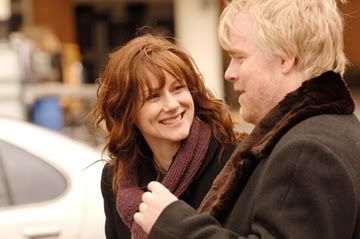
Jon (Philip Seymour Hoffman) is a college professor working in Buffalo, and Wendy (Laura Linney) is a struggling temp in New York City. Jon is consumed by his writing on a book about Brecht. Wendy spends the days in her office writing letters requesting grants so she can fund the play she's writing. Jon is allowing his girlfriend for three years to move back to Poland because he's too afraid to marry her. Wendy is sleeping with an older married man to keep her sex life alive even if she's more in love with the guy's dog. They are both disgruntled, in the midst of a middle-age mid-life crisis, and are forced to come together due to their elderly father, Lenny (Philip Bosco), who was found cussing out his ill girlfriend's caregiver by writing in feces on the bathroom wall.

Wendy receives the call of her father's early signs of dementia, and she drags a reluctant Jon along to fly to Arizona. Once there, they discover their father living with his same-age girlfriend, Doris, until she quickly passes. Wendy doesn't hesitate to take the dead woman's prescription painkillers. Having no place to live, Wendy and Jon fly Lenny back to Buffalo where they plan to put him into a nursing home; he is too far along in his condition to be able to handle just assisted living. Wendy feels like a terrible person for doing this to her father, but Jon believes its best. While temporarily housing together, the two of them argue over what establishment to keep him in, which leads from one tragically funny scene to another.

I just love Laura Linney. She and Philip Seymour Hoffman are in top form here. Linney is heartbreaking as Wendy, a woman who cherishes her cat and her symbolic ficus. She is desperate, aching, and painfully humorous in her attempts to make things better. Hoffman delivers another dynamite performance to go along with his two other big performances this year in "Before the Devil Knows You're Dead" and "Charlie Wilson's War," playing Jon, a worn-out guy who cries over his girlfriend's eggs, stuffing all of his emotion behind a nonchalant attitude that doesn't fool anybody. Even Bosco presents a convincing picture of an elder who has lost it, and yet not entirely, because he still can roll his eyes at his children's usual quarrels. There are so many refined nuances within these winning performances that make the movie what it is. It's so beautifully nuanced with acting so good that we see these actors playing real people, not just characters. We see traces of ourselves within them, as hard as that may be, with all of their flaws.

Writer and director Tamara Jenkins delivers her own nuances within the script, expressing realism without any frills, which makes it so endearing. The writing finds comfort and humor in small moments, which is really what life is all about. One scene, in particular, involves Jon throwing his back out during a game of tennis; he and Wendy come home to put him in a hanging neck brace that takes strain off his back. He looks hilarious, telling Wendy not to laugh, but while telling her, he's laughing himself. In times such as that, Linney and Hoffman truly make us believe the sibling dynamic underneath their relationship; it's superb. They both know what they're doing at every exact moment, playing off each other with great collaboration, and they do it with energy and are both very funny.

"The Savages" is a movie with uncommon appreciation for life just how it is. It's comedic without even lifting a finger and contains genuinely dark humor with just the right bittersweet taste to make you either want to laugh or cry. This is a movie that shows us the paths in life we must travel, crappy as they may be, and the people that are created at the end of them.

Wednesday, March 10, 2010

Archive: 'Synecdoche, New York"

Movie Review
Synecdoche, New York (2008)


The title of Charlie Kaufman's "Synecdoche, New York" is the first and least of your worries with understanding this movie, so let's start with that. Synecdoche is an alternate spelling and the way locals pronounce the city of Schenectady, which is where the movie takes place. Synecdoche is also a term on its own, meaning, and I quote, a figure in which a part of a thing is put for the whole. And somehow, just somehow, that definition seems to ring true for this movie. You'll have to see it first, of course. Maybe to say that is a bit of a stretch, but this movie is in itself one long stretch of the imagination anyway.

Here's a movie that's easy to love and easy to hate. I fell into the former category. It's too bad people may not even have the patience to give this movie one viewing because it certainly requires multiple. It's a movie that is nearly impossible to put down into words because it's not so much about the plot than it is about the ideas that are inspired by the plot. No review could ever describe the soaring ambition this movie holds. We're familiar with Charlie Kaufman's writing from wonderful other movies such as "Eternal Sunshine of the Spotless Mind," "Being John Malkovich," and "Adaptation." With this latest feature, we're given the same signature wacky weirdness, but this time he is not held back as he serves as director, too. Kaufman likes observing the mind, its inner workings, and how we use it to try to grasp this crazy thing we call life. Using this formula, he takes it to a much grander scale and miraculously pulls off including essentially every possible aspect of life and aging in just two hours.

Caden Cotard (Philip Seymour Hoffman) is a theater director, and with such a job comes the loneliness, deprivation, self-pity, and self-loathing. He continuously finds himself acquiring new ailments that send him to doctors that really don't know what's wrong with him except that something is. Caden concludes that he's dying. His wife, Adele (Catherine Keener), is a painter of miniature portraits, and their marriage is falling apart. They attend sessions with an egotistical psychotherapist (Hope Davis) who only wants to promote her own book. Adele eventually leaves Caden with their daughter, Olive, for Berlin to pursue her career. Caden breaks down and decides he needs to do something meaningful with his life. Upon receiving funding from a MacArthur Award, Caden initiates a project he hopes to be a monumental theater production.

It starts with one enormous warehouse that Caden buys and transforms into a city-size theater set piece. He starts by recruiting hundreds of actors and then thousands. He rehearses them in their own personal vignettes. Caden wants his play to capture the very essence of life, and his ultimate goal is to have nobody as an extra and have everybody perform his or her own special story. It becomes his obsession, and his work on this play becomes his life, and therefore, the play becomes about his life. It transforms into a self-layering, self-referential autobiography, one that becomes increasingly more dense and complex. Inside his warehouse, Caden replicates life line-by-line, replacing real-life people with fitting actors. Everything we see happening on screen is recreated for us on continuously building layers. It even gets to the point where there are warehouses within warehouses, and we never know if we're in fiction or reality.

And there's more. Caden gets involved with a box-office teller named Hazel (Samantha Morton) who lives in a perpetually burning house. Things go wrong, and Caden ends up marrying an actress named Claire (Michelle Williams). Later, they get divorced and Caden returns to Hazel, enlisting her to be his assistant in producing the play. Meanwhile, there are actors who play Caden and Hazel. Even a woman plays Caden at one point. Hazel ends up finding the man who plays Caden more fascinating than Caden himself. In an attempt to make Hazel jealous, Caden hooks up with the woman playing Hazel. And so on, and so on. The entire city is a stage and their world is a play but that play is their world and it is real and it is life.

Does any of that make sense? No, and "Synecdoche, New York" isn't a movie you have to understand right away mainly because, well, you can't. Instead of dismissing it, the better approach is to appreciate the fact that it's a great movie that can slowly unfold and reshape itself within your mind for many moments long after you've seen it. And then you can go see it again. With so many heartbreaking and poignant scenes and images throughout, this movie can't help but be called a masterpiece. Is the Academy going to recognize Charlie Kaufman's accomplishment? It's unlikely. Nonetheless, this is a beautiful film, and one that is near and dear to my heart.

Archive: 'Doubt'

Movie Review
Doubt (2008)


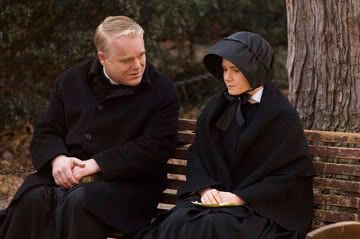
This powerful and thought-provoking drama's opening scene shows Father Flynn (Philip Seymour Hoffman) giving a sermon on the subject of doubt. He contemplates the true meaning behind having doubt and its juxtaposition against certainty. This one word, doubt, is what fuels this film that requires to be seen more than once. Walking out of the theater, I already wanted to see it again. It's an intellectually engaging piece that challenges the mind and pins you to your seat. The movie probes the definition of uncertainty and the feelings of isolation and confusion it can bring, therefore forcing viewers to confront their own beliefs and morals.

"Doubt" is, above all, a showcase for its four extremely talented actors who each do Oscar-caliber work. As he shows in the film's initial moments, Hoffman holds a commanding presence and perfectly inhabits a man put up against cruel judgment. He has a deep compassion for standing up for what he believes to be right and fair. He's a confident man but is also hesitant enough to make us second guess him. He is put under a microscope of scrutiny by Sister Aloysius (Meryl Streep). And what really shows Hoffman's expertise as an actor is his ability to stand in a scene with Meryl Streep without slipping behind her bravado. This actress can do anything, and it's no wonder she gets nominated so frequently for her roles. She understands each character she plays, and Sister Aloysius is no exception. Wearing her dark costume as a mask concealing any ounce of compassion, Streep creates a character who is monstrous in her nonnegotiable convictions. Amy Adams, as well, provides a quieter but no less effective role as Sister James who finds herself caught in the middle, not knowing which side is right and wrong.

And then there is Viola Davis who plays Mrs. Miller, the mother of a young black boy enrolled at the Saint Nicholas Church School in the Bronx in 1964. There is a ten minute scene, a conversation between Mrs. Miller and Sister Aloysius, and it is the soul of the movie. While Davis spends the least amount of time on screen, she packs in the most emotional punch. This scene alone makes her extremely worthy of a nomination. It's a wrenching moment, one that unveils startling revelations. Mrs. Miller's son, Donald, has been placed at the center of a fiery dispute between Father Flynn and Sister Aloysius. After Sister James witnesses Father Flynn take Donald into the rectory, she reports the potentially unsavory behavior to Sister Aloysius. While Father Flynn denies any accusations of foul play, Sister Aloysius refuses to back down. From the conversation between Sister Aloysius and Mrs. Miller, we discover that not only is Donald the only black student in an all-white school, but he's also gay. What conclusion can be drawn about the relationship between Father Flynn and Donald Miller?

There's no proof of anything, but as Sister Aloysius states, "I have my certainty." But, as the movie addresses, how far does that take us? The movie is based on the Pulitzer Prize-winning play of the same name by John Patrick Shanley, who also adapted his own screenplay and directed. So, therefore, yes, the movie has the distinct feel of rather than a night out to the movie theater, a night out to an actual theater. This isn't a bad characteristic, however, due to the movie being so strongly fueled by demanding and eloquent writing and stand-out performances. This movie is admirable in the fact that with just simply a great script and great acting alone with no extra frills, it can make for a rousing and dynamic experience.

"Doubt" is brilliant in that it never supplies a clear-cut answer, but rather, offers its audience a chance to look deeper into their own thoughts and opinions, further questioning everything they just witnessed. It creates the full feeling of doubt within not only the minds of its characters but also the mind of its audience. The movie works mostly through subtleties and small details, all wrapped up into a concise but dense piece of filmmaking. We are left contemplating the result of good intentions and how far people are willing to go to satisfy their own beliefs. What does it truly mean to be faithful and to do what is right or moral? There's doubt as to who's the righteous one, and this becomes most troubling especially in a time of certainty. And meanwhile, who's ever really entirely certain of anything? That is the biggest question of all.