Showing posts with label octavia spencer. Show all posts

Monday, June 30, 2014

SNOWPIERCER Review


As we continue into the summer movie season with superheroes, sequels and money-grubbing tentpoles, here arrives "Snowpiercer," a thrilling piece of international filmmaking that carries the gusto of any great blockbuster and the brains of the most sophisticated sci-fi dystopian fare. From visionary director Joon-ho Bong, who took the creature feature (2006's "The Host") and murder mystery (2009's "Mother") genres and turned them on their heads, he has created a wildly original and inventive take on a sociopolitical parable. Simply put: it's the action film everyone should be (and probably isn't) seeing and talking about right now.

It's the year 2031, and an attempt to counteract global warming has sent the world into an Ice Age with the only survivors boarding a guargantuan locomotive that circumvents the earth at a rate of one revolution per year. It is humanity's brave new world, a place severely divided into a harsh class system. The deprived, soot-covered 99 percent are forced to live in miserable conditions in the back of the train while the one percent enjoy decadent luxuries in the front of the train. Curtis (Chris Evans) is the reluctant hero of his fed-up cohorts in the back who've long been planning a prison break-styled revolt to charge their way to the front. The premise may sound like something you've seen before -- most notably the class system found in "The Hunger Games" franchise -- but that's where the familiarities begin and end.

What follows is a headlong rush into complete lunacy, a wild ride that could only work as well as it does because it comes from such a visually audacious filmmaker. The action sequences are propulsive and spectacular, each uniquely stylized as the revolters hack and slash their way through swarms of thugs; one of the scenes in particular is a heart-pounding stand-out. Beyond visually, what's most impressive is the crazy balancing act the film strikes in its tone; it's profoundly serious with brutal violence and then throws in spurts of pitch black hilarity.

Delivering the most laughs is Tilda Swinton who beams in her performance from what feels like a different planet entirely. The chameleon actress is batshit brilliant and knocks out every scene she's in. A close runner-up is Alison Pill as a delusional school teacher in a sequence that stands as the film's downright most bizarre. Chris Evans sheds his "Captain America" exterior to deliver a grounded, rugged performance while John Hurt is great as the peg-legged old man of wisdom. Octavia Spencer shines with ferocity and warmth while Jamie Bell plays a go-getting sidekick, and Kang-ho Song is superb as a drug-addicted securities expert.

Here's a film that pulls you into its strange, scary and wonderfully weird world and recaptures the feeling of truly transporting cinema. Think "The Matrix" -- it's that good. Joon-ho Bong doesn't shy away from reaching for greatness and comes out the other end with something to say, too. The film is not subtle about its powerful ideas and using the train as an allegory for the world we live in today. How far are we willing to go in order to exist comfortably in our society at the expense of so many suffering? "Snowpiercer" suggests a bleak reality.

Sunday, July 21, 2013

FRUITVALE STATION Review


Without the verdict of the Zimmerman trial now etched into our nation's history, 26-year-old Ryan Coogler's debut "Fruitvale Station" would be no less powerful and resonant. But, with this film opening in the wake of that decision, there's no denying the added level of immediate relevance. An extremely well-made and well-acted film that already is timeless in its story of a young man's life cut short now becomes more timely than ever. This is essential viewing.

On New Year's Day in 2009 at 2:15 a.m. 22-year-old Oscar Grant (Michael B. Jordan) was shot in the back by a Bay Area Rapid Transit police officer at a Fruitvale station platform in Oakland, Calif. Writer/director Coogler's brisk 84-minute film traces back Oscar's final day in roughly a 24-hour period. We follow him in the course of a typical day. Waking up with his girlfriend, Sophia (Melonie Diaz), and young daughter, driving them to day care and work respectively and then preparing for a birthday party for his mother (Octavia Spencer). Along the way, we get a glimpse into his troubled past. Prior to his untimely death, Oscar is not painted as a saint; he's a multi-faceted man bridging the gap between his old ways and the new life he wants for his family.

Sophia has just caught Oscar cheating, he got fired from his job and a year ago was in jail for getting involved with drugs. A flashback takes us to Oscar's mom visiting him in the penitentiary. He's warm but rough-edged and temperamental, and their emotionally-charged exchange reveals a strained relationship. Flash forward to this day where Oscar is trying to get back on track. He's surrounded by love, and the film's naturalism in its shooting style -- knowing exactly how long to linger and when to cut away -- shows such human warmth, especially his undying love toward his daughter. On this day it looks like everything might work out, but we of course already know it doesn't.

Enter the tension-fueled scene on the Fruitvale station platform between Oscar, his group of friends and a testy police officer (Kevin Durand) -- a singular moment that seals Oscar's fate. Coogler opens his film with real footage taken from a witness' phone as the incident was circled with bystanders capturing footage. Juxtaposed to this, the scene becomes effectively jarring taking a moment of voyeurism and turning it into a pointed feeling of urgency and panic.

"Fruitvale Station" presents two major emerging talents. As a debut, Coogler's film is a powerhouse while at the same time modest and personal. And Jordan plays Oscar with an assured steady hand, balancing sincerity and ferocity. His performance should go on to awards consideration later this year next to Octavia Spencer, the movie's heart and soul. In the hospital waiting room, she calms the men's cries of injustice telling them they need to put all their energy toward Oscar's well-being. "Fruitvale" won both the Grand Jury Prize and Audience Award at this year's Sundance, and no wonder. There's not a dry eye in the audience when the credits roll.

Monday, February 27, 2012

84th Annual Academy Awards Recap


Last night's Oscar telecast went (pretty much) as expected. "The Artist" walked away with the top awards, but not before "Hugo" picked up a slew of awards earlier in the evening. Both films act as a reverie to the golden age of Hollywood, so it was fitting they went home with five awards each considering the theme of this year's ceremony.

The entire telecast revolved around feelings of appreciation and nostalgia for the art of filmmaking with interludes of actors revealing favorite movie moments of their past. The stage was even set up to replicate an old fashioned movie theater. So, it was as if the show was purposely modeled after the films the producers knew would take the most awards -- and with the show's renewed sense for a love of cinema, it felt fitting.

Not to mention the return of veteran host Billy Crystal who, while definitely nothing too exciting to tweet about with no real jokes to remember, he was congenial enough and kept the night moving along. He opened with a medley introducing the nine Best Picture nominees, and while it was rushed and awkward it worked fine. Not only as a moderate distraction but as a reminder to the Academy to just cut it back down to the usual five nominees already. Besides, his old shtick fit right in with the evening's theme of film throwback. Hey look, it's the Oscar host from the early 90s!

"The Artist" took home the awards for Best Picture, Director for Michel Hazanavicius, Score, Costume Design and Best Actor for Jean Dujardin who during his acceptance speech proclaimed, "I love your country!" and then ended it with an explosion of French. He was the first ever Frenchman to win in the category, and "The Artist" winning marked the first time a black and white silent movie has taken the top prize since 1928.

"Hugo" garnered awards early in the night nabbing plenty of technical awards including both Sound Editing and Mixing along with Art Direction as expected, but then it surprised by taking Cinematography out from under "The Tree of Life" leaving Malick's prestigious film with nothing. It then swooped in and snagged Best Visual Effects from the frontrunner of "Rise of the Planet of the Apes."

The biggest technical surprise, however, went to "The Girl with the Dragon Tattoo" winning Best Editing over the likes of both "Hugo" and "The Artist." My question: if "Dragon Tattoo" was good enough to not only get nominated for Editing but win in that category, then why wasn't it good enough to at least get nominated for Best Picture? I mean, "Extremely Loud & Incredibly Close" got nominated, and the majority of the evening was spent trying not to remind the audience that it did.

The supporting acting awards went without a hitch. Christopher Plummer, 82, became the oldest actor to ever receive an Oscar getting his predicted Best Supporting Actor award for "Beginners." He received a well-deserved standing ovation along with Best Supporting Actress winner Octavia Spencer for "The Help." They both had the most heart-warming speeches of the night, especially Spencer who burst into tears.

The third standing ovation went to Meryl Streep. Yes, for her Best Actress win for "The Iron Lady" over frontrunner Viola Davis for "The Help." They thankfully didn't cut to Davis who most likely was wearing a crushed expression upon her loss. I was rather irate at Streep's win realizing to myself I had forgotten the rule of the biopic; that is, if a renowned actor/actress plays a real life person, they most likely win.

My anger subsided, however, when Streep provided us an instance of comedic brilliance. Upon reaching the mic (which had annoying digital feedback for most of the night), she joked how half of America was probably grumbling to themselves thinking, "Aw c'mon, her again?!" She then paused briefly and concluded with a non-chalant, "But whatever!" It was a perfect moment that made up for poor Davis' snub.

Critics are already calling last night's telecast a dud. Let me be the one to remind everyone that this is an award show. It's hard to pump it with pizzazz, especially considering they scrapped all shreds of musical performances. Save, however, for the Cirque du Soleil performance which turned out to be quite thrilling and extravagant. And, for me at least, the night was full of memorable moments.

Can we talk for a second about, say, Angelina's right leg? Not ten minutes after Angelina Jolie was on stage to present the award for whatever she was presenting an award for (sorry, I was distracted by her right leg the whole time), a Twitter page was created in honor of her protruding ligament.

The ladies of "Bridesmaids" were certainly a treat sprucing up the presentation for the short films which are otherwise dreaded categories to sit through. Kristen Wiig and Maya Rudolph managed to sneak in penis jokes while Melissa McCarthy and Rose Byrne created a Martin Scorsese drinking game right on stage.

When Emma Stone presented next to Ben Stiller and when Zach Galifianakis and Will Ferrell appeared with their silly cymbal crashing, they were all making strong cases as to why they should perhaps host in future years. Producers, take note.

While last night certainly didn't reclaim the spirit of Oscar we've lost over the years, it was at least a step in the right direction reminding audiences why films like "The Artist" and "Hugo" might have been such a big deal. Last year certainly was about reclaiming the magic of going to the movies, and last night's telecast captured that feeling. And before you complain about Billy Crystal, just think back to how the hosting went last year.

As for my predictions, I came out with a rather solid 19/24 categories predicted right. Go me.

Check out the full list of winners from the 84th Annual Academy Awards, and revel in the fact that we don't have to talk about this for at least a few more months!

Thursday, August 11, 2011

THE HELP Review


"The Help" (2011)

It's 1961 in Jackson, Mississippi at the height of the Jim Crow era in the heart of the Deep South middle class. While blacks and whites co-exist casually and brushing shoulders every single day on a regular basis, they are still separate and not equal. White women go about their days of leisure while their black maids take care of the house raising the women's white children. And while they're called maids, they might as well be titled house slaves and -- even more -- surrogate mothers. "The Help," the alive and rich adaptation of Kathryn Sockett's 2009 bestselling novel, is aware of the sobering truth at its center: segregation in the South wasn't just wrong -- it was a grand and sweeping delusion as a proper way of life.

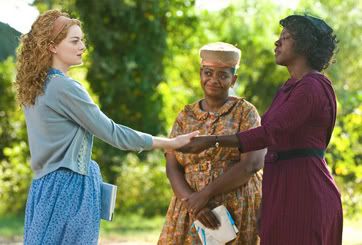
The story is told from the perspective of Aibileen Clark (Viola Davis), a maid who says she's raised 17 white children in her lifetime. Her grandmother was a maid, her mother was and so is she. Your heart breaks for her when Skeeter (Emma Stone) -- the journalist writing a book composed of interviews with the maids of Jackson -- asks Aibileen if she wants to do something more. The book is dangerous to write exposing the unfair and cruel Southern domestic life these women endure. Completing the book is the film's narrative force, and Emma Stone carries the leading role well. We've seen her as a chipper comic, but here she plays a woman grown to be disturbed by what she witnesses around her.

Take for example when Skeeter persistently questions her mother (Allison Janney) on what happened to Constantine (Cicely Tyson), their maid of 29 years who mysteriously left. The betrayal she feels after hearing the answer brings the South's wrenching moral condition to a personal level. Skeeter takes a job at the Jackson Journal writing a cleaning advice column and recruits Aibileen for help; this leads to the collaboration on something much greater.

Bringing a weight and solemn sincerity to the film is the tough and brilliant performance from Viola Davis as Aibileen. Playing Aibileen's best friend Minny is Octavia Spencer (known primarily for smaller roles), and her performance is just as note-worthy full of fiery sass and spark. These women steal scenes left and right, and the movie becomes solely theirs weaving a story of aspirations and squandered dreams.

Like the book Skeeter is writing, this is the story of the maids and the women they work for. Under the facade of prim and proper bridge games and fundraiser benefits, saying these women take what they call the help for granted would be an extreme understatement. It does, however, seem like most of the women have feebly accepted the social norm and treat their black maids how they have been shown they should be treated. That is except for Hilly (Bryce Dallas Howard), a vile princess and blatant racist pushing for separate outdoor bathrooms for the black maids -- the domestic equivalent of being forced to the back of the bus. She fires Minny sending her over to Hilly's archenemy Celia (Jessica Chastain of "Tree of Life"), a flaky but well-meaning blond bimbo who hires Minny without the knowledge of her husband; that way home-cooked meals and a clean house look readily prepared by Celia.

When opting for light humor, the movie really gets the laughs. This is especially true when Minny surprises Hilly with a very special dessert delivering hilarious returns. The incident does get played to overkill, however, and here newcomer writer/director Tate Taylor lays bare the film's obvious intentions as a surefire crowd-pleaser -- but it also worked wonders on me. I didn't mind knowing the exact desired emotions because I felt them -- the warmth and hopeful joy sprung from these women's story showing that cruel people in the world get their just desserts. Pun intended.

What I most admire about "The Help" is how it escapes the bounds of its Oprah book club wrapping with exceptional actresses who all make for a touching and exhilarating tale that, in between the humor, is a truly affecting tear-jerker with characters we are moved by and care about. It also doesn't shy away from the dark ugliness of the era. Within the cheer there's a whole lot of sad and aching pain, and at the film's end is the realization that it's still the same Jackson, Mississippi we started with even after Skeeter finishes writing her book.