Showing posts with label tilda swinton. Show all posts

Monday, June 30, 2014

SNOWPIERCER Review


As we continue into the summer movie season with superheroes, sequels and money-grubbing tentpoles, here arrives "Snowpiercer," a thrilling piece of international filmmaking that carries the gusto of any great blockbuster and the brains of the most sophisticated sci-fi dystopian fare. From visionary director Joon-ho Bong, who took the creature feature (2006's "The Host") and murder mystery (2009's "Mother") genres and turned them on their heads, he has created a wildly original and inventive take on a sociopolitical parable. Simply put: it's the action film everyone should be (and probably isn't) seeing and talking about right now.

It's the year 2031, and an attempt to counteract global warming has sent the world into an Ice Age with the only survivors boarding a guargantuan locomotive that circumvents the earth at a rate of one revolution per year. It is humanity's brave new world, a place severely divided into a harsh class system. The deprived, soot-covered 99 percent are forced to live in miserable conditions in the back of the train while the one percent enjoy decadent luxuries in the front of the train. Curtis (Chris Evans) is the reluctant hero of his fed-up cohorts in the back who've long been planning a prison break-styled revolt to charge their way to the front. The premise may sound like something you've seen before -- most notably the class system found in "The Hunger Games" franchise -- but that's where the familiarities begin and end.

What follows is a headlong rush into complete lunacy, a wild ride that could only work as well as it does because it comes from such a visually audacious filmmaker. The action sequences are propulsive and spectacular, each uniquely stylized as the revolters hack and slash their way through swarms of thugs; one of the scenes in particular is a heart-pounding stand-out. Beyond visually, what's most impressive is the crazy balancing act the film strikes in its tone; it's profoundly serious with brutal violence and then throws in spurts of pitch black hilarity.

Delivering the most laughs is Tilda Swinton who beams in her performance from what feels like a different planet entirely. The chameleon actress is batshit brilliant and knocks out every scene she's in. A close runner-up is Alison Pill as a delusional school teacher in a sequence that stands as the film's downright most bizarre. Chris Evans sheds his "Captain America" exterior to deliver a grounded, rugged performance while John Hurt is great as the peg-legged old man of wisdom. Octavia Spencer shines with ferocity and warmth while Jamie Bell plays a go-getting sidekick, and Kang-ho Song is superb as a drug-addicted securities expert.

Here's a film that pulls you into its strange, scary and wonderfully weird world and recaptures the feeling of truly transporting cinema. Think "The Matrix" -- it's that good. Joon-ho Bong doesn't shy away from reaching for greatness and comes out the other end with something to say, too. The film is not subtle about its powerful ideas and using the train as an allegory for the world we live in today. How far are we willing to go in order to exist comfortably in our society at the expense of so many suffering? "Snowpiercer" suggests a bleak reality.

Friday, April 18, 2014

ONLY LOVERS LEFT ALIVE Review


Jim Jarmusch's "Only Lovers Left Alive" exudes cool and sinks its teeth into a genre that has otherwise been tarnished into trash by pop culture. The writer-director brings it back to rare life and escalates it to art, diving into territory those others wouldn't dare to. The biggest question: what motivates these creations (vampires) to keep loving, living and moving forward for untold centuries at a time? They have no wonder grown tired of this earth and the people that inhabit it -- problem is, there's nowhere else for them to go.

Tom Hiddleston and Tilda Swinton -- with long hair, swaying limbs and ever-present shades to block out the light -- are absolutely magnetic as the arty, existential vampire couple at the film's center, Adam and Eve.  They refer to humans as zombies, those who have ruined the world in which they live, watching as it wastes away before them. The two have been married forever (almost literally) but begin the film apart. Eve rests in Tangier using the precious blood supply from ancient vampire Marlowe (John Hurt) to sustain herself, while in Detroit, Adam sneaks into a hospital to get blood from Dr. Watson (Jeffrey Wright) who asks no questions and accepts a wad of cash. Adam and Eve have to be cautious because blood, their life supply, has become increasingly contaminated.

Adam is also a musician, fascinated by the age of analogue rock, but he's also in complete recluse and doesn't want his music out in the world. He relies on errand boy Ian (Anton Yelchin) to help keep him hidden from the scene. Eve comes to join her love in his hideaway, but her presence also draws her mischievous sister Ava (Mia Wasikowska) to them, as well. Music plays a large part in the film's aesthetic, the camera swirling like a record player along with repeated variations of a theme. With cinematographer Yorick Le Saux ("I Am Love") shooting Jarmusch's first foray into digital, it marks the filmmaker's most visually exciting film to date. It's very much a Jarmusch film ("Broken Flowers," "Coffee and Cigarettes"), and as long as you can groove with his unhurried pace, it's an alluring two-hour treasure.

"Only Lovers Left Alive" is both dead-serious in its meditation on pressing onward even amid a feeling of having nothing left to live for, while also lightly funny in moments of perfectly executed, bone-dry humor. It's also more than a little hopeful in its strange way, a lamenting love letter to the city of Detroit, a microcosmic wasteland of civilization that has a glimmer of potential for rejuvenation.

Saturday, March 8, 2014

THE GRAND BUDAPEST HOTEL Review


Wes Anderson's "The Grand Budapest Hotel" is a delightful farce, a wonderful romp and a screwball caper. It's fanciful and funny, but it's also perhaps Wes Anderson out-Wes Anderson-ing himself. I haven't seen everything out of the writer/director's canon, but I think I've seen enough, from his very best ("The Royal Tenenbaums," "Fantastic Mr. Fox," "Moonrise Kingdom") to his lesser efforts ("The Life Aquatic with Steve Zissou"). It's certainly safe to say since 2009's animated entry, he has solidified, even more than before, a stylistic signature. With "Grand Budapest," the film comes standard with all the tropes we recognize with characters and cameras only moving at right angles, framed in pretty little boxes, with swiveling, pivoting cameras and swooping zooms, tiny miniatures and a cast of familiar faces (Owen Wilson, Bill Murray, Jason Schwartzman). The filmmaker is who he is, and with this latest outing his style has been refined to pinpoint precision.

Set in a fictional European town in between the world wars, the story is told through the visit of a young writer (Jude Law) to the now rather decrepit Grand Budapest, long past its glory days in the 1930s. He meets a man named Zero (F. Murray Abraham) who recalls his extraordinary tale of when he was a young lobby boy (played by newcomer Tony Revolori) under the wing of head concierge Monsieur Gustave H (Ralph Fiennes). Fiennes excels in the role with rapid-fire poetics and dialogue, an operatic man who acts as if all the wrongs in the world can be righted with proper manners. Etiquette, above all, defines his charmed era, which he refuses to believe is soon coming to an end, with darker times on the horizon.

When we switch from the older Zero recalling his tale to back in the day, the film switches from widescreen to a 4:3 aspect ratio, and cinematographer Robert Yeoman uses both to great effect; most recognizably the latter as every shot is squared off and perfectly symmetrical. And it's all set to a bouncy, delectable score from mainstay Alexandre Desplat. The winding tale springboards from the death of the 84-year-old Madame D (a hilariously elderly Tilda Swinton), one of the many female residents of the hotel Gustave had relations with. At the reading of her last will and testament by Deputy Kovacs (Jeff Goldblum), it's discovered that the Madame left her most prized possession, a Renaissance painting called "Boy with Apple," to not her ruthless son Dmitri (Adrian Brody), but instead Gustave. This puts Dmitri in a fit of rage, along with his dastardly henchman Jopling (Willem Dafoe), a man so cruel he'd even throw a cat out the window.

Gustave and Zero steal the painting, which launches an extravagant manhunt led by an Inspector played by Edward Norton, not dissimilar to the Scout Master he played in "Moonrise Kingdom." Zero at the same time is falling for his true love, the sweet bakery girl Agatha (Saoirse Ronan) whose Mendl pastries come into smart play. It all gets a bit nuts and slapstick, but the production design pops, and the characters lay into the humor and fluffiness of it all. The absurdity reaches its peak during a prisonbreak that looks straight out of an old cartoon, led by a bald, tattooed Harvey Keitel. While for a second you might think there's no real depth of feeling, the darkness lurking beneath the candy-colored confection, like a sweet pastry from Mendl's, rears its head.

"The Grand Budapest Hotel" is like a wind-up dollhouse with so many trinkets and moving parts, it's a marvelous contraption. But with spurts of coarse language, shocking violence and the impending gloom of war, there's an important line from older Zero recalling his hero, Gustave: "He was a glimmer of civilization in the barbaric slaughterhouse we know as humanity."

Saturday, May 26, 2012

MOONRISE KINGDOM Review


It's the summer of 1965 on the small, sleepy island of New Penzance off the coast of New England in Wes Anderson's return to live action after his "Fantastic Mr. Fox." The film opens on a quaint lighthouse home, and we're given a tour as a camera moves around laterally perfectly framing different rooms and introducing us to the Bishop family. And with this is a boy narrating the parts of an orchestral piece announcing the addition of each new instrument. In a sense, Anderson's latest feature plays in this style of a building symphony. More parts and flourishes get added and added until it crescendos to a grand and beautifully tumultuous finale. That's without even mentioning Alexandre Desplat's score which, in its own right, mirrors the symphony theme wonderfully.

The story centers around a blossoming young love between two precocious 12-year-olds. Sam Shakusky (Jared Gilman) is a nerdy orphan scout, and Suzy Bishop (Kara Hayward), is the troubled daughter of her family who's otherwise occupied with three younger boys. Her parents, played with effortless deadpan nuance by Frances McDormand and Bill Murray, are distracted with their own marital malaise. It's one morning when Scout Master Ward (Edward Norton) finds Sam's tent empty and discovers from a written note the boy has ran away. And when the local cop, Captain Sharp (Bruce Willis), gets involved in the disappearance, the Bishops realize their daughter has run away with the boy.

The children are no-nonsense about their plan. They look each other squarely in the eyes without blinking and tell each other how they feel, how dedicated they are to the other -- Suzy with her heavy, blue eye shadow and Sam behind his black, thick-rimmed glasses. Running away from home in such a small setting is absurd, especially considering it's an island. But the fanciful nature of their journey is the idea behind it, the dreams it holds for these displaced children. Meanwhile they're being relentlessly pursued by adults, notably Social Services -- not the organization, but one severe-looking woman played by Tilda Swinton.

Expertly shot by longtime collaborator Robert Yeoman, he knows Anderson's classic style inside and out. The movie is shot straight-on with each scene meticulously propped and detailed as to look like a vintage still photograph. The miniature look to each setting, as well, is reminiscent of Mr. Fox's underground animal dwelling. And no Anderson film would be complete without the appearance of Jason Schwartzman, although both Wilson brothers are conspicuously absent.

Some people may find it irritating that this is very much a Wes Anderson film. I used to be one of those people. "Moonrise Kingdom," however, contains a newfound emotional undercurrent. In evolving and perfecting his technical mastery, he's infusing it with new elements creating a deft and rich blend of humanism and surrealism. Among all the magic and whimsy, there's a sorrowful look at childhood, the spirit and hopefulness of youth, the adventurous spirit and the ever-present potential for it to get lost in passing time and age.

Sunday, April 4, 2010


Archive: "Michael Clayton" (2007)

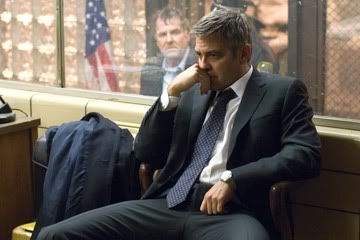
Michael Clayton (George Clooney) is a fixer. He's the guy lawyers go to when they need some messes cleaned up. These are the kind of messes that lawyers wish to turn a blind eye to, the kind that must be avoided in high-stake lawsuits. Clayton doesn't break the law, but he knows how to bend it a little. He knows when to talk to the right people and how to smooth certain details out. He's not entirely proud of what he does. Late one night at a poker game, Clayton gets a call on his cell phone because a client of his law firm needs help with a hit-and-run just committed by that said client. When the client bitterly states that he thought Clayton was a miracle worker, Clayton states that he's only a janitor. Michael Clayton shoots down the man's options and tells him how it is because sometimes the truth hurts.

After the encounter, Clayton takes a drive and ends up at a serenely empty field. He gets out of his car to admire some horses up on the hill, and gazes at them silently to clear his head. Behind him, his car suddenly explodes. And that's when the movie officially begins as we go back four days previous. A friend of Clayton's from the law firm, Arther Edens (Tom Wilkinson), has gone completely berserk as he stripped down during a Milwaukee deposition and ran naked through a snowy parking lot. Edens has been defending a pesticide company called U North, which is in the middle of a $3 billion class-action lawsuit because the product supposedly killed many of the farmers who used it. His disgust with the company led him to this outbreak and has caused him to be labeled a manic-depressive, where the fact is that he actually may have come across a huge revelation.

Michael Clayton is sent in to keep Arther Edens in line, but there is also U North's counsel at work, Karen Crowder (Tilda Swinton). This is a woman who appears to have everything together from her neatly pressed suit coats to the pearls around her neck. Underneath that, however, is a legal shark ready to make the kill as she hires two watchmen to keep an extra eye on Arthur Edens. The issue behind all of this is simple: The corporation is guilty and knows that it's guilty, and the law firm defending it knows that it's guilty, too. Arther Edens, however, holds the piece of evidence that could blow everything wide open, and there are people out there that realize he must be kept quiet.

But, enough of the legal stuff; the movie is named after its title role for a reason. Michael Clayton has a secret life, one that involves a desperate $75,000 debt after a failed attempt to open a restaurant. He's divorced and only gets to drive his son to school and see him on Saturdays. He's forced to get the money for his debt from the head of the law firm, Marty Bach (Sydney Pollack), who has a viciously dry acceptance of corruption. So, you see, Clayton has his own messes to clean up. He has to discover what his own options are and what his own priorities are, which leaves less time to figure out those of his clients. George Clooney is the perfect fit for this character that is never seen without wearing a full suit. He, too, on the surface appears to have everything in check. Clooney just gets better and better as he brings a deeply rich and layered performance as a conflicted man struggling with his own problems while a ruthless legal case swirls around him. Watch his face in the credits after he gets in a cab and tells the driver to just drive anywhere to get away; just in that short and seemingly insignificant scene, there's a whole range of emotions.

Tony Gilroy makes a superb directorial debut with "Michael Clayton." His previous work was writing the screenplay for all three "Bourne" films. What makes this film such a crackling and absorbing legal thriller is that Gilroy doesn't back out by dumbing anything down. Every nook and cranny in the tense case is fully explored with no details left behind. Every scene counts, including one of a conversation between Clayton and his son, along with a scene of watching Crowder stand before her mirror preparing a speech; they're both entirely effective in their up-close views. Clooney is also supported by three solid performances; these include Swinton, Wilkinson, and Pollack, all of whom provide vivid clarity to the psyche of their characters. Just watching Clayton and Crowder face-off in a searing final confrontation is satisfying all on its own.

As the title suggests, this is a film driven by strong performances portraying strong characters. George Clooney all on his own brings a rough-edged, somber feel to the affair and sets the tone from the start. Through its realism behind the characters, this is a drama that has connections to today's life and is mature, accomplished, and profoundly engrossing. The idea may seem like something you have seen before, but "Michael Clayton" reinvigorates the genre and makes it feel brand new all over again. It's a tale about how far corporations are willing to go, the underhanded violence they're willing to dish out, the law firms that help them get away with it, and the loss of humanity behind certain decisions and schemes; most of all, though, it's a glimpse at a man who's not only fighting for his case, but his soul. It's mesmerizing and one of the year's best.

Thursday, March 11, 2010

Archive: 'Burn After Reading'

Movie Review
Burn After Reading (2008)


After the Coen brothers' bleak Best Picture winner last year, "No Country for Old Men," they certainly have no problem returning to their previous form of dark screwball comedy. Their latest movie, "Burn After Reading," is a comedic thriller or a thrilling comedy, depending on which way you want to view it, but either way you put it, it's always difficult to place any Coen movie into a distinct category. Here's another example of their zany ways of using sharp wit to concoct something truly absurd and wild, and this time it comes in the form of a savvy caper farce.

The movie opens with a man named Osborne Cox (John Malkovich) getting fired from his job at a CIA headquarters due to being labeled as an alcoholic. Cox is the type of angry drunk who refuses to admit he has a drinking problem because he has the decency to at least wait for the clock to strike five o'clock. To his wife, Katie (Tilda Swinton), back at home, he claims that he quit and that he has decided to write a memoir. "Who would want to read that?" she bitterly responds. At the same time, she’s been sleeping with another man, Harry (George Clooney), a sex-crazed sleaze who has constructed a sex chair that you must see to understand. While he’s sleeping with Katie, Harry is also involved with a woman named Linda (Frances McDormand) who found her on a dating website. Linda's biggest desire is to have four simple surgeries done to improve her look but doesn't have the insurance to cover them. Meanwhile, she's also an employee at a gym called Hardbodies with her friend, Chad (Brad Pitt), who gets his hands on what he believes to be highly secretive CIA information.

It's a total riot to watch these A-list actors give everything they got and deliver performances that ooze with an absolutely contagious and exuberant amount of enthusiasm. They know what they're involved in is silly goof ball stuff, and that's what makes it all the more enjoyable. These actors provide entertaining and memorable characters, whether they're completely idiotic or just a downright asshole. McDormand connects with her go-getter attitude she presented in "Fargo" and has a quirky chemistry with Clooney who lets it all loose here. Malkovich is more pissed-off and funnier than ever, and Swinton is perfectly scalding. And then there’s Brad Pitt, who's new to any Coen production and somehow miraculously pulls off his gum-chewing, highlighted-haired, obnoxious puppy dog of a character. It's a breakthrough. There are also brief but excellent turns by Richard Jenkins ("The Visitor," "Step Brothers") as a seemingly levelheaded Hardbodies employee and J.K. Simmons ("Juno") as the CIA head.

So, there's definitely a lot going on throughout the movie, and the plot zips along and turns in on itself and comes out every which way. All of the characters eventually cross paths in one way or another and then there are some surprising deaths. It's all very dark, about as dark as any comedy is allowed to get while still being funny. All the characters involved in the random scenarios aren't necessarily very intelligent and sometimes drop to the level of sheer stupidity, and while some may find that aspect frustrating, I believe it adds to the overall loopiness of the ordeal. There's a constant lapse in communication between each character with far too many holes and gaps that aren't getting filled, and it makes for great hectic humor.

Just as the CIA head doesn't want to be called again until "all of this makes sense," the fact is that it never really does make any sense, and the whole movie ends on an abruptly ideal note. "Burn After Reading" is a more playful project for Joel and Ethan Coen, and it's definitely no award-winner, but it's still put together with clever perfection and a hilarious script. It's just one big entertaining romp through greed, vanity, and ignorance, and it is fantastic fun.

Wednesday, March 10, 2010

Archive: 'The Curious Case Of Benjamin Button'

Movie Review
The Curious Case of Benjamin Button (2008)


"The Curious Case of Benjamin Button" is a beguiling fantasy. Like "Synecdoche, New York," this is a film that closely observes life and aging in a fascinatingly original way. Very loosely based on F. Scott Fitzgerald's 1920s short story of the same name about a man who ages backwards, director David Fincher ("Zodiac," "Fight Club") and screenwriter Eric Roth ("Forrest Gump") have taken such a simple premise and transformed it into something marvelously cultivated and involving that works like a blossoming flower that progressively grows more beautiful. Through classical, straightforward storytelling, we're given a sweeping tale of a life lived in reverse. I have a feeling the Academy will eat this up. Not without good reason, though. It's a visionary piece of art, a technical wonder, and a timeless masterpiece.

Amazing digital special effects have been employed here to tell the most old-fashioned of stories. Benjamin is, for the most part, played by Brad Pitt. In his early years, which leave him looking like an old man in his 70s, Brad Pitt's features are superimposed onto aged, withered faces. From there, we're gradually revealed the strapping actor we're familiar with. Touches of makeup take care of Pitt through those middle years until one point we're introduced to him looking the way we haven't seen him look since his days of "Thelma and Louise." It's a grand visual accomplishment, and watching the transformation of Brad Pitt is in itself captivating. And the progression of those around Benjamin aging normally is equally well done.

The movie is a framed story and actually begins in 2005 when Hurricane Katrina is just about to hit a New Orleans hospital. It's here where an elder woman named Daisy (Cate Blanchett) lies on her deathbed, and her daughter (Julia Ormond) begins reading her the diary of a man named Benjamin, and it opens with this: "My name is Benjamin Button, and I was born under unusual circumstances." Born at the end of World War I in 1918, Benjamin Button's mother dies giving birth to him, and he is abandoned by his horrified father (Jason Flemyng). Oddly enough, the man eventually feels guilty and finds his way back into Benjamin's life, astonished at what his own son becomes. Benjamin is raised in an old folks' home by a generous black woman named Queenie (Taraji P. Henson) who claims him as her own. Benjamin first meets his lifelong love, Daisy, when they're both chronologically 7-years-old, but only Daisy physically appears so. She is fascinated by Benjamin and understands he's most certainly not an old man.

Soon enough, Benjamin journeys off on his own looking like a man in his 50s as he takes a job working on a tugboat. He meets his captain (Jared Harris) who longed to be an artist so covered himself in tattoos. Benjamin gets a break from the sea in Russia where he meets an older woman, Elizabeth Abbott (Tilda Swinton), who dreams of being the first woman to swim the English Channel. They spend many nights together in a hotel lobby, and it's the first time Benjamin is introduced to sex and love. And then, like a dream, she's gone. World War II then sneaks up on Benjamin, and he's back out to sea and then finally returns home again. These picturesque moments contain meticulous attention to detail and work like miniature episodic period pieces. Each era is given its own unique color palette and mood, which gives the film a very classy and old school style and look.

Daisy becomes a dancer in New York and starts traveling the world. The sad part about Benjamin and Daisy's romantic situation is that they're never allowed to grow old together. There are many gaps in their time together, and they don't officially hook up until the early 1960s back at the old folks' home. This time together is utterly magical, and as Daisy says, they meet in the middle. Their bodies finally correspond, and you can imagine the raw joy that brings. And then their ages continue going their separate ways, touching only for a brief moment in time. It's here where the film addresses its most delicate questions. What really lasts forever, and is anything ever really eternal? Does the poignancy of love lie within its impossibility?

As Benjamin Button, Brad Pitt gives the performance of his career. To go along with his physical transformation, he delivers something equally emotional and moving. It's a deeply thoughtful and subtle performance even behind all the makeup and CGI. There's a calmness to his performance, which rightfully inhabits this rare character we're watching. He understands his strange situation and acknowledges his fate, accepting the fact that a life is a life no matter which way you live it. Alongside Pitt is the always magnificent Cate Blanchett who truly is the soul of this movie. Her character may very well hold the biggest struggle of all, and Blanchett embodies it. Others, such as Tilda Swinton and Taraji P. Henson, are also excellent.

Yes, the movie is very long at nearly 3 hours, but a life this fascinating needs such an epic scope. And not once does this movie stop enchanting or intriguing. There's a good amount of sentiment, but it's never overbearing thanks to the direction of Fincher. Rather than dropping to pure sentimental goo, the movie turns to the more lyrical and poetic. It draws you in completely. And don't you just love those movies that speak a world of rich, resonant meaning to you? The ones that sneak up on you like that? Those movies that hold wonderful truths and, in the end, require the wipe from the back of your hand just beneath each eye? "The Curious Case of Benjamin Button" is one of those movies.