Showing posts with label willem dafoe. Show all posts

Saturday, March 8, 2014

THE GRAND BUDAPEST HOTEL Review


Wes Anderson's "The Grand Budapest Hotel" is a delightful farce, a wonderful romp and a screwball caper. It's fanciful and funny, but it's also perhaps Wes Anderson out-Wes Anderson-ing himself. I haven't seen everything out of the writer/director's canon, but I think I've seen enough, from his very best ("The Royal Tenenbaums," "Fantastic Mr. Fox," "Moonrise Kingdom") to his lesser efforts ("The Life Aquatic with Steve Zissou"). It's certainly safe to say since 2009's animated entry, he has solidified, even more than before, a stylistic signature. With "Grand Budapest," the film comes standard with all the tropes we recognize with characters and cameras only moving at right angles, framed in pretty little boxes, with swiveling, pivoting cameras and swooping zooms, tiny miniatures and a cast of familiar faces (Owen Wilson, Bill Murray, Jason Schwartzman). The filmmaker is who he is, and with this latest outing his style has been refined to pinpoint precision.

Set in a fictional European town in between the world wars, the story is told through the visit of a young writer (Jude Law) to the now rather decrepit Grand Budapest, long past its glory days in the 1930s. He meets a man named Zero (F. Murray Abraham) who recalls his extraordinary tale of when he was a young lobby boy (played by newcomer Tony Revolori) under the wing of head concierge Monsieur Gustave H (Ralph Fiennes). Fiennes excels in the role with rapid-fire poetics and dialogue, an operatic man who acts as if all the wrongs in the world can be righted with proper manners. Etiquette, above all, defines his charmed era, which he refuses to believe is soon coming to an end, with darker times on the horizon.

When we switch from the older Zero recalling his tale to back in the day, the film switches from widescreen to a 4:3 aspect ratio, and cinematographer Robert Yeoman uses both to great effect; most recognizably the latter as every shot is squared off and perfectly symmetrical. And it's all set to a bouncy, delectable score from mainstay Alexandre Desplat. The winding tale springboards from the death of the 84-year-old Madame D (a hilariously elderly Tilda Swinton), one of the many female residents of the hotel Gustave had relations with. At the reading of her last will and testament by Deputy Kovacs (Jeff Goldblum), it's discovered that the Madame left her most prized possession, a Renaissance painting called "Boy with Apple," to not her ruthless son Dmitri (Adrian Brody), but instead Gustave. This puts Dmitri in a fit of rage, along with his dastardly henchman Jopling (Willem Dafoe), a man so cruel he'd even throw a cat out the window.

Gustave and Zero steal the painting, which launches an extravagant manhunt led by an Inspector played by Edward Norton, not dissimilar to the Scout Master he played in "Moonrise Kingdom." Zero at the same time is falling for his true love, the sweet bakery girl Agatha (Saoirse Ronan) whose Mendl pastries come into smart play. It all gets a bit nuts and slapstick, but the production design pops, and the characters lay into the humor and fluffiness of it all. The absurdity reaches its peak during a prisonbreak that looks straight out of an old cartoon, led by a bald, tattooed Harvey Keitel. While for a second you might think there's no real depth of feeling, the darkness lurking beneath the candy-colored confection, like a sweet pastry from Mendl's, rears its head.

"The Grand Budapest Hotel" is like a wind-up dollhouse with so many trinkets and moving parts, it's a marvelous contraption. But with spurts of coarse language, shocking violence and the impending gloom of war, there's an important line from older Zero recalling his hero, Gustave: "He was a glimmer of civilization in the barbaric slaughterhouse we know as humanity."

Tuesday, June 22, 2010


EIFF Premiere: "My Son, My Son, What Have Ye Done?" (2009)

It's not that Werner Herzog's "My Son, My Son, What Have Ye Done?" is necessarily bad, it's just a film that is forever impenetrable. Just look at the title, and you know there's no getting past that. The movie is produced by David Lynch's production company Absurda, and that's understandable as this latest work from Herzog resembles a lot of what interests Lynch: elements of the absurd, the unconventional, the horrific, and most notably, the exasperatingly dumbfounding.

The plot revolves around a police procedural, but it is fueled by clues that lead to nowhere and a suspect who has already been found. It's a story based on facts from a true event in 1979, but Herzog is less interested for his story to follow the facts and much more interested in aiming the story toward a Lynchian-friendly audience.

Willem Dafoe plays a detective who leads the group of police officers arriving on the scene of the crime. He tackles the assignment with straight-faced seriousness no matter how crazy the circumstances. The crime alone is crazy as it involves a man named Brad McCullum (Michael Shannon of "Revolutionary Road") who killed his mother (Grace Zabriskie) with a rusty antique sword that was used as a prop in a theater production where Brad was supposed to play the lead part, a production that, yes, is about a son who kills his mother. Brad takes refuge in his house with two hostages while the cops surround his place outside. As Brad communicates with the police, he literally becomes part of the house rattling the front blinds as he shouts and opening the garage door like a burping mouth to toss objects out like a radio and a can of oatmeal that rolls down the driveway in a brilliantly shot sequence.

When Brad's future wife, Ingrid (Chloe Sevigny), shows up along with the theater director, Lee Meyers (Udo Kier), a series of flashbacks is prompted, and they end up taking up the majority of the running time filling in the gaps of when Brad might have decided to murder his own mother. There's something about him having a revelation during a trip in Peru. Another memory is of a trip to an ostrich farm run by Uncle Ted (Brad Dourif), a scene that has no connection to anything relating back to the San Diego crime scene but is nonetheless strangely fascinating.

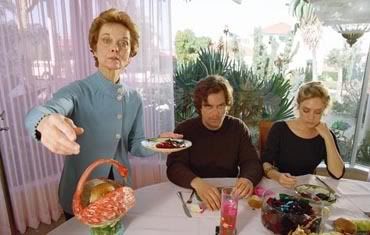
The film is filled with scenes and shots that evoke wonder and awe, but their connection to the narrative is nearly impossible to find. A moment with Brad and an escalator is magical, and any scene with the wonderful Grace Zabriskie (who appeared in Lynch's "Inland Empire") as Mrs. McCullum is astonishing. As Brad's mother, Zabriskie plays a woman who is so attached and loving to her son that you wouldn't think of her as evoking murder but maybe just annoyance. There is a moment where she hands Brad and Ingrid some refreshments and remains in the doorway waiting for their reaction. She stands for an uncomfortably long time shifting between two or three supernaturally eerie facial expressions and glances. A similar moment occurs during a long shot at the dinner table where Mrs. McCullum, Brad and Ingrid all stop moving and stare into the camera. What appears to be freeze frame is not as you can tell it's still real-time because the actors are shifting just ever so slightly, and this lasts for nearly a minute. What does it mean? Couldn't tell you, but I loved it anyway.

I can't say, though, that I loved "My Son, My Son, What Have Ye Done?" as a whole. I can't say I liked it, either. I liked Michael Shannon, though, who sure knows how to play insane. Apart from that, I can't say much about the film at all because I don't think any individual viewer has the rights to even begin contemplating what any of it means, and in the end, maybe that was Herzog and Lynch's intention. These two are the most interestingly unique and uncompromising filmmakers working today. While it could have been a match made in heaven, this jumbled experiment comes out being far too trapped inside the creators' heads. Maybe next time, guys.