Tuesday, January 4, 2011

Portman/Kunis Rom-Com Battle


"No Strings Attached" is a movie starring Natalie Portman and Ashton Kutcher about two friends who decide to have sex without a relationship.


"Friends With Benefits" is a movie starring Mila Kunis and Justin Timberlake about two friends who decide to have sex without a relationship.


It's happened again. We've entered 2011 and already there are two movies being released with the exact same premise. Why have these two seemingly inconsequential rom-coms caught my attention? Well, look at the leads.

One stars Natalie Portman, the other Mila Kunis. These two lovely ladies are clearly riding on the tailwind of their noteworthy performances in "Black Swan"--they're now in high demand. But why have these two taken a step backward into such territory rather than further expanding their boundaries as gifted actresses?

Natalie Portman is opposite Mila Kunis' ex-costar from "That 70's Show" meanwhile Kunis is opposite Justin Timberlake who is also riding the tailwind of his acclaimed performance in "The Social Network."

I think it would be a really funny joke if the twist at the end of both movies is that the actors from each make cameos in the other's movie. Portman gets with Timberlake while Kunis gets with Kutcher. Perfect!

Check out the trailer for "No Strings Attached" and the trailer for "Friends With Benefits," and ask yourself, which looks like the better mediocre rom-com?

"Friends With Benefits," at least in the trailer, appears to be kicking up the raunchiness and is shooting for an R-rating perhaps in the same vein as "Love & Other Drugs." This I can appreciate. "No Strings Attached" looks a little too tame.

In any case, only time will tell who comes out on top in the Portman vs. Kunis rom-com battle. Actually, there's no suspense there because it's probably neither.

Monday, December 27, 2010

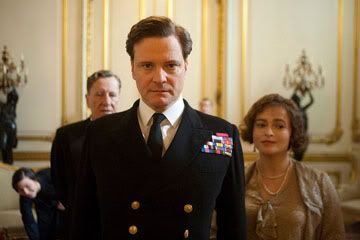
THE KING'S SPEECH Review


"The King's Speech" (2010)

I still believe Colin Firth deserved an Oscar for his role in last year's "A Single Man." This role in Tom Hooper's "The King's Speech," however, as the stammering King George VI is just as worthy. It's time for Firth to receive his Oscar now with two outstanding and memorable performances two years in a row. As in another film this holiday season, "The Fighter," we follow a real life person who needs to find his voice. He doesn't just need a family to listen, though; his entire country relies on his voice for reassurance in a time of need, a time when Britain is on the eve of war with Germany in 1939.

We begin with a man named Albert (Colin Firth), the Duke of York, before he is crowned king. It's 1925, and he is required to address the public at the British Empire Exhibition. He chokes on his words delivering a stuttering mess full of painful silences and stammering outbursts, a condition of speech he has lived with for as long as he can remember. It's only apparent now because of the public speaking demands of his royal position, and so he begins desperately seeking help from speech therapists. His wife (Helena Bonham Carter) thankfully stumbles upon a new possibility: a failed Australian actor named Lionel Logue (Geoffrey Rush) who takes his speech therapy practice very seriously. Geoffrey Rush delivers the film's other outstanding performance as the eccentric, expressive, clever and well-humored Logue.

The film is greatly about the give-and-take, lifelong relationship that forms between Albert, referred to as "Bertie" in the speech therapy sessions by the insistent Logue, and Logue himself. Logue realizes the only way to properly instruct as a therapist to royalty is to lower him to the same level. It's a method Albert finds deplorable at first but warms up to only upon realizing it's getting him the results he wants. He's beginning to speak better. These two roles are extremely well written from screenwriter David Seidler, and they work best when sparring with each other. Albert's sessions with Logue are the lively highlights especially during a scene where Logue suggests Albert shout vulgarities to get his words out, a scene that inappropriately earned the film its R rating. But this isn't the place to rant about the MPAA.

The need for Albert to get rid of his stammer gets elevated with more urgency as the stresses of the monarchy unfold. Albert's father, George V (Michael Gambon), frowns upon the dawn of radio technology forcing monarchs to place themselves into the living rooms of their people. Also because it prevents his preferred son from properly taking the thrown with security. The other son is Edward (Guy Pearce) who does take the thrown after the untimely death of George V but only briefly. He's in love with Wallis Simpson (Eve Best), an American woman twice divorced. She would not be accepted into royalty, so Edward's only choice is to flee. This leaves Albert to become King George VI.

This places pressure on both Albert as king and Logue now as a king's therapist, and through the interplay of their growing relationship against the ominous threat of the wider sphere where Hitler is gaining power in Germany, the film becomes a fascinating blend of personal drama and historical period piece, one about friendship, loyalty and bravery, thanks to deft direction from Tom Hooper ("The Damned United," HBO's "John Adams").

A rich supporting cast fleshes out the strength of the two leads including Michael Gambon and Guy Pearce as part of Albert's royal family and even Timothy Spall as Winston Churchill. Helena Bonham Carter is also magnificent as Albert's loving and sympathetic wife. We're used to seeing her in such dastardly roles as in the "Harry Potter" films, but here she is quite the opposite and quite lovely.

Cinematographer Danny Cohen captures the scenes in an interesting way with tight, narrow framing which is unique for a lush and historically accurate period piece. Best is when the frame is filled with Albert's horrified, sweaty face placed before a radio microphone, the red flashing light reflecting off his skin. This arrives when he must deliver his first wartime speech, the pivotal moment to all of which "The King's Speech" builds up. Hooper expertly handles this final scene which escalates in tension as composer Alexandre Desplat uses the grandeur of Beethoven's Seventh Symphony.

In this moment we absolutely feel the nerve-racking and pulse-pounding anxiety right there with Albert, a moment that boasts a walloping emotional impact. "The King's Speech" is about speech in two senses of the word. King George VI had to learn to control his speech in order to give the most importance speech of his lifetime.

TRUE GRIT Review


"True Grit" (2010)

This is the story of young Mattie Ross (Hailee Steinfeld), only 14-years-old, who wants to avenge the death of her father. He was ruthlessly killed at the hands of a man named Tom Chaney (Josh Brolin). Scrappy and resourceful, Mattie recruits a haggard old bounty hunter, Rooster Cogburn (Jeff Bridges), to help her in killing Chaney for what he has done. Cogburn reluctantly sets to go out on the journey with her and together they traverse the gunslinging western frontier on horseback.

"True Grit" is based on the novel by Charles Portis and a remake of the 1969 film of the same name where John Wayne won an Oscar playing the role of Rooster Cogburn.

It is a story already laid out to be told, and so this leaves Joel and Ethan Coen to work at their best. Nothing about the tale is too complicated. It is, at its core, a tale of good and evil, of what is right and wrong. It's all about the storytelling here, and allowing the Coens to tell it how they want, that's a thing of beauty. This is them casting aside their usual tricks and flexing their muscles in their mastery of the craft that is filmmaking.

And what they have lovingly crafted is a glorious western. With gorgeous cinematography we've come to know from Roger Deakins and a score from Carter Burwell that hits all the right tones, at the heart of it all is the rich dialogue that trails off like the twang of a guitar giving time for each and every line to settle in. It is a deliberately slow-moving movie in this respect, and so the best way to enjoy is to ease back with the pace and admire every detail.

I can't compare Jeff Bridge's Rooster Cogburn to John Wayne's Rooster Cogburn simply because I haven't seen it. I probably should. But, in any case, Bridges inhabits the role as the purposely growling and crotchety old actor should. He's perfect. With his crazy grey hair haphazardly slicked back and a patch covering one eye, his performance appears effortless. His inevitable Oscar nomination is well deserved, and right along with him touting what should be another nomination is the newcomer Hailee Steinfeld, 13, as Mattie Ross.

Steinfeld's impeccable skill in the role is presented early on during a lengthy scene where she barters with a rat of a horse trader (Dakin Matthews). She, using her swift words and intelligence, gets her way easily enough. It's a fantastic scene. Our introduction to Bridges' in his role comes to us in a similar fashion. In another lengthy scene, he's being questioned at a court trial, and his gruff responses and demeanor get us to believe that Bridges is an ideal fit for this man, Cogburn. The entire film, however, belongs to Mattie Ross. From the serene opening all the way through to the thoughtful and nostalgic epilogue, this is her narrative.

They enter increasingly dangerous Indian Territory in search of Chaney, Mattie bringing along with her who she calls the "one-eyed fat man." A Texas Ranger, LaBoeuf (Matt Damon), occasionally joins the search dropping in and out at pivotal moments. LaBoeuf is there to bag Chaney for a large reward, and this rustles Mattie's feathers because she paid Cogburn specifically to have Chaney captured and killed her way, nobody else's. Damon's performance here must not be forgotten as he carries great weight in a supporting role.

On the side of villainy is Josh Brolin as the nasty Tom Chaney along with Barry Pepper who plays Lucky Ned, a spitting leader of a gang Chaney ends up with. This leads to a charge across a barren valley with guns flaring and horse hooves stomping furiously. While "True Grit" has an emphasis on violence, some of which is quite graphic for being PG-13, and the grit and dirt of the Old West, it really leaves you smiling, which is one of its greatest feats.

This film is the first in the Coen brothers' career that is a straightforward exercise in a genre. It is a western, but it's not a reinvention of a modern western like "No Country for Old Men." There's humor, but it's not their usual humor. There's nothing wry, deadpan, quirky or strange as in most of their other movies. This is the directors using all they know, and know well, to tell a simple story with simple artistry. While "True Grit" is still unmistakably a Coen brothers movie, they have now officially transcended their own particular style and have done so with such distinguished grace. It's a film I fell in love with more than I ever thought I would, and I can't wait to see where they go from here.

Wednesday, December 22, 2010

THE FIGHTER Review


"The Fighter" (2010)

If it seems that Micky Ward (Mark Wahlberg) lacks a personality, it's because the rest of his family has enough personality to go around. There are moments during David O. Russell's "The Fighter" that we even forget the movie is supposed to be about Micky. He's a fighter all right, fighting in the world of professional boxing but also fighting above the influence of his boisterous family members including his mother Alice (Melissa Leo), his seven sisters and his older brother, Dicky (Christian Bale). Mark Wahlberg in the lead role does his character justice; there is strength in his quiet, reserved and seemingly impersonal performance. Sure he's passive but in his passivity he presents the core of his character's predicament: here's a family so hyped up to speak for him they don't let him speak for himself. His struggle is finding his own voice.

The movie is embedded in the American working class of Lowell, Massachusetts to tell the true story of Micky Ward. It's 1993, and we're placed in this sagging and worn down industrial town that is desperate for news and stricken with unemployment. Dicky Eklund is a local legend for the 15 minutes of fame he received back in the 80s when he beat down Sugar Ray Leonard in a boxing match. Or did Sugar Ray trip? It's a controversy that keeps the bruised underdog legend of Lowell alive. Dicky swears there's a documentary being made about his inevitable boxing comeback, but the cameras are following him for a different reason: his inevitable downfall.

Christian Bale is nothing short of phenomenal as the crack-addicted Dicky. We don't know he's a drug addict right away, but we realize something is wrong with him. His eyes bulge out of his head and dart around wildly, and his grin looks like something carved into a jack-o-lantern. We can tell he's an intelligent and skilled man, but it's all in decay now. Bale conquers the man's psychological and physical challenges and portrays them with ease.

Then there's their mother Alice who serves as Micky's manager who wants to bring him to the top and get him the best matches, but more often than not, it is she and Dicky as Micky's trainer that are unintentionally holding him back from success. Micky trying to tear away from his family, though, his blood, that's not going to happen. Melissa Leo is astounding as the chain smoking chatterbox mother who is a bit of a nightmare resembling the likes of Mo'Nique from "Precious" and Barbara Hershey from "Black Swan." Unwittingly aggressive and overprotective.

When another woman, Charlene (Amy Adams), a fiery bartender, steps into Micky's life over his mother, that's when things get ugly. The family becomes divided. Micky with Charlene and his soft-spoken but protective father (Jack McGee) against his hotheaded mother and brother. Amy Adams is cast against type here as we're used to seeing her playing the good girl. In a film full of throwing punches, she lands some of the heaviest blows when it comes to swinging her fists.

"The Fighter" is expertly cast, and the performances are all around outstanding making this a rousing ensemble piece. The best scenes are when these characters are all together butting heads like bulls. David O. Russell ("I Heart Huckabees") directs with a manic energy flipping rapidly from scene to scene. And while the movie is more exciting when it's outside of the ring, the fighting sequences are shot well in a grainy television style.

This is a movie that is more powerful in individual scenes than as a whole perhaps due to its confinement to the conventions of its genre. This is a sports movie about an underdog rising up in the world of boxing. It's a low-grade "Rocky." We've seen it before. For the most part, though, before that crowd-pleasing climactic knockout, Russell avoids the conventions and marks "The Fighter" as a solidly offbeat sports movie rather than the more typical one it turns out to be.