Showing posts with label charlize theron. Show all posts

Sunday, June 10, 2012

PROMETHEUS Review


The first image in Ridley Scott's "Prometheus" is a pale-looking superhuman man who is probably neither human or man. He stands on the edge of a cliff with some sort of spaceship far above him. Something horrific happens to his body, and he's cast into the water below with what appears to be cellular structures forming in the rushing water. Is this place Earth? Is this person or alien where humans came from? Is this showing us our beginning? From outer space?

Scott's first sci-fi feature since 1982's "Blade Runner" asks big questions about the origins of humankind. The promise is a deep existential journey with philosophical musings on God and meeting our maker. The problem with this quasi-prequel to his 1979 "Alien" is that the movie poses the questions, but the end result doesn't uphold the initial lofty ambition. In trying to expand his sci-fi classic into something more grandiose, an entire universe of possibility, he actually ends up taking a step back and muddling the story.

A spaceship named Prometheus heads toward an unknown planet following the discovery of a prehistoric star map by two scientists. They believe this distant location marks the spot where humankind was originally conceived. One of the scientists who made the discovery is an intelligent and brave woman, Elizabeth Shaw (Noomi Rapace of the Swedish "Dragon Tattoo" trilogy). She's a woman of faith but holds to the notion of a higher life form responsible for creating us. Shaw's boyfriend, Charlie (Logan Marshall-Green), is a fellow scientist who aided in the discovery. Together they get recruited to lead the mission aboard Prometheus, which is headed by a frigid corporate woman, Meredith Vickers (Charlize Theron in ice queen mode much like her role last weekend in "Snow White and the Huntsman"). She represents the company who funded the mission; they're not in it for the discovery, just the money.

We could've been satisfied with a top-notch thrill ride in space, but Scott and his writers Damon Lindelof (of TV's "Lost") and Jon Spaihts go for something bigger. This gives the movie a crippling split-personality disorder. On the one hand it wants to be a crowd-pleasing action-packed adventure full of ooey gooey guts galore and gross-out alien creature moments. On the other hand is the Terrence Malick aspirations, a minor version of "The Tree of Life," contemplating where life had its beginnings. Whether you go in expecting one or the other, either way you'll end up unsatisfied. Instead, we get left with an empty feeling of missed opportunity and disappointment.

And what more is a feeling of frustration in seeing just how well-produced the whole project is. What's inside the gift wrapping, however, turns out to be less so. You'll still feel like you're getting your money's worth because it sure doesn't look cheap, but the visual grandeur of it all becomes nearly disheartening to see all the wasted potential because it really is a technically profound and awe-inspiring film. The desired scope and sphere of the whole story, however, is never achieved. You may be fooled with breathtaking set pieces and some harrowing sequences of alien action, but these are only temporary distractions from the glaring plot holes, threadbare plot, incoherent narrative and countless unanswered questions.

What doesn't fail is the superb acting, most notably from Michael Fassbender as the on-board android, David. He's like a mobile and humanized version of HAL 5000 of "2001: A Space Odyssey." We're first introduced to him as he watches Peter O'Toole in "Lawrence of Arabia" carefully arranging his hair and speaking patterns to imitate the actor. Fassbender's performance here is a thing of beauty. He's restricted by a character unable to show true human emotion yet he uses subtlety to build up quiet menace and wit behind his robot's stiff frame.

"Prometheus" does kick itself up a notch in the end, and the last 30 minutes almost forgives what preceded. And if you walk away remembering one scene, it'll be the powerhouse of Noomi Rapace conducting self-surgery with an automatic operating table. It's a visceral and nerve-jangling scene that'll have you cringing and cheering. That moment alone proves this talented Swedish actress is going to have a prolific American film career.

Sunday, June 3, 2012

SNOW WHITE AND THE HUNTSMAN Review


Kristen Stewart is painfully miscast in this dark new vision of the Snow White fairy tale. There's a lot going wrong with our leading lady. In "Snow White and the Huntsman," she plays the title heroine all heavy sighs and mouth breathing. It's described that not only is Snow White the fairest of them all, she is also full of heart, energy and spirit -- all things Stewart's performance is not. She flat-out doesn't fit the role, and one must wonder if the actress ever will be able to escape "Twilight" mode.

This marks the first feature film from British commercial director Rupert Sanders, and he does deliver on his promise of taking the Snow White legend to its most sinister and harshest extreme. This is a brave re-imagining of the fairy tale, and the exact opposite of earlier this year's "Mirror Mirror." Visually speaking, the movie is a stunner with sceneries that are both bleak and gorgeous. Take the Dark Forest for example full of haunting creatures and deep fog, all which contrasts perfectly with an enchanting fairyland Snow White is later led to. This locale is full of lush greens and woodland creatures no doubt in tribute to Disney's 1937 classic animated film.

The film kicks off with a background story about the Evil Queen Ravenna (Charlize Theron) who married Snow White's father only to murder him and gain rights to the throne. This left young Snow White locked in a tower for years with her evil stepmother ruling as a ruthless and maniacal queen hated by all in the land. And now that Snow White is mature, she poses the only threat to Queen Ravenna's rule and requires her dead. All very intriguing, but it's once Snow White makes her escape when the storyline slams into a standstill. What the screenplay suffers from is a distinct slog in pacing.

The queen sends out the Huntsman (Chris Hemsworth) to seek out Snow White in the Dark Woods, apprehend her and bring her back to the castle. The strong, mead-guzzling hero swings an ax like nobody's business and upon finding Snow White, he realizes whose side he should be on and decides to help her defeat the queen. There's another man in the tale, as well; Snow White's childhood love named Prince William (Sam Claflin). The love triangle becomes apparent, and yet nothing comes of it. The relationship between any of these pivotal characters is left frustratingly ambiguous to the point of being completely moot.

Charlize Theron's snarling, vicious queen is by far the movie's biggest selling point. With a tall, spiked iron crown and ominous gowns, she brings a violent charge to even silent, simmering moments. And while she mostly triumphs, her yelling fits do tend to feel strained. When she asks her precious mirror on the wall -- a cloaked golden figure -- who's the fairest of them all, and it's Stewart over Theron, you can't help but wonder who paid him to say that. This is also a Snow White who's meant to rouse a kingdom to action, donning a suit of armor upon a white steed to lead a charge to the castle. This Joan of Arc replica is all the more unconvincing played by Stewart.

And we can't forget our dwarves, eight of them in this version. These aren't the kind of dwarves you'll be expecting, especially once you notice they're played by notable actors including the likes of Nick Frost, Eddie Marsan, Ian McShane, Bob Hoskins, Toby Jones and Ray Winstone. Through the magic of CGI, they are shrunken down to size and put into character. Yet I couldn't help but think how casting these gentleman rid real life acting dwarfs potential work. Isn't that discrimination?

If you could take the visual spectacle of "Snow White and the Huntsman" on its own accord, the film would act wonderfully as a breathtaking, fantasy epic poem. But at just over two hours, there has to be some acting and characterization accounted for. It's a harsh lesson both the evil queen and the movie should've took to heart: looks aren't everything.

Saturday, December 17, 2011

YOUNG ADULT Review


The re-teaming of screenwriter Diablo Cody and director Jason Reitman proves "Juno" was no fluke. Their collaboration with "Young Adult" is inspired, a scalding black comedy about the queen bitch in high school and everyone's worst nightmare -- except now she's 37 and returning to her hometown. The movie is cynical and goes down like a sour shot, but it's the year's most unexpected surprise by breaking every rule in conventional Hollywood storytelling.

Mavis Gary is played by Charlize Theron in a ferocious and raw performance. She is a protagonist that is completely unlikable and unsympathetic. She is unpleasant, cruel, condescending, delusional and fueled by a keen sense of self-destruction. Yet what's so remarkable is the way Theron ever so casually makes us -- with the help of Cody's fearless writing -- feel for Mavis.

She is relatively successful having moved out of her Midwest town now living in an apartment in Minneapolis. She writes young adult novels for a popular series but really is just a ghostwriter -- and the series is no longer selling. Her apartment is a pigpen, she spends every night slamming back bourbon, every morning chugging liters of Diet Coke to cure hangovers and is destined to be single forever. And while she moved away and feels superior to anyone back home, she still puts more thought into them than she lets on. Then she receives a mass email from her high school sweetheart, Buddy (Patrick Wilson), who recently had a baby with his wife. Mavis immediately becomes obsessed with the idea of going home and stealing Buddy back.

When Mavis first gets into town, she has a run-in with Matt (Patton Oswalt), a chubby geek from high school whose life was ruined from being the target of a hate crime. The media paid attention to it until they found out he wasn't actually gay, just mistaken for being gay. Patton Oswalt's Matt is pivotal to the movie's success. He is the cushion for all of Mavis' impossibly reckless behavior and provides a perspective we can agree with. Well knowing the hilarity and absurdity of Mavis' pitch black predicament with Buddy, he also sees she is just as miserable as him even if she fails to realize it. We recognize a sadness that she doesn't know is there. She can think the only reason she's hanging out with Matt is because he's the only one in town, but in fact they share a connection.

"Young Adult" plays out in a series of incidents that will have you crawling in your skin. Patrick Wilson has a tough job as Buddy playing a really nice, well-meaning guy who's desperately trying to not to offend or embarrass Mavis. It is, in some ways, a better movie than "Juno." It's more complicated and a whole lot harsher placing Diablo Cody not just as pop-savvy but a screenwriter of importance. In Mavis we're watching a humiliating train wreck, but one that is treated with honesty. In such we can't help but derive a bit of truth out of it, and more than a few laughs.

Sunday, April 4, 2010


Archive: "In The Valley Of Elah" (2007)

Paul Haggis certainly doesn't work on bad movies. He wrote the Best Picture winner "Million Dollar Baby" and co-wrote the Best Picture nominee "Letters from Iwo Jima." Most of all, he wrote and directed 2005's Best Picture winner "Crash." Now he's back as the writer and director of "In the Valley of Elah," a meditative observation on one of the most controversial issues of our time: the war in Iraq. The movie's title comes from the story of how David kills Goliath the giant with a well-placed stone between the eyes in the Valley of Elah. The child hearing the story asks if the young boy was scared facing such a monster like that; the monster being alluded to here is war. But I'm sure it also can be taken in numerous ways. This unsettling metaphor of America today defines the core of this essential and truly important movie.

At a glance, the movie could be viewed as a simple stateside murder mystery, but of course it builds into much more than that. Hank Deerfield (Tommy Lee Jones) is a retired military sergeant who hauls gravel for a living. One night as he is sitting in his Tennessee home, he receives a call about his son, Mike, who recently returned home from Iraq but has gone missing. With hardly a word to his wife, Joan (Susan Sarandon), Hank packs up and heads to Fort Rudd in New Mexico to shed more light on the issue. Once at the base, however, none of Mike's buddies know anything about him or where he is; neither they nor any officers are willing to answer any of Hank's questions. He searches Mike's room and while pretending to take a Bible from his drawer, he swipes a cell phone that is fried from the heat in Iraq. The videos taken on there are salvaged by a local street hacker, however, and he sends them along one by one. They each provide haunting insight into what goes on over there; it's a glimpse into a world of bizarre chaos and destruction.

Shortly after checking into a cheap motel and taking a look around the local area, Hank soon learns the painful truth about his son. He is taken to a spot by the side of a dirt road right outside the base where charred pieces of a body are scattered; these remains are identified as what's left of Hank's son. The videos taken by Mike are now used by Hank as any clue to why he might've been murdered, along with other clues leading to plenty of visits to topless bars and a chicken shack. The Army investigators want to sweep the crime scene under the rug because it'll make them look bad; the local cops, meanwhile, are apathetic because the terms of whose jurisdiction the investigation is under are too muddy. Hank does receive help from Detective Emily Sanders (Charlize Theron), however reluctant she may be. Hank attempts to head the investigation himself and gets aggravated at the carelessness of Sanders' colleagues. His veteran sleuthing is driven by a broken father's rage and pain, and it carries a heavy resonance.

To explain the rest of this police procedural would be ruining the movie's persistently engaging tension. It would also suggest the fact that the movie is no more than a conventional crime thriller, which is not at all the case. The screenplay intelligently and excellently sidesteps that by not having all of the characters heightened as they would be in any other police thriller. Emily Sanders isn't necessarily working for or against Hank Deerfield. She is merely a woman doing her job to the very best of her ability. She isn't sexy, she doesn't have any attraction with anyone, she ignores the abuse at work, and she cares for her son at home. Hank isn't any sort of hero and isn't trying to be. He's simply trying to understand war and why it has ruined two of his sons. Then there's his wife, Joan, who is a mother rightfully crushed but not overly manic. There's a scene where Hank reveals the troubling news about her son to her over the phone, and she reacts with such despair and sadness that is gut-wrenching in its realism.

"In the Valley of Elah" works so well because of an affectionately realized performance by Tommy Lee Jones along with the tone he creates, which permeates throughout the entire film. His face is constantly solemn and contemplating. The lines under his eyes show a man who is constantly concerned and under pressure. And when he talks, there is an authority in his voice that demands he be listened to and understood. This is one of the best performances of his career because it's a role with knowledgeable experience behind it. Charlize Theron also gives a deserving performance as a woman who is in constant struggle with herself in the course of trying to help somebody else. And then there's Susan Sarandon who packs in heartfelt emotion in the brevity of her scenes with her pools of welling tears for eyes.

There's a lot going on underneath the movie's deceptively quiet surface in terms of trying to understand the consequences of the war in Iraq. None of it is too heavy-handed, and nothing here flat-out states that there is opposition to the war. Anybody who says that the movie is blatantly anti-war really wasn't watching close enough. The war in Iraq isn't so much immediately used an idea, but more so just as a setting because the majority of the movie involves the search for Hank's son. It's through that setting in which the theme about the war is brought about, and that is the beauty of the film's construction. There's definitely something to be about war transforming our soldiers and sucking the humanity out of them, and how that reflects upon us as a nation.

Is "In the Valley of Elah" in the running for being a Best Picture nominee? In a word, maybe. It depends on whether or not this is the type of film the Academy is looking for, and it also depends on what else there is out later this year. I wouldn't mind seeing it on the list because it is an entirely worthy one. It seems that whenever Paul Haggis makes a film, he has something to say, and the question is whether or not the Academy is ready to award a powerfully impactive film such as this; however, they did do it for "Crash," which addressed the tension amongst racist stereotyping. "In the Valley of Elah" is a movie that becomes entirely essential. It tackles a real subject that truly means something and approaches it with good taste along with shrewd and sorrowful storytelling as it questions, observes, and heals.

Thursday, March 11, 2010

Archive: 'Hancock'

Movie Review
Hancock (2008)


In this surprisingly bizarre summer diversion, Will Smith puts himself up in line for yet another Fourth of July weekend at the box office. It'll probably do just fine as there's enough here to keep audiences happy, but that's also where the movie's biggest problem comes into play. "Hancock" has a severe case of split personality disorder. While trying to deliver all of what audiences crave for in their dose of summer flicks, the filmmakers here take a moderately promising premise and let it plummet to the ground. There are two movies here, which are both kind of good on their own. The issue is when the two get mashed together making for a result that just isn't so great.

Will Smith plays John Hancock, a superhero that nobody likes. He's a disheveled drunk, sleeping on benches in the street while bad guys fill Los Angeles. By older people and kids alike, he's referred to as an asshole. Those people learn quickly that Hancock really doesn't like being called an asshole. When Hancock does get roused to action, he flies around hungover, bottle still in hand, and haphazardly "saves the day," which sometimes involves piercing an SUV full of crooks through the top of a skyscraper or saving a stranded whale by heaving it onto a yacht. For probably the first time in movie history, we are introduced to a superhero who's an anti-superhero. Hancock is avoiding a series of subpoenas and lawsuits, and the public generally loathes him because even when he's saving somebody, he leaves a path of destruction in his wake. But Hancock's going through his own stuff, too. He doesn't remember how he got where he is or even who he is, hence the generic name John Hancock. He just woke up in the hospital with extraordinary powers.

And then one day Hancock saves a PR named Ray (Jason Bateman) from a speeding train even if he wrecks his car and driveway in the process. With Ray's own business goal to make the world a better place failing on him, he decides to assist Hancock in giving him a better image. Now, so far, this is all very original and promising and a good start for the movie, and I couldn't help but wonder where it could possibly go next. Ray has Hancock surrender to doing time in jail figuring that the public will eventually need his superhero services. And so, when the call for duty comes, Hancock gives himself a shave and dons a sharp, black leather suit. He's a newly rehabilitated man, or at least trying his best to be. That's all very well. What next?

Enter Ray's wife, Mary (Charlize Theron), who spends the first half of the movie glaring at Hancock after Ray asks him over for dinner as a thank you. Let's just say there's a lot more to her than that stink eye she's got going on, and that's when the movie takes a totally unexpected turn and completely disregards everything else you just previously witnessed. Hancock, the sarcastic, rude, screwed up guy who had a deep inner emotional conflict turns into Hancock, the guy who finds himself all over again and learns a thing or two about life, responsibility, and the importance of loyalty and togetherness. Will Smith had fun while it lasted, but everyone knew he couldn't go on for that long being the bad guy.

Rather than focusing on Hancock's transformation, the focus is placed on too many subplots that make the whole movie extremely choppy, uneven, and ultimately incoherent. The end result really makes no sense leaving the final act to lack any powerful impact. It seems that everybody on screen is a whole lot more emotionally involved than the people watching; I'm guessing they were just waiting for Will Smith to destroy more stuff. Director Peter Berg and writers Vincent Ngo and Vince Gilligan struggle to find a balance of tone as they abandon the quirky humor that kicked the movie off and go for something heavier. Superheroes are the modern day implications of the existence of gods and angels? Oh, all right.

Will Smith is a fine actor, and he makes Hancock a much more layered character than the screenplay requires. Jason Bateman doesn't make a false move and does the subtle humor very well. Charlize Theron, too, places herself alongside Smith and matches him in several scenes. It's just the material isn't all there to support the cast. They're grasping for straws here and the movie leaves them short. There are some nifty special effects, though, even if they do go by in a flash. "Hancock" is basically an interesting premise that runs out quick and splits violently on itself. It's not quite the retooling of a superhero movie we're looking for. We've got plenty of other better options for that. "The Dark Knight," anyone?

Saturday, November 28, 2009

A Man And His Boy Against All Odds

The Road


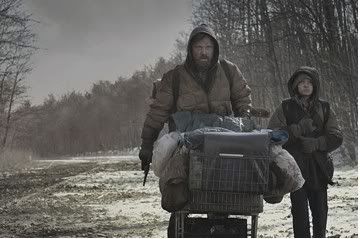
This is the journey of a Man (Viggo Mortensen) and his Boy (Kodi Smit-McPhee) at the end of the world. The Man "carries the fire," and teaches the Boy well throughout their time together, a bonding that thoroughly proves the undying power of love alone. It's what keeps them going and what keeps them alive. The Man is surviving in order to fulfill the obligation he feels he owes to his son. They represent a minority in the world, whether it's after the world's demise or otherwise, and it's this minority who chooses to be righteous against chaos and evil. This ideology is similar to "No Country for Old Men," and rightfully so as that and this film, "The Road," are both adaptations of novels by Cormac McCarthy, this time from his Pulitzer Prize winner from 2007. Like the Coen brothers, director John Hillcoat ("The Proposition") does a fine job at interspersing McCarthy's restrained and beautiful prose into his adaptation. It's what makes this post-apocolyptic movie much more poetic than, say, "2012."

This isn't a disaster sci-fi affair as the actual cause of the world ending is left up to ambiguity. Fires raged, but we don't know why. There are sporadic earthquakes without explanation. Only flashbacks give us any clue to the past and what happened (disease, war, or worse?), and they're shot in sunlight, a stark contrast to the grey, fog-covered world the Man and the Boy drift through in present day. Hillcoat keeps his scenery real and grounded as there are minimal special effects with sparse landscapes of Pennsylvania, Oregon, and Louisiana used to convey an empty, desolate place with abandoned vehicles on the roadside and towns turned to wreckage.

In the flashbacks there is the Man's wife (a reserved and glowing Charlize Theron) who left them when things got too rough. She chose death over a life not worth living, and as McCarthy's words state, "She was gone, and the coldness of it was her final gift." This leaves the Man and the Boy alone in a world of people turned evil, and the film is correct about showing how such circumstances turned modern society to complete savagery. The only thing scarier than knowing you're the only ones left is knowing that any other group you run into is more likely an enemy than a friend. The Man and the Boy come across cannibals who resemble flesh-eating zombies from horror movies, except this time the horror is their reality. A scene inside the basement of an old house will leave you breathless.

The Man and the Boy are traveling with two bullets in a handgun and a shopping cart with sparse amounts of food to a mythical coast that promises a blue expanse of escape. Escape from what is unclear, but the point is that it's a goal, something for which to reach. Along the way, they come across a wandering traveler like themselves. This man is on the verge of collapse and covered in dirt and grime. He can't ask for death because "it's foolish to ask for luxuries in times like these," he says. The man is played effortlessly by Robert Duvall as a man who speaks in only tongue and riddles. These are people who live in a constant state of weariness, alert, and fear.

Viggo Mortensen is unstoppable in the vast roles he has played. From a Russian mobster in "Eastern Promises" to a Middle Earth warrior in "Lord of the Rings," his range is endless. Here is a demanding and affectionate performance from him, and he brings striking realism to a man exhausted to death but not lacking a soul and a heart in the right place toward his son. They are not sympathetic together, but rather, real. A young actor named Kodi Smit-McPhee plays the role of the boy, and he is deeply convincing.

Amidst all the doom and gloom "The Road" provides in ample dosages there is an ending note of optimism and hope that is refreshing and welcoming. In this respect John Hillcoat's film acts as a proclamation of the life-affirming power of the human spirit, but we've also heard that once or twice or too many times before from more memorable movies. This is a good movie, but it doesn't resonate with importance like it wishes. While impressive, it falls just short of being the Oscar-bound masterpiece it originally aspired to be.