Showing posts with label tommy lee jones. Show all posts

Monday, January 28, 2013

19th Annual Screen Actors Guild Award Winners


The Golden Globes turned out to be more of a prognosticator for awards season as this weekend reaped more awards for Ben Affleck's "Argo." The Best Picture nominee which, after Oscar nomination morning in the wake of Affleck's Best Director snub looked down for the count, is now the easy front-runner to win. And this comes after the film's win from the Producers Guild of America and Sunday night's Best Ensemble win at the 19th Annual Screen Actors Guild Awards.

While a Best Ensemble win at the SAGs doesn't always mean a boost for Best Picture potential (see last year's win for "The Help"), it certainly does mean something when the picture is busy picking up other accolades, as well. And also when it was widely expected that other more actor-oriented films like "Lincoln" or "Silver Linings Playbook" would've nabbed the top SAG prize. "Argo" is giant right now and could likely become the first film in a very long time to win Best Picture without its director not only winning but not even earning a nomination.

Now it's pretty much guaranteed Ben Affleck will also be winning the Directors Guild of America, too. Where does that leave the Oscar director race? David O. Russell? Steven Spielberg? Ang Lee? Hard to say.

Three acting categories are locks after Sunday's ceremony. Anne Hathaway for "Les Miserables" will take Best Supporting Actress, Jennifer Lawrence for "Silver Linings Playbook" will win Best Actress (in a tight race against running-mate Jessica Chastain for "Zero Dark Thirty") and Daniel Day-Lewis for "Lincoln" will win Best Actor.

Tommy Lee Jones winning Best Supporting Actor for "Lincoln" gives him a boost while Christoph Waltz for "Django Unchained" (not nominated for a SAG) won the Golden Globe. It's pretty much a toss-up between the two as I could see the academy going for either.

I'm thrilled about the awards success of "Argo." It's a great movie, Ben Affleck deserves the praise as a young and talented actor-turned-director (especially in light of that impossible-to-ignore Oscar snub) and it makes for a wild comeback story for Oscar history.

Check here for a full list of winners from the 19th Annual Screen Actors Guild Awards.

Wednesday, December 12, 2012

19th Annual SAG Award Nominations


David O. Russell's "Silver Linings Playbook" made an impressive appearance this morning with four SAG award nominations during the announcement for the 19th Annual Screen Actors Guild Awards. Both of its leads, Jennifer Lawrence and Bradley Cooper, as well as a supporting nod for Robert De Niro and a Best Ensemble nomination made up the four total. Tying at four was Spielberg's "Lincoln" with nominations in the same categories for Daniel Day-Lewis, Sally Field, Tommy Lee Jones and the cast.

Along with "Silver Linings" for Best Ensemble, the nominated films were "Lincoln," "Les Miserables," "Argo" and "The Best Exotic Marigold Hotel" which gives the latter film a slight edge toward a possible (but still long shot) Best Picture nomination. The obvious snub here is for "Zero Dark Thirty" which has otherwise been getting plenty of accolades.

The Best Actor nominations here pretty much affirm what we'll see for the category at the Oscars. That is, the usual suspects with John Hawkes for "The Sessions" and Hugh Jackman for "Les Miserables" getting in over the likes of previous contendor Joaquin Phoenix for "The Master."

Best Actress got a bit of a shake-up with Helen Mirren for "Hitchcock" and Naomi Watts for "The Impossible" re-emerging over two major snubs for Quvenzhane Wallis for "Beasts of the Southern Wild" and Emmuanelle Riva for "Amour." Somehow I can't see this overlook happening come Oscar nomination morning.

And it looks like we may have our very first Bond villain make its way to an Oscar nomination in the Best Supporting Actor category. Then again, never before has a Bond villain been played by the entirely capable Javier Bardem. The actor received another nod for his turn in "Skyfall," extending his reach to Oscar potential. This, however, meant that Matthew McConaughey for "Magic Mike" got edged out.

Sneaking their way into Best Supporting Actress were Maggie Smith for "The Best Exotic Marigold Hotel," which is a fine inclusion to the category, but then also Nicole Kidman for her raunchy, twisted turn in "The Paperboy." That's a tiny miracle for the film, and there must've been a big campaign behind her. This meant not including the possible contendor of Ann Dowd for "Compliance," but more notably a pretty big snub for Amy Adams in "The Master."

The biggest thing we can walk away with here is that "Zero Dark Thirty" suddenly just hit a wall with only one nomination for its lead, Jessica Chastain. This, however, could all get rectified come Globe nominations tomorrow morning.

Check out the full list of nominations, and be sure to tune in to the 19th Annual Screen Actors Guild Awards on Sunday, January 27 at 8 p.m. on TNT and TBS.

Wednesday, November 28, 2012

LINCOLN Review


There's a point in watching Daniel Day-Lewis as our 16th president of the United States where you realize you're not just watching an actor portrayal. You are watching a man disappearing behind a historical figure, an icon of American history. You stop seeing Daniel Day-Lewis. You see Abraham Lincoln. Never again will an on-screen representation of him be so close, so real and so accurate. And it all starts with that voice. The voice Day-Lewis decided to inhabit the president with is nothing short of brilliant. The legend and lore of Lincoln brings to mind a deep, booming voice. History tells us otherwise, and the master method actor brings this richly to life. Before this film, Lincoln was a figure, a representation, an idea. Now, there's a man to go with it.

Instead of the painterly, picturesque puffery of last year's "War Horse," Steven Spielberg directs "Lincoln" with refined understatement. He allows the densely packed script from Tony Kushner ("Angels in America," "Munich") speak for itself, which was expertly crafted from Doris Kearns Goodwin's "Team of Rivals." Full of monologues, heated debates and strategic discussions, the movie documents the final months of Lincoln's presidency leading up to the passing of the thirteenth amendment and his tragic assassination at Ford's Theatre. The beauty in the collaboration is that it works like a time machine transporting audiences effortlessly to the 19th century, a time when the Civil War raged on and worry surrounded Lincoln's re-election.

Longtime Spielberg cinematographer Janusz Kaminski shoots "Lincoln" full of dark interiors and light spilling in through windows and curtains. Only a few shots are outside, and the only piece of battlefield action is in the film's first fleeting moments. For the majority of its two-and-a-half-hour running time, the film is a lesson in history -- and I mean that in the best way possible. It's smart, and you feel smart watching it. It can drag and does take a bit to get settled in with its vast cast of characters and familiar faces, but once we first enter that House of Representatives, the rewards for your attention and perseverance are immense.

The supporting crew is a laundry list of names and faces audiences will recognize. The main players are Joseph Gordon-Levitt as Lincoln's eldest son, Robert; David Straithairn as Secretary of State William H. Seward, Lincoln's right-hand man; Tommy Lee Jones as the hot-tempered radical liberal Thaddeus Stevens, a fervent advocate of black rights; and Sally Field as Lincoln's wife, Mary Todd. But that's only the beginning. James Spader, Hal Holbrook, John Hawkes, Jackie Earle Haley, Lee Pace, Jared Harris and  Michael Stuhlbarg among many other actors play strong supporting roles to give this moment in history real drama and life.

Casting Sally Field as the impassioned Mary Todd was inspired, as the veteran actress shows us the 16th president's wife as both indignant toward and admirable of her husband. Likewise, Tommy Lee Jones brings a weathered yet tough energy to Thaddeus Stevens whose private secret reveals his personal connection to Lincoln's cause. Both of these seasoned performances will be nominated alongside Day-Lewis.

All of this, all of "Lincoln," it all circles back to Day-Lewis. The scenes of him speaking to his Cabinet are captivating. He plays Lincoln with a quicksilver spirit that is ideal to the president's lore and how well-loved and appreciated he was by his party members. He has all the patience in the world, idling by and telling long stories -- but he also has his moments where he doesn't see what he knows needs to be done getting done. And when he slams that fist of his down on the table and asserts his power, you'll get chills. If nothing else, Steven Spielberg's "Lincoln" could likely restore your faith in American politics.

Monday, August 20, 2012

HOPE SPRINGS Review


For those craving a departure from the usual summer movie fare, "Hope Springs" is a pretty good alternative. And for those wanting to see Meryl Streep's first role in which she acknowledges herself as a perfectly average older woman, this is it. Even in another romantic comedy, "It's Complicated," she had a youthful bounce. This is Streep's "The Bucket List," the one where Jack Nicholson and Morgan Freeman officially stamped themselves as senior citizen actors in 2007. Have no fear, however, as this is no "Bucket List." From director David Frankel ("The Devil Wears Prada"), Streep shines alongside fictional spouse Tommy Lee Jones in this realistic and touching look at a marriage stuck under the weight of time and without any spark left.

Within the confines of potentially stuffy material, Streep breathes life into Kay, a woman who too long ago became complacent in her 31-year marriage. She stopped seeking attention from her husband, Arnold (Tommy Lee Jones), who otherwise has become preoccupied with his job, meals and the golf channel. All intimacy is absent, as well, with them no longer kissing, touching or hugging, and even sleeping in separate beds in separate rooms. Their life has become an unchanging routine, and the movie begins right as Kay realizes she desperately wants change.

Kay signs them up for intensive couples counseling in the quaint, postcard-ready town of Great Hope Springs, Maine with marriage expert Dr. Feld (Steve Carrell). Rather than suggesting the idea to Arnold, Kay tells him she bought plane tickets and hopes he will board the flight with her. Of course Arnold doesn't take kindly to this idea. Not realizing there's anything that needs fixing, he figures why disrupt the peace. Huffing and scowling all the way, he reluctantly agrees to go. Tommy Lee Jones is really the one to watch here as he presents Arnold as a stubborn and angry man, giving a performance we never knew he could. While stern, he also shows vulnerability slowly revealing more layers to Arnold's stonewall exterior.

Majority of the running time is spent inside Dr. Feld's office where Steve Carrell plays the compassionate counselor perfectly straight, no trace of comedy. With Carrell providing zero of the movie's humor (which stems from Streep and Jones only), he does two things. He gives Kay and Arnold the platform to sort through their issues for not only them but the audience, as well. With them both so visibly uncomfortable talking about their sex life, we begin to see how their marriage slumped into its current state. The screenplay from Vanessa Taylor is sharp in these instances but can also feel claustrophobic and sluggish at times. The other thing Carrell does is show a possible turning point for his career post-"Office" days.

"Hope Springs" is just three characters the whole time with only a glimpse into Kay and Arnold's family and outside life. Interaction with more people and a slightly larger scope would've given the movie more stretching room and made it feel less slight. Worth watching, though, is Streep and Jones, especially during a charming and hilarious movie theater scene where the couple tries something way outside their comfort zone. What's more is that this isn't just about a 20-plus year marriage crisis -- it's more universal and through the outlet of this couple reaches to themes about seemingly small problems in life that can grow to something more painful and permanent.

Saturday, July 23, 2011

CAPTAIN AMERICA: THE FIRST AVENGER Review


"Captain America: The First Avenger" (2011)

Joe Johnston's "Captain America: The First Avenger" is the last of the Marvel superhero movies before the big collaboration of next summer's "The Avengers," and it couldn't be any more obvious. What follows in the next paragraph is my major gripe with this movie and I guess what you could call spoilers. Consider yourself warned.

I actually quite enjoyed "Captain America" until the end credits came along. Samuel L. Jackson made his obligatory appearance as Nick Fury to let us know yet again that an Avengers movie is on the horizon. Not like we haven't been beaten over the head with it already in "Iron Man," "Iron Man 2" and "Thor." Not only does he show up, but at the end of the credits we're given a full-blown teaser trailer for "The Avengers." It just makes me sick of Marvel's agenda as a whole. Here we're given this rather well thought out superhero flick, and then the whole experience is cheapened because we're forced to see that, oh wait, there's more on the way! So, there's "The Avengers," and then each of these superheroes are going to, of course, have their own sequels, too. I just can't help but wonder when the fad is going to end.

Anyway, back to the movie at hand which I'm still struggling to view as standalone entertainment. The point -- and the problem -- is that I don't think we're supposed to be viewing it as standalone entertainment. Nonetheless, the entertainment it does provide is a pleasantly stupid, hokey and wholesome throwback. It's complete with a courageous but conspicuously square hero at its center, a lovely dame, a seasoned veteran military officer, a genius scientist and an evil super villain.

Chris Evans has fine screen presence, but as Captain America he's perfectly vanilla. With blond hair, blue eyes, big muscles and a bit of a dopey yet courageous demeanor, Evans does what he can to bring the character to life. What he becomes, however, is just OK and can't make it his own as Robert Downey, Jr. or even Chris Hemsworth did. He gets the all American spirit down pat with an old-fashioned patriotism that actually feels just right. And he sure wears his uniform well swinging around his powerful stars-and-stripes shield like it's a deadly Frisbee.

Before Captain America becomes the iconic hero of WWII, though, he used to just be skinny Steve Rogers who wasn't able to enlist in the army. After being chosen as a part of a super soldier project by Dr. Erskine (Stanley Tucci), he's instantaneously transformed and ready for action. Seeing Chris Evans before his bulked-up self as a 90-pound little guy was a bit startling, but the CGI was convincing. Destined for great things, Rogers instead gets thrown into performing acts to get people to buy bonds for the war. He dons an early version of his Captain America suit strutting around with red, white and blue ladies singing "Star Spangled Man." It's a fun moment encapsulating the film's retro feel while giving Rogers his superhero name and an incentive to drop the act and go fight the war on his own terms.

Captain America earns the respect and help from Peggy Carter (Hayley Atwell) who is a love interest but feels like a more imperative love interest than most. She has the brunette bob, bright red lips and sharp uniform to make her the ideal pin-up military woman. There's also the hardheaded Col. Phillips played by Tommy Lee Jones who seems angry and bitter the whole time, and I couldn't tell you if that was him in character or just him showing up to pay for the bills. Our villain is a vile Nazi commander named Johann Schmidt (Hugo Weaving) who creates his own regime surpassing even that of Hitler. Hugo Weaving does Nazism well, especially when he rips off his skin and presents his true form of a hideous red skull giving him the obvious nickname of Red Skull.

The action is swift, the effects are nice, the story is solid -- and through it all we meet the engineer named Howard Stark (Dominic Cooper). He assists with Dr. Erskine's research, but more importantly we're aware that he will be the father of Tony Stark, or Iron Man. This brings us back to that Marvel collaboration--the blatant reason Joe Johnston's pretty good superhero flick exists. Maybe it's clever, maybe it's cool, but me? I found it pushy. But hey, at least Captain America has a neat origin story taking place in the 1940s. It was a smart decision to keep in that spirit, but I can't help but wonder how he's going to adapt to the 21st century.

Sunday, April 4, 2010


Archive: "In The Valley Of Elah" (2007)

Paul Haggis certainly doesn't work on bad movies. He wrote the Best Picture winner "Million Dollar Baby" and co-wrote the Best Picture nominee "Letters from Iwo Jima." Most of all, he wrote and directed 2005's Best Picture winner "Crash." Now he's back as the writer and director of "In the Valley of Elah," a meditative observation on one of the most controversial issues of our time: the war in Iraq. The movie's title comes from the story of how David kills Goliath the giant with a well-placed stone between the eyes in the Valley of Elah. The child hearing the story asks if the young boy was scared facing such a monster like that; the monster being alluded to here is war. But I'm sure it also can be taken in numerous ways. This unsettling metaphor of America today defines the core of this essential and truly important movie.

At a glance, the movie could be viewed as a simple stateside murder mystery, but of course it builds into much more than that. Hank Deerfield (Tommy Lee Jones) is a retired military sergeant who hauls gravel for a living. One night as he is sitting in his Tennessee home, he receives a call about his son, Mike, who recently returned home from Iraq but has gone missing. With hardly a word to his wife, Joan (Susan Sarandon), Hank packs up and heads to Fort Rudd in New Mexico to shed more light on the issue. Once at the base, however, none of Mike's buddies know anything about him or where he is; neither they nor any officers are willing to answer any of Hank's questions. He searches Mike's room and while pretending to take a Bible from his drawer, he swipes a cell phone that is fried from the heat in Iraq. The videos taken on there are salvaged by a local street hacker, however, and he sends them along one by one. They each provide haunting insight into what goes on over there; it's a glimpse into a world of bizarre chaos and destruction.

Shortly after checking into a cheap motel and taking a look around the local area, Hank soon learns the painful truth about his son. He is taken to a spot by the side of a dirt road right outside the base where charred pieces of a body are scattered; these remains are identified as what's left of Hank's son. The videos taken by Mike are now used by Hank as any clue to why he might've been murdered, along with other clues leading to plenty of visits to topless bars and a chicken shack. The Army investigators want to sweep the crime scene under the rug because it'll make them look bad; the local cops, meanwhile, are apathetic because the terms of whose jurisdiction the investigation is under are too muddy. Hank does receive help from Detective Emily Sanders (Charlize Theron), however reluctant she may be. Hank attempts to head the investigation himself and gets aggravated at the carelessness of Sanders' colleagues. His veteran sleuthing is driven by a broken father's rage and pain, and it carries a heavy resonance.

To explain the rest of this police procedural would be ruining the movie's persistently engaging tension. It would also suggest the fact that the movie is no more than a conventional crime thriller, which is not at all the case. The screenplay intelligently and excellently sidesteps that by not having all of the characters heightened as they would be in any other police thriller. Emily Sanders isn't necessarily working for or against Hank Deerfield. She is merely a woman doing her job to the very best of her ability. She isn't sexy, she doesn't have any attraction with anyone, she ignores the abuse at work, and she cares for her son at home. Hank isn't any sort of hero and isn't trying to be. He's simply trying to understand war and why it has ruined two of his sons. Then there's his wife, Joan, who is a mother rightfully crushed but not overly manic. There's a scene where Hank reveals the troubling news about her son to her over the phone, and she reacts with such despair and sadness that is gut-wrenching in its realism.

"In the Valley of Elah" works so well because of an affectionately realized performance by Tommy Lee Jones along with the tone he creates, which permeates throughout the entire film. His face is constantly solemn and contemplating. The lines under his eyes show a man who is constantly concerned and under pressure. And when he talks, there is an authority in his voice that demands he be listened to and understood. This is one of the best performances of his career because it's a role with knowledgeable experience behind it. Charlize Theron also gives a deserving performance as a woman who is in constant struggle with herself in the course of trying to help somebody else. And then there's Susan Sarandon who packs in heartfelt emotion in the brevity of her scenes with her pools of welling tears for eyes.

There's a lot going on underneath the movie's deceptively quiet surface in terms of trying to understand the consequences of the war in Iraq. None of it is too heavy-handed, and nothing here flat-out states that there is opposition to the war. Anybody who says that the movie is blatantly anti-war really wasn't watching close enough. The war in Iraq isn't so much immediately used an idea, but more so just as a setting because the majority of the movie involves the search for Hank's son. It's through that setting in which the theme about the war is brought about, and that is the beauty of the film's construction. There's definitely something to be about war transforming our soldiers and sucking the humanity out of them, and how that reflects upon us as a nation.

Is "In the Valley of Elah" in the running for being a Best Picture nominee? In a word, maybe. It depends on whether or not this is the type of film the Academy is looking for, and it also depends on what else there is out later this year. I wouldn't mind seeing it on the list because it is an entirely worthy one. It seems that whenever Paul Haggis makes a film, he has something to say, and the question is whether or not the Academy is ready to award a powerfully impactive film such as this; however, they did do it for "Crash," which addressed the tension amongst racist stereotyping. "In the Valley of Elah" is a movie that becomes entirely essential. It tackles a real subject that truly means something and approaches it with good taste along with shrewd and sorrowful storytelling as it questions, observes, and heals.

Wednesday, March 24, 2010

Archive: 'No Country for Old Men'

Movie Review
No Country for Old Men (2007)

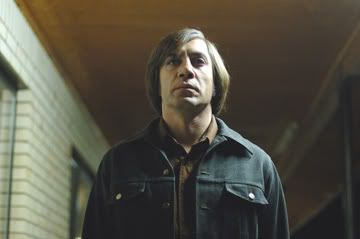

This is the movie we've been waiting for. What we have here is absolutely brilliant filmmaking that could only come from the brother directors, Joel and Ethan Coen. The audience I saw it with probably felt the movie was was a simple, conventional suspense thriller, one full of bloodlust and vengeance with an unsatisfying ending. I know this from the grumbles and groans I heard leaving the theater. These people, however, are terribly misguided and obviously shouldn't have been seeing it to begin with. So, have no worry, "No Country for Old Men" is an undeniably great movie. It's stunning, assured, intelligent, and even if December has yet to deliver probably some of the season's best movies, I can safely state that this is the very best film of 2007.

The movie takes place in the barren countryside of West Texas in the 1980s, and it opens with the solemn voice of Tommy Lee Jones. He explains about a 14-year-old boy who killed his girlfriend in what the papers called a crime of passion. When he sent the boy to the electric chair, he asked him about the murder, and the boy responded that it had nothing to do with passion; he had been thinking about killing someone for as long as he can remember. The tone of this story sets everything up perfectly for the rest of the movie. Jones' character is a sheriff and he, along with the other sheriffs, doesn't understand the crimes of today. Other movies have used war to describe dehumanization, but this film is above preaching. This certainly is no country for old men, and no country for any man, for that matter. And to think out there is a man of such incomprehensible evil.

The man is Anton Chigurh (Javier Bardem), and his presence on the screen can silence and chill a theater. He carries with him the worst hairstyle imaginable and a tank of compressed air, a cattle gun. This is a man who quietly asks his victim to get out of a car, and then proceeds to place the device on the man's forehead, blowing a hole through his head. Chigurh takes care of his victims calmly without breaking a sweat. And he can easily repair whatever wounds he receives. He is the scariest villain to come along in a movie for a long time, one of such dark evil with just a hint of perverse humor and also a smile that makes your skin crawl. In one scene, Chigurh enters a lonely gas station and, unknowing to the old man he's speaking with, they begin talking about whether or not Chigurh will kill him. The killer retrieves a coin from his pocket, flips it onto his hand, and tells the man to call it. The stakes are drawn, and this is Chigurh's game; he gambles with the lives of others through a coin toss. It's scary, that randomness in life.

And then there's Llewelyn Moss (Josh Brolin), who, while hunting in the vast expanse of prairie, randomly comes across the site of a drug trade gone wrong. There are abandoned trucks surrounded by dead bodies, even dogs, and a truck bed full of heroin. But, where's the money? Moss follows more tracks to find it in a briefcase, all $2 million of it. Amidst the carnage is also a man begging for water. After stopping at home to tell his wife (Kelly MacDonald) to stay with her mother, Moss makes the bad move of returning to the site with a jug of water for the man. While out there, a second pair of headlights appears, shots ring out, and Moss is officially on the run. It's not entirely clear how Chigurh is tied to the money, but something is assumed; Moss is attempting to keep the money for himself, and Chigurh is hot on his trail to get it back.

In pursuit of the two men is Sheriff Bell (Tommy Lee Jones), who is trying to save Moss from the trouble he's in and trying to stop Chigurh's murderous rampage. There's also a cocky bounty hunter named Carson Wells (Woody Harrelson) who compares Chigurh to the bubonic plague. All of these people understand what they're up against, but they really have no idea how to stop it. The chase takes Moss from motel to motel where all of the clerks get a visit from Chigurh. The suspense is heightened by a persistent and haunting silence. During one scene in particular, Moss waits in the dark for Chigurh to arrive; the only sound is the increasing beeps of a tracking transponder, warning of the approaching mayhem. It's truly scary, and this is not the only scene so flawlessly constructed. There are countless sequences that you don't want to end, but then when they do, there's something even better to experience next.

Josh Brolin is excellent as a common man thrust into a hellish world where he believes he's smarter than he really is. Moss is a man possessed by something beyond him, and Brolin adds a much-needed human touch to the role. And Javier Bardem's inexplicable ability to terrify is astonishing all on its own. Then there's Tommy Lee Jones, who is right at home playing the worn-out sheriff dealing with the worst of all evil. He has those tired eyes and long drawl, which is immensely fitting for the role. These three actors make every single line of dialogue count and all give Oscar-worthy performances. Now, as for that so-called disappointing ending, I believe it is pitch-perfect, bringing everything full circle and ending on a fittingly sentimental note that will reverberate in your soul long after the credits roll.

"No Country for Old Men" is based on the 2005 novel of the same name by Cormac McCarthy. The Coen brothers have adapted the story for the screen with the infusion of their signature dark humor. This is top-notch writing with a fine script, combining for absolutely great storytelling. The cinematography comes from Roger Deakins, and there's an effectively controlled sense of style, which is hauntingly bleak and violent, yet beautiful. Similar to Joel Coen's Best Picture nominee, "Fargo," the Coen brothers have a certain fascination with empty rural areas and the people who occupy them. This directing duo's latest effort is by far their best work yet.

This is a movie that drags you in, and as the minutes fly by, you'll find yourself entirely engrossed without a blink. It's hypnotizing, and at some points, you may even have to remind yourself to breathe. The movie is a meditation on time, the complexity of good and evil, the morality of choice, the immorality of injustice coincidence, and the unpredictability of fate. And all of this is tackled by the Coen brothers in a world that is all their own. The best part is that it's also damn entertaining and, yes, a masterpiece. Don't miss it.