Showing posts with label clint eastwood. Show all posts

Saturday, November 12, 2011

J. EDGAR Review


"J. Edgar" (2011)

"J. Edgar" should've been one of the best films of the year. There's no reason for it not to be, but here it is -- an epic missed opportunity that turns what could've been a riveting drama about one of America's most controversial figures into a long, ponderous mess of a movie. All the elements were there and ready for something great, too. It's directed by Clint Eastwood ("Million Dollar Baby," "Changeling") from a screenplay by Dustin Lance Black ("Milk") with Leonardo DiCaprio in the lead role as J. Edgar Hoover.

Clint Eastwood is a master of mood, and here is no exception. The issue, however, is how noncommittal he is on the subject. When ambitiously tackling such a man of history -- one who was powerful and hated but never understood -- you have to pull out the stops. Eastwood doesn't. He puts all the pieces in place but never engages them fully. We're left with something stolid and stagnant, not a juicy biopic as we might have expected. It's still respectable and sophisticated entertainment because Eastwood is incapable of making something not watchable. But the disappointment cannot be ignored, the feeling that whatever opinion you may draw about J. Edgar, neither side is with any conviction here.

And while Eastwood's direction and Dustin Lance Black's script falter, the acting stands tall. Leonardo DiCaprio disappears within the exterior of a conflicted and unruly man. Hoover ruled the Federal Bureau of Investigation like a mad bulldog from 1935 until his death in 1972. Nobody dared cross him even though he schemed and blackmailed without shame -- this includes a cruel, anonymous letter to Martin Luther King, Jr. After seemingly playing the same character in both "Shutter Island" and "Inception" last year, it's richly satisfying to watch DiCaprio successfully transform himself, an acting feat that could no doubt earn him a Best Actor nomination or even win.

Armie Hammer of "The Social Network" plays Hoover's FBI associate director and life-long companion, Clyde Tolson. It's remarkable to note that Hammer, a relative newcomer since his breakout last year, holds his ground next to DiCaprio and -- in some instances -- even outshines him. Both actors, however, are hampered by layers of distracting prosthetic aging makeup.

Tolson is Edgar's dark secret, and a majority of Black's screenplay is purposely speculative about their relationship. And while an important aspect of the man's life, Black takes the easy way out. Sure Hoover was terrible and did some terrible things -- but he was gay. And while he bases most of the film around Hoover's repressed homosexuality, he also uses it as reasoning for his hidden evils and paranoia about commies and radicals. His sexuality is not the only reason -- that's too simple, and even with DiCaprio's performance this tactic threatens to make Hoover one-dimensional, which he's certainly not. 

Scenes between Hoover and Tolson are nuanced and the film's best. In a most wrenching scene, Hoover's mother Annie (played with stern severity by Judi Dench) calculates what's going on between her son and Tolson. "I'd rather have a dead son than a daffodil," she says. The effectiveness of these moments, though, point to the film's greater downfall. Every gay man of that generation was repressed and struggling with something profound -- that's no mystery. So let's focus on what made Hoover different than the rest of those men.

Thursday, August 19, 2010


After a bit of a mid-summer slump, August churned out some notable movies, and now the year in movies really kicks into gear for the beginning of Oscar season. And even though some have been calling 2010 a lackluster year for movies so far, they need to hold their tongues before looking at what's to come. With that, listed below are the top 10 films I'm most looking forward to go see between now and December.

10. Love and Other Drugs

Director Edward Zwick, who's used to directing big Oscar bait flicks like "Defiance," "Blood Diamond" and "The Last Samurai," tones it down a notch with this down-to-earth romantic comedy starring Jake Gyllenhaal and Anne Hathaway. Although the plot seems pretty familiar of the genre, what gets me excited about it is Gyllenhaal and Hathaway working together for the first time since "Brokeback Mountain." Both are gifted actors and seeing their playful side together could be frivolous good fun, and who knows, maybe even something a little more.

9. It's Kind of a Funny Story


Here's another comedy, this time in the vain of those low-key indie comedies like "Little Miss Sunshine" and "Juno." This will most likely be this year's rendition with the breakout star Zach Galifianakis of "The Hangover" taking on a still silly yet also slightly more serious role. I'm less excited about this movie than I am anxious just to see how it turns out. The young actors, Emma Roberts and Keir Gilchrist, look promising, but my worry is this: could we be looking at Galifianakis overkill? Either he'll shine here or just be too much.

8. Hereafter

It's another Clint Eastwood film, this one starring Matt Damon and another one meditating on the possibility and consequence of death. So, it's basically Eastwood back in his usual directing form after his little break with "Invictus," which did not meditate on death. Not much has been released about it aside from a brief synopsis telling of three people who are connected through some form of brush with death. Gloomy stuff, but it could also be powerful stuff à la "Million Dollar Baby."

7. Machete


You read that right. "Machete," the fake trailer from Robert Rodriguez which premiered in "Grindhouse" is now blown up into a feature length movie from Rodriguez himself. It stars Danny Trejo, Jessica Alba, Robert De Niro, Steven Seagal, Michelle Rodriguez and, yes, Lindsay Lohan before she got hauled off to jail. If "Planet Terror" is any taste of what this is going to be, I'm totally there for all the uproariously bloody, absurd and hilarious action.

6. True Grit

The only thing I know about this latest from Joel and Ethan Coen is that it is a western remake of a 1969 original of the same name. We've learned from "No Country for Old Men" that the Coen brothers have excellent control of the western genre, so I'm definitely looking forward to this one. It stars Jeff Bridges and Josh Brolin.

5. Another Year


What can I say? Mike Leigh cannot go wrong, and every review coming out of Cannes for this one was a rave. I have no idea what it's even about, but according to the trailer that just got released, it looks to be simply about people and relationships and, well, life in general. In other words, what Leigh does best. And it stars Jim Broadbent who I love.

4. Somewhere


After "Lost in Translation," my love for writer/director Sofia Coppola officially began. That movie still ranks among my top favorites of all time. This woman could pretty much direct a commercial about laundry detergent, and I'd be more than thrilled to see it. In any case, her newest film seems to be very similar in style to "Lost in Translation" with a focus on the relationship between two people, this time one between a man and his young daughter. It's going to have some great music from Phoenix, too.

3. The Social Network


The first trailer for David Fincher's new movie was a wondrous tease. Now that the second trailer is up, we can see some of the acting chops this movie has to offer, especially from Jesse Eisenberg most notable from movies ending in the word "land"--also known as "Adventureland" and "Zombieland." The movie boasts a timely and intriguing premise, too, about the founding of Facebook. The hype for this one is running high, and I'm sure Fincher will deliver.

2. Black Swan


Like Coppola, anything directed by Darren Aronofsky I'm going to be excited to check out. "Requiem for a Dream" is a classic and 2008's "The Wrestler" was an absolute knockout. And so, upon hearing that his latest movie would be about a ballet dancer, I was immediately fascinated. Then came that startling photo of Natalie Portman with a porcelain-white face and black makeup. Finally came the trailer which was astonishing and breathtaking. It absolutely solidified in my mind that this was one of the most anticipated movies of the fall for me.

1. Harry Potter and the Deathly Hallows: Part 1


Well, it's Harry Potter and it is, without a doubt, the movie I am most looking forward to seeing. And it's not just because I'm some sort of Harry Potter junkie or crazy fan. This isn't "Twilight" we're dealing with here. These are legitimately great movies, each and every one of them, and I don't see how this one could be any different. "Harry Potter and the Half-Blood Prince" even made it into my top films list for last year. It was that good. And since this first part of the franchise's finale is coming from the same filmmaking team, we're more than likely looking forward to something just as good. Besides, we gotta see how this whole thing ends.

Wednesday, March 10, 2010

Archive: 'Changeling'

Movie Review
Changeling (2008)


On March 9, 1928 in Los Angeles, the son of Christine Collins (Angelina Jolie) went missing. The worried mother contacted the police, and a fruitless search ensued for her son, Walter. Months later, the LAPD announced they had found her son alive in DeKalb, Illinois. When reunited with her son, she claimed the boy brought to her was not him. The police force, who was under fire for corruption, insisted that Collins must be mistaken. Standing before the press, Capt. J.J. Jones (Jeffrey Donovan) assured Collins that the boy was her son and stated the case as a superior example of the LAPD's hard work. The LAPD was in dire need of such positive coverage and continued to ignore Collins' assertions that her real son was still missing and the boy she was forced to take care of wasn't Walter. Collins was then claimed as mentally insane and locked up in a psychiatric ward.

Clint Eastwood's "Changeling" focuses on the factual retelling of this true story. It all begins as a simple case of a missing boy and explodes into an entire critique of the structure of Los Angeles in the 1920s including the LAPD, status and rights of women, and treatment of the mentally unstable. After "Mystic River," "Million Dollar Baby," and then the duo of "Flags of Our Fathers" and "Letters from Iwo Jima," it appears Eastwood is only gaining steam and at the peak of his creative abilities. Because this real life event happened so long ago and because it's simply something sad that happened to somebody, it's amazing how Eastwood was able to craft such a powerful and disturbing drama out of it. It's not the history that makes the movie important, but rather, the stylistic abilities behind the storytelling that makes the history so important. Eastwood is a strong force, and watching this movie is watching a master at work doing what he does best. Walking out of it, there's the immense satisfaction of just having watched something so well-made.

There's a certain look to the entire movie as a period piece, and the scenery is glossed over in beauty with certain colors popping out. An entire world is created, and it's like viewing this time period as we've never seen it before; the movie initially starts in black and white and fades back into it at the end. It's a sly stylistic approach, and it works wonders. It's visually appealing, and there are so many details relating to the time period to notice throughout. And not to mention Eastwood's subtle but deeply resonant musical score. The entire film acts as an observation within this vividly realized world, an observation that makes us angry, very angry. The story is the unraveling and unwinding of such anger that leads to somber resolve.

Christine Collins receives aid from a radio preacher named Rev. Gustav Briegleb (John Malkovich) who seeks out to uncover the unlawfulness of the LAPD. Meanwhile, a detective is put on a seemingly insignificant case that leads to the discovery of the murder of 20 young boys on an isolated ranch in Winesville, California. This discovery takes the fight in a whole new direction. The film has a sense of very traditional storytelling while at the same time remaining complex and morally challenging, focusing on the essential and fragile hope of having any sort of decency in the world we know. The structure is fascinating as the movie starts off intimately personal and then zooms out to a nearly epic sweep and tightens right back in again to the individual. The story should really be left for viewers to discover on their own, and so I must refrain from giving too much away. For such a heart-wrenchingly sad saga, the movie is equally exhilarating.

Angelina Jolie is inspired casting. Donning bright red lipstick, she sustains an assured presence building in terror and anger and ending in silent resolution, all which brings the LAPD crumbling to the ground. She, however, never takes center stage and simply delivers what she is good at, right alongside John Malkovich who perfectly fits his role as the crusading minister. Geoff Pierson as the lawyer who takes Collins' case to court is a demanding presence, as well. And not to be overlooked is Jason Butler Harner's haunting role as the frightened remnants of a man turned murderer, Gordon Northcott. Amy Ryan absolutely nails her brief number of scenes as Collins' fellow psycho-ward inmate. Surprisingly impressive, as well, is Eddie Alderson who plays the 15-year-old nephew of the killer; his account of the grisly murders is harrowing. "Changeling" is another triumph from a very accomplished filmmaker. It's a film to discuss, remember, and admire, and it's among the best of the year.

Archive: 'Gran Torino'

Movie Review
Gran Torino (2008)


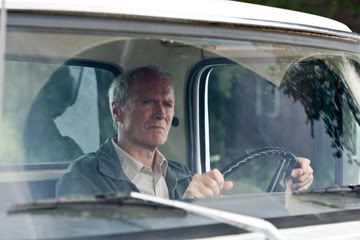
Clint Eastwood is the man. It's another good year for him because now after "Changeling," at age 78, he's even directing himself. In "Gran Torino," Eastwood plays Walt Kowalski, a disgruntled and retired auto worker from a Ford plant who lives in a rundown neighborhood in Detroit. Walt views the world as a place filled with senseless sons of bitches, and the neighborhood where he lives is racially mixed. Walt is a Korean War veteran, so when a Hmong family moves right next door, one can imagine his discontent. He calls them "chinks" and "gooks" and any other name in the book. He so easily infuses racial slurs and bad-mouthing into his everyday talk because he justifies that it's how all Americans talk. Just look at how he talks with his barber. Walt isn't so much a racist as he is just using it as a surface protection against himself. Eastwood's portrayal of the beer-guzzling Walt nears self-parody, and he's often quite hilarious. It's an excellent and fittingly career-capping role for him as he's now claimed this will be his last time acting. Take note, Academy.

Even though his wife just passed, Walt makes sure his spoiled son with his foreign car and his ungrateful granddaughter keep out of his business. He gets visited frequently by a priest (Christopher Carley) who received a dying wish from Walt's wife to have her husband go to confessional. Walt has some lingering inner demons that still haven't let him be at peace. He spends his days guarding his front porch with a shotgun ready and loaded inside the house. His initial involvement with the Hmong family comes when a gang starts rustling with the youngest in the family, Thao (Bee Vang). Walt breaks up the fight mainly because it encroached onto his lawn. "Get off my lawn," he growls at the gang members. Walt has a prized 1972 Gran Torino tucked away in his garage, and when the gang members force Thao to try to steal it, Walt catches him. Thao's sister, Sue (Ahney Her), begs Walt to allow Thao to do work for him to earn his forgiveness. Walt reluctantly accepts and soon discovers that he has more in common with Sue and her family than he even does with his own. He unintentionally becomes the neighborhood hero.

For the most part, Walt seems unaware of his important role with the Hmong family. He mostly just likes when he's brought delicious Hmong food that he quickly gains a taste for. But then again, he begins helping out Thao a whole lot after wanting to shoot him dead, meanwhile acting like there's nothing to it. Walt is a good man, but he's also not a very easy man. While he has the capacity within himself for generosity, he doesn't show it well. And so, when he eventually confides in the Hmong family as he does, it's a real honor and means something. It's in Walt's nature to act as security, so when the gang persistently continues their threats, there's no good end for them. One line of Walt's tells it all: "Ever notice how you come across somebody once in a while you shouldn't have fucked with? That's me."

Clint Eastwood's "Gran Torino" has a twist of an ending that pulls no punches and provides no easy route for redemption. It's vintage stuff, echoing Eastwood's earlier days of "Unforgiven." While this latest movie of his feels a little more quickly tossed together than his other work, it's no less a great movie. It's also comforting to see a movie being shot in Detroit, even if it's being presented as a cesspool of gang violence. A quick reference to Michigan State was a nice little treat. Eastwood works with the same familiar themes he's focused on in his recent films, and especially here, it's all wonderfully understated. The movie works as a comedy and as a drama, but most all, it works as a meditation on violence and tolerance. And perhaps also as a farewell.

Wednesday, December 16, 2009

Rugby As Reuniting A Nation

Invictus


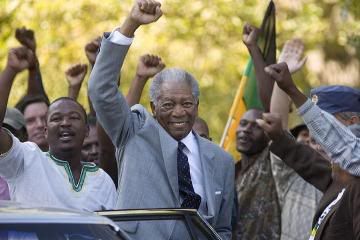
In the opening of Clint Eastwood's "Invictus," there is what appears to be real-life footage of Nelson Mandela, but then, upon further observation, one can notice that it is actually Morgan Freeman in reenacted footage. And from that moment on, Freeman embodies the voice, mannerisms, and even ideologies of Mandela and gives a performance that evokes the spirit of a man who became an icon in South Africa. In this opening moment, Freeman shares a wide, genial smile and gives a portrayal that is calmed, subdued, and charming. He infuses Mandela's speeches with the same grace he gives when he, well, when he plays God. Here's a movie that, in its serious, classical, handsome, and well-produced style and direction, for which Eastwood has become a trademark, is an Academy Award contender automatically because it deals with a worthy subject in the hands of an intelligent director with superb actors dealing with real-life people. And in that respect, it succeeds as a great movie.

The movie takes place in the 1990s when Nelson Mandela was elected the country's first black president after being in prison for 27 years. The challenge facing Mandela upon his election was finding a way to make peace with the apartheid forces that had originally put him in jail. His weapon? Forgiveness. The Afrikaner nationlists living in South Africa are viewed as the enemy, and so Mandela's vote into office had them waiting for his payback. It never came. Instead, Mandela embraced his position and took it as an opportunity to unite his country that had been so harshly divided by racism. The politics of the film have deeper implications that go beyond the time and the place and breach quite blatantly into today. Obama's name of course never gets mentioned (how could it?), but we know in the back of our minds the historical analogies being made.

Mandela turns to the all white (save for one player, Chester Williams) rugby team, the Springboks captained by Francois Pienaar (Matt Damon). The core of the movie rests in Mandela's counterintuitive decision of promoting support for the Springboks even though they were mostly hated by the nation's blacks. The fascinating aspect of the sports drama portion of the film is the way in which it fits into the political drama already unfolding. And even more fascinating is that it was simply because Mandela was a loyal fan of rugby. Both stories are substantial on their own merit, but together they make for a more potent and moving experience. While the climactic moment of the World Cup match is predictable, and although Eastwood spends a rather unnecessarily lengthy 20 minutes on it, it is still a moment that is earned. In any case, the weight of the moment resonates throughout the film's final scenes, and when the fade to black over Mandela's face arrives with the words to the Invictus poem being read aloud, it'll hit you.

Based on John Carlin's book, "Playing the Enemy: Nelson Mandela and the Game that Made a Nation," Eastwood and his screenwriter Anthony Peckham tell the story with straightforward assertiveness that doesn't pour on the glorification as Hollywood could've done with this underdog tale. Matt Damon plays the leader of these underdogs, sporting a beefed-up physique and platinum blonde hair, and he is admirable in the role. Francois visits the very cell where Mandela was held prisoner, and, as the film was shot on location, we're shown the actual cell. There is a chair and a blanket on the floor, and upon seeing that image, you can't help but wonder how this man waited so patiently in faith, and even, after all that, still had the courage for forgiveness and not revenge. For Francois, ever since a first visit with Mandela for tea in his office, he had become the greatest man he had ever met.