Showing posts with label judi dench. Show all posts

Thursday, December 5, 2013

PHILOMENA Review


In the true story of Philomena Lee (Judi Dench), an old Irish woman in her 70s who kept the secret of her abducted child for 50 years, it's less about discovering the details of her son but what these discoveries mean for her. As portrayed in Stephen Frears ("Dirty Pretty Things," "The Queen") new film, it's thank goodness for Judi Dench who manages to not sentimentalize the sometimes naive and simple character always looking for the best in people. So much so that she hesitates before incriminating the very convent who stole her three-year-old son away from her when she was a teenaged girl.

The covent's nuns are quickly dubbed the "evil nuns" of Philomena's human interest story, one that British political writer and journalist Martin Sixsmith (Steve Coogan) begrudgingly takes on after being out of a job. He doesn't necessarily care for Philomena's personal story but is cherry-picking for what would make good journalism, "evil nuns" included. The fact is, however, they are a representation of the worst of Catholicism: shockingly cruel acts committed under a veneer of sanctity. Also touched on throughout the film: the ignorant social restrictions of the Republican party.

But all of this is contained within a film that is quaint and slight, never committing to deeper moral themes about institutional wrongs. Co-written by Jeff Pope and Steve Coogan, the film suffers from tonal confusion but mostly maintains a light, pleasant air occasionally dipping into emotional waters via Dench's soulful performance. Coogan's Sixsmith remains a one-note curmudgeon throughout, which is darkly humorous -- as the actor's most dramatic role yet -- but it begins to tire, especially when the always well-meaning Philomena can't even break through to him. A woman who manages to forgive a horrible sin committed against her should be able to transfer a lesson on to the man, but to no avail.

"Philomena" boils down to Judi Dench, giving us a woman no stranger to sorrow but who knows how to put her best foot forward. It's both a delightfully playful and fittingly gloomy performance that deserves the accolades it'll receive come Oscar time. Although the dame deserved it just as much playing the ill-fated M from last year's "Skyfall."

Friday, November 16, 2012

SKYFALL Review


Forgetting "Quantum of Solace" ever existed, the latest James Bond reinvention arrives as a full-bodied piece of rousing entertainment that's even better than Martin Campbell's original reboot of the franchise with 2006's "Casino Royale." First off, Daniel Craig (reprising his Bond role for a third time) looks more confident and assured than ever. Less bulky, more lean, looking haggard but still handsome and with a newly added sly sense of humor, the actor portrays 007 as less brooding and more finessed. Director Sam Mendes, whose most recent outing was the small indie comedy "Away We Go," has worked with Craig on "Road to Perdition" and proves the perfect man for the job. And coupled with a talented trio of writers -- Neal Purvis, Robert Wade and John Logan -- "Skyfall" excites from the start hitting the ground running with a breathless opening action sequence.

The elaborate chase takes us to the first of the film's exotic locations: Istanbul. Bond and a fellow agent, Eve (Naomie Harris), are in a pursuit that takes Bond on top of a moving train with Eve watching closely. Monitoring remotely from MI6 in London is the severe-looking M (Judi Dench); as Bond gets into a wrestling match with the enemy in pursuit, Eve announces she can take a shot to take the enemy down. It's a risky shot, but a shot nonetheless. M makes a judgement call ("Take the shot!") that sends Bond plummeting to the rushing water below.

Brilliantly choreographed action like the above is sprinkled throughout the duration of "Skyfall" taking us to Shanghai and a mysterious island that houses the film's best Bond villain in years. Played effortlessly by Javier Bardem, Silva is all the more terrifying in his theatricality with flamboyant dress, cat-like eyes and bleach blonde hair. A playful and perversely sexual exchange between Silva and Bond is inspired. No stranger to sinister roles having embodied Anton Chigurh in "No Country for Old Men," Bardem plays Silva as the face of cyber terrorism. He's a computer whiz who can spark chaos with one key stroke and the newest threat to MI6 even if only M and her agents realize it yet.

There's a Bond girl (Berenice Marlohe), but just barely. Perhaps it's because Eve's real name is Miss Moneypenny -- hint, hint. Instead, the emphasis is on the complicated relationship between Bond and M, a storyline thread that takes them to Bond's origin: an old Scottish mansion fittingly named Skyfall and inhabited by a man named Kincade (Albert Finney) who raised the young James. This brand new Bond comes just in time for the series' 50th anniversary, and it both invigorates the modern and commemorates the past. M is past her years, and there's a new boss in position, Mallory (Ralph Fiennes). When Bond is debriefed on a mission from a much younger Q (Ben Whishaw), the only gadgetry he receives is a palm-recognizing pistol and radio transmitter. And yet when the original Aston Martin from "Goldfinger" is unveiled, it's a blast of pure nostalgia for fans.

Adele's gorgeous theme reverberates throughout "Skyfall" with the classic Bond theme trumpeting in later on, and the whole thrill ride is accented with a touch of artfulness from Roger Deakins whose keen cinematography deserves awards consideration. And speaking of awards, if never in its 22-film history has a Bond film been nominated for an Oscar, the 23rd entry in the prolific franchise is a better time than ever.

Monday, December 19, 2011

MY WEEK WITH MARILYN Review


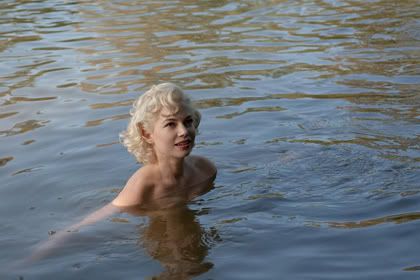
While watching "My Week with Marilyn," you might find yourself feeling as if you're caught under a spell, a certain magnetism that you can't quite explain. Except that it can be explained. Like Marilyn Monroe herself, Michelle Williams is utterly hypnotic as the iconic screen goddess. The blond bombshell actress -- the woman everyone wanted to either be or be with in the mid-1950s -- had a personality that nobody could figure out, and the performance from Williams doesn't try to. Instead she emanates everything Monroe was about and what it must've felt like for anyone to be in her presence. There's the fact alone that being her was an act itself. In one instance she says, "All people ever see is Marilyn Monroe." Williams deserves an Oscar for embodying the actress effortlessly -- her effervescence, aloofness, mystery, grief and insecurity. She'll most certainly receive a Best Actress nomination.

The film follows the backstage proceedings of filming "The Prince and the Showgirl" (1957) in Pinewood Studios, London. Starring alongside Marilyn Monroe in the picture is Laurence Olivier (Kenneth Branagh) who also served as director. One might think working with such a world-renowned celebrity would be a dream and the highest honor, but Olivier clashes with her almost immediately. He is all about proficiency and the technicality of filmmaking and has no patience for Marilyn. There's always a delay whether she's not feeling well, she's sick, hungover or too tired. She's never on time, and when she does arrive she trips over her lines and doesn't believe in the character she's playing. But when she finally gets it right, her screen presence sings.

Everyone working on the film fully knows Monroe is difficult, but only Olivier has the nerve and audacity to blow up about it to her face. Branagh gives an important performance here as a man who's a genius in the film industry but is hardly in love with it. And when forced to put up with Marilyn's behavior, this immovable object that everyone adores and loves -- he can't bear it. Paula Strasberg (Zoe Wanamaker) is Marilyn's personal acting coach she brings along who coddles her, boosts her self-esteem and counteracts Olivier's direction. There's also Dame Sybil Thorndike (Judi Dench) who understands the director's frustration but also knows how to delicately handle Marilyn's sensitivity.

The biggest focus, however, is on the relationship between Marilyn and the impressionable 23-year-old Colin Clark (Eddie Redmayne) who was the gofer on the project. The movie is based on his memoirs and gives the film a fascinating perspective. Colin landed in between the Olivier and Monroe camps taking note of everyone and letting the backstage pass experience soak in. This unique position also sparked Marilyn's interest in him to hear what everyone thought of her.

The film captures Marilyn's absolute allure, the light she radiated and what it must've been like for Colin when she kissed him and said she loved him -- even if she didn't mean it. Everyone warns Colin to not get himself involved, but instead of dating the nice wardrobe girl (Emma Watson's first role since playing Hermoine in the "Harry Potter" series), he becomes enraptured by Marilyn. Redmayne captures a naive awe that makes us feel what he must've felt in the era. The power of the film, and of course Williams' performance at its center, is the way it makes you believe this luminous woman's ability to have such a profound impact on people's lives.

Saturday, November 12, 2011

J. EDGAR Review


"J. Edgar" (2011)

"J. Edgar" should've been one of the best films of the year. There's no reason for it not to be, but here it is -- an epic missed opportunity that turns what could've been a riveting drama about one of America's most controversial figures into a long, ponderous mess of a movie. All the elements were there and ready for something great, too. It's directed by Clint Eastwood ("Million Dollar Baby," "Changeling") from a screenplay by Dustin Lance Black ("Milk") with Leonardo DiCaprio in the lead role as J. Edgar Hoover.

Clint Eastwood is a master of mood, and here is no exception. The issue, however, is how noncommittal he is on the subject. When ambitiously tackling such a man of history -- one who was powerful and hated but never understood -- you have to pull out the stops. Eastwood doesn't. He puts all the pieces in place but never engages them fully. We're left with something stolid and stagnant, not a juicy biopic as we might have expected. It's still respectable and sophisticated entertainment because Eastwood is incapable of making something not watchable. But the disappointment cannot be ignored, the feeling that whatever opinion you may draw about J. Edgar, neither side is with any conviction here.

And while Eastwood's direction and Dustin Lance Black's script falter, the acting stands tall. Leonardo DiCaprio disappears within the exterior of a conflicted and unruly man. Hoover ruled the Federal Bureau of Investigation like a mad bulldog from 1935 until his death in 1972. Nobody dared cross him even though he schemed and blackmailed without shame -- this includes a cruel, anonymous letter to Martin Luther King, Jr. After seemingly playing the same character in both "Shutter Island" and "Inception" last year, it's richly satisfying to watch DiCaprio successfully transform himself, an acting feat that could no doubt earn him a Best Actor nomination or even win.

Armie Hammer of "The Social Network" plays Hoover's FBI associate director and life-long companion, Clyde Tolson. It's remarkable to note that Hammer, a relative newcomer since his breakout last year, holds his ground next to DiCaprio and -- in some instances -- even outshines him. Both actors, however, are hampered by layers of distracting prosthetic aging makeup.

Tolson is Edgar's dark secret, and a majority of Black's screenplay is purposely speculative about their relationship. And while an important aspect of the man's life, Black takes the easy way out. Sure Hoover was terrible and did some terrible things -- but he was gay. And while he bases most of the film around Hoover's repressed homosexuality, he also uses it as reasoning for his hidden evils and paranoia about commies and radicals. His sexuality is not the only reason -- that's too simple, and even with DiCaprio's performance this tactic threatens to make Hoover one-dimensional, which he's certainly not. 

Scenes between Hoover and Tolson are nuanced and the film's best. In a most wrenching scene, Hoover's mother Annie (played with stern severity by Judi Dench) calculates what's going on between her son and Tolson. "I'd rather have a dead son than a daffodil," she says. The effectiveness of these moments, though, point to the film's greater downfall. Every gay man of that generation was repressed and struggling with something profound -- that's no mystery. So let's focus on what made Hoover different than the rest of those men.