Showing posts with label michelle williams. Show all posts

Monday, December 19, 2011

MY WEEK WITH MARILYN Review


While watching "My Week with Marilyn," you might find yourself feeling as if you're caught under a spell, a certain magnetism that you can't quite explain. Except that it can be explained. Like Marilyn Monroe herself, Michelle Williams is utterly hypnotic as the iconic screen goddess. The blond bombshell actress -- the woman everyone wanted to either be or be with in the mid-1950s -- had a personality that nobody could figure out, and the performance from Williams doesn't try to. Instead she emanates everything Monroe was about and what it must've felt like for anyone to be in her presence. There's the fact alone that being her was an act itself. In one instance she says, "All people ever see is Marilyn Monroe." Williams deserves an Oscar for embodying the actress effortlessly -- her effervescence, aloofness, mystery, grief and insecurity. She'll most certainly receive a Best Actress nomination.

The film follows the backstage proceedings of filming "The Prince and the Showgirl" (1957) in Pinewood Studios, London. Starring alongside Marilyn Monroe in the picture is Laurence Olivier (Kenneth Branagh) who also served as director. One might think working with such a world-renowned celebrity would be a dream and the highest honor, but Olivier clashes with her almost immediately. He is all about proficiency and the technicality of filmmaking and has no patience for Marilyn. There's always a delay whether she's not feeling well, she's sick, hungover or too tired. She's never on time, and when she does arrive she trips over her lines and doesn't believe in the character she's playing. But when she finally gets it right, her screen presence sings.

Everyone working on the film fully knows Monroe is difficult, but only Olivier has the nerve and audacity to blow up about it to her face. Branagh gives an important performance here as a man who's a genius in the film industry but is hardly in love with it. And when forced to put up with Marilyn's behavior, this immovable object that everyone adores and loves -- he can't bear it. Paula Strasberg (Zoe Wanamaker) is Marilyn's personal acting coach she brings along who coddles her, boosts her self-esteem and counteracts Olivier's direction. There's also Dame Sybil Thorndike (Judi Dench) who understands the director's frustration but also knows how to delicately handle Marilyn's sensitivity.

The biggest focus, however, is on the relationship between Marilyn and the impressionable 23-year-old Colin Clark (Eddie Redmayne) who was the gofer on the project. The movie is based on his memoirs and gives the film a fascinating perspective. Colin landed in between the Olivier and Monroe camps taking note of everyone and letting the backstage pass experience soak in. This unique position also sparked Marilyn's interest in him to hear what everyone thought of her.

The film captures Marilyn's absolute allure, the light she radiated and what it must've been like for Colin when she kissed him and said she loved him -- even if she didn't mean it. Everyone warns Colin to not get himself involved, but instead of dating the nice wardrobe girl (Emma Watson's first role since playing Hermoine in the "Harry Potter" series), he becomes enraptured by Marilyn. Redmayne captures a naive awe that makes us feel what he must've felt in the era. The power of the film, and of course Williams' performance at its center, is the way it makes you believe this luminous woman's ability to have such a profound impact on people's lives.

Monday, January 17, 2011

BLUE VALENTINE Review


"Blue Valentine" (2010)

"Blue Valentine" is about the presence and absence of love, the start and end of a marriage. What makes this sad and painful observation of a failed marriage so genuine is that any moral compass gets erased. There is no contemplation of who was right or wrong in the relationship. Ryan Gosling plays Dean, and Michelle Williams plays Cindy, a couple who feels real. You don't walk out wondering whether it was Dean or Cindy's fault as to why they didn't work. They just didn't, it is life, and it happens to people.

There are two pivotal scenes in the film, one of which was the reason the MPAA nearly gave it an NC-17 rating. Dean and Cindy take a romantic night off, or what was supposed to be, and check in to a sleazy hotel room that is futuristic themed. In an attempt to rekindle their love, Dean puts on an old, scratchy song from the 70s, one that clearly must've meant something to them back in the day. We don't discover until later it was their song. Meanwhile, they choke down vodka slowly crawling to the moment where they have to make love. Not want to make love but have to. It's a nearly unbearable scene to watch but absolutely crucial in understanding how far this couple has come since their original spark.

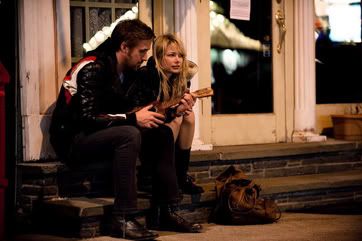
The other pivotal scene comes at the beginning of their courtship. Standing outside what looks to be a floral or bridal shop, Dean twangs a playful tune on his guitar and sings along as Cindy performs an impromptu tap dance for him. It is touching yet heartbreaking knowing how the couple ends up.

Director Derek Cianfrance leaps back and forth in time interspersing between showing the audience what brought Dean and Cindy together and what tore them apart. We watch Dean as a charming, funny and handsome young man with a scrappy sense of workman promise; we understand what Cindy sees in him. Jump ahead to Dean as a 30-year-old with a receding hairline, thick-rimmed glasses and a misconstrued mustache. He works as a painter not bothering to wash his hands with a cigarette always dangling from his lips, but in the way he interacts with his daughter we see his kindness and why Cindy might still love him. Cindy begins as a shy and attractive young woman striving to become a doctor, but she eventually gains a little weight losing her vivacity and glow.

These physical transformations reveal a deeper inner shift of character, and the raw and brutal performances from Gosling and Williams portraying this should be, and most likely will be, nominated for Oscars. These two actors have the chemistry and understanding of the human condition to provide us with two characters who don't feel like characters at all but like real people of flesh and blood.

"Blue Valentine" asks the demanding questions of what we ask for in a spouse and what the meaning of true love is. As we watch Cindy and Dean, we wonder whether they should've been together. Were they right for each other, or was it something out of necessity? The filming is purposefully claustrophobic both in the way their relationship is told and the way shots are framed with the frequent use of close-ups on the two actors.

While a brave and ugly portrait of a marital decline, I couldn't help but think we weren't getting anything more than snapshots of Dean and Cindy's life together; the full picture felt missing. We aren't clear exactly how they got from point A to point B, but maybe the point is that even they don't know how.