Showing posts with label ryan gosling. Show all posts

Tuesday, October 11, 2011

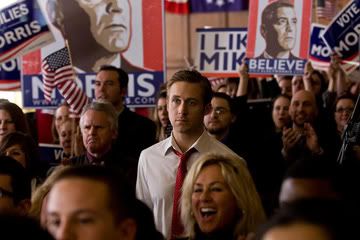
THE IDES OF MARCH Review


"The Ides of March" (2011)

The fourth feature directed by George Clooney (following "Confessions of a Dangerous Mind," "Good Night, and Good Luck" and "Leatherheads"), "The Ides of March" provides us with knowledge a lot of us may already know: the current climate of American politics leaves no room for idealism and dignity. It's a harsh and cynical look at the modern presidential campaign landscape, but it's also less about the candidates and more about the campaign managers working for them. There is scheming, backstabbing and lapses in loyalty aplenty, and it's all a riveting inside look at the men behind the faces we end up voting for.

The movie stars Ryan Gosling playing another rather introverted character. It's a much different character than "Drive," but his focus and intensity remains the same. Just when we think we have him figured out, he surprises us with a twist of action. He plays Stephen Meyers, a press secretary for Pennsylvania Gov. Mike Morris (George Clooney) during a presidential primary in Ohio, which acts as a pressure cooker for the proceedings. Perfectly cast, Clooney plays Mike Morris as an idealistic fictional Obama in 2008 candidate who is articulate and promising with a new kind of politics. Stephen works under Paul Zara (Phillip Seymour Hoffman in top form), a seasoned campaign manager for Morris. On the other side of the playing field is Tom Duffy (Paul Giamatti), the campaign manager for the opponent Pullman. All of these men, save for Stephen, are hardened realists who know exactly how to play their pieces on the board. Young professionals such as Stephen have yet learned how to check their values at the door.

The screenplay (adapted from Beau Willimon's play "Farragut North") co-written by Clooney, Willimon and Grant Heslov paired with Clooney's understated direction brings conversations and exchanges to the utmost importance. The title suggests a grand sweeping Shakespearian theme, but Clooney's goals are actually much simpler and straightforward and, in such, create an even greater impact. What Clooney strives to present may not be wholly profound, but it is pulpy and provocative. I don't think the screenplay sticks in the knife as deeply as Clooney hopes, but he still assembles an astonishingly powerful cast to navigate murky waters where the lines of political and emotional agenda get skewed.

A New York Times reporter played by Marisa Tomei represents manipulative media involvement in the campaign looking for the best scoop. A key conversation between her, Stephen and Paul early on shows where true loyalty lies along with the real perception of any campaign -- it always divulges into disappointment no matter who takes the title. At one point Stephen receives a call from Tom Duffy with a job offer to change sides. Motives here become unclear. Does Duffy actually want Stephen, or does the offer simply work as a ploy? Stephen is just opportunistic and looking out for his best interest revealing a surprising but subtle amorality. The real focus of the plot doesn't arrive, however, until a scandal surfaces around a luscious intern named Molly (Evan Rachel Wood). Stephen is handsome and suave, so he charms Molly into bed but in the process learns some unnerving information.

From here the film is tight, smart and swiftly paced showing us everything we've already come to know about how campaigns are really run in this country. It plays as if the pressure cooker finally goes over, and scenes flow with boiling urgency. The revelations keep us riveted but what keeps us engaged and interested is the toxic and malevolent atmosphere that Clooney expertly upholds. It's down and dirty stuff with men in pressed suits, and it's all the more disturbing considering the setting. "The Ides of March" works like a wrenching punch to the gut in the acceptance that sometimes politics is just about keeping a job.

Tuesday, September 20, 2011

DRIVE Review


"Drive" (2011)

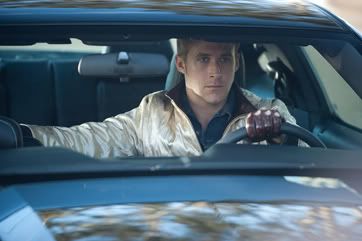
He is a driver and only a driver. He has no name to the men he works for and not even to us. He's the guy behind the wheel who will be there if you tell him when and where. He's the getaway driver and a man defined by what he does. We're introduced to this driver -- with his steely blue eyes and gloved hands gripping the steering wheel -- during a job. He's cool and collected even during a vehicular game of cat-and-mouse with the authorities. It's a sequence wrought with tension and suspense and one of the most expertly handled car chases I've seen. Eyes fixated on the road and not ever on the faces of the criminals he carts around, the driver doesn't commit the act; he only gets those doing so from point A to point B. "I drive," he says.

Albert Brooks, who's not at all funny here, plays a nasty man of business named Bernie in "Drive" from Danish director Nicolas Winding Refn ("Bronson," "Valhalla Rising"). His character is a producer for the type of B-movies that the driver does car stunts for, which is the driver's day job when he's not a driver for hire by night. Bernie describes the movies he used to produce in the 80s as action thrillers lauded by critics. Some critics even called them European. But he thought his movies were shit. As a self-knowing nod, he could be describing the very movie he's in -- minus the part about being shit.

The modern soundtrack recalls 80s synth with titles presented in a retro pink cursive font like something out of "Miami Vice." A sleek, subdued and sophisticated European sentiment permeates the mood. It's an action thriller for the art house crowd but in no way pretentious. "Drive" provides the perfect elements of a genre flick in high fashion emphasizing the master of craft. While putting the pedal to the metal, there's respect for acting and writing. It plays on commercialism while becoming an exact rebuttal to convention.

As the driver Ryan Gosling sustains an impenetrable and indiscernible calm that's unnerving. He has the severe cool of a young George Clooney, and here he seems to be channeling him in "Michael Clayton" form. He's wordless and expresses a wide expanse of inner-thought through a shift in the brow or a twinge of the mouth. A master of nuance, Gosling gives us a brilliant work of existentialism through moments of idling silence before this mysterious wheel man slams on the accelerator. He's a man who's been around cars most his life mentored by a fatherly figure, a mechanic named Shannon (Bryan Cranston of "Breaking Bad"). The driver lives in an apartment complex and becomes close with his neighbor, Irene (Carey Mulligan). She has a young son, Benecio (Kaden Leos), and a husband, Standard (Oscar Isaac), who's in jail. The driver and Irene grow fond of each other, but Standard returns home within the week. Once there he's not jealous of the driver but instead finds opportunity. He's in trouble -- the kind of trouble the driver can deal with.

Filling in the blanks of back story are characters' expressions and subtleties. The film doesn't wear its emotions on its sleeve but they do run deep. The script by Hossein Amini is minimal in dialogue, so reading between the lines is essential and it works. The driver's loyalty to Irene's family is obvious as he accepts a job with little to no benefit to himself. It's a heist that goes horribly wrong with bloodshed aplenty namely from Christina Hendricks of "Mad Men" who plays a sexy accomplice. With the smooth purr of seduction "Drive" offers filmgoers, it is a gradual and moody escalation with hyper-violent and ultra-stylized eruptions that fuels this beast's engine. It's a simple parable of fast cars and dangerous deeds involving men not defined by what they say but, instead, by their actions -- no matter the blood stains left in their wake.

Monday, August 1, 2011

CRAZY, STUPID, LOVE. Review


"Crazy, Stupid, Love." (2011)

Emma Stone is the new go-to girl for light comedy, there's no question about that. She's charismatic, glowing and provides the perfect blend of sassy and self-deprecating humor. In the warm and welcome delight of the summer, "Crazy, Stupid, Love." she's no different.

The revelation here, however, is Ryan Gosling who brings a remarkable knack for comedy we never knew he had before. As the suave, overbearingly charming and hustling womanizer Jacob, he nails it -- with or without his shirt on. I guess that's what you get when an Oscar-worthy actor gets casually tossed into the mix. And after being quietly overlooked for his performance in "Blue Valentine," he's bouncing back with more force, and it'll be nice to see him as the lead in George Clooney's "Ides of March." Gosling and Stone serve as one of the couples we follow in this unassuming comedy, and after seeing them together you might be wondering why we haven't seen it sooner.

Sometimes a movie comes along that takes you for surprise and sweeps you off your feet. "Crazy, Stupid, Love." from directors Glenn Ficarra and John Requa ("I Love You Phillip Morris") is that movie. You may go in just expecting a conventional romantic comedy, but don't be fooled. With a stand-out ensemble cast and a thoughtful look at life that feels ever so real, it's a movie that is potent with true value and emotion firing on all cylinders. Best of all, it comes off as such breezy entertainment while dealing with weighty issues about love, longing and loss. Its characters are able to laugh it off because, before truly understanding what it means to follow your heart, they understand the pain that comes with it.

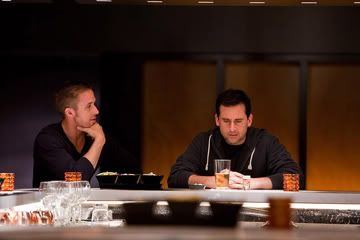
Opening with a punch to the gut, Cal (Steve Carell) hears from his wife, Emily (Julianne Moore), on a nice dinner out that she wants a divorce. He's shocked to the point where exiting a moving vehicle feels like an appropriate response. She has slept with another man, a co-worker whose name turns into a repeated curse word, David Linghaden (Kevin Bacon). Maybe Cal has lost his alpha male instinct after being a cozy husband and father of three as he loafs around in wrinkled khakis and worn-in New Balance sneakers. Enter Jacob who finds Cal pitying himself in a glitzy bar and makes it his duty to give Cal both a physical and personality makeover. As Jacob tells Cal to "be better than the Gap," their moments together are magnetic, and that's only the beginning.

Other romantic mismatching involves Cal's 13-year-old son, Robbie (Jonah Bobo), who has a major crush on his babysitter, 17-year-old Jessica (Analeigh Tipton). She, however, has eyes for an older man: Robbie's dad. There's also Marisa Tomei having tons of fun as Robbie's eighth grade school teacher who feels betrayed by Cal. And, of course, there's Jacob relentlessly courting law student Hannah (Emma Stone). All of these minor subplots surround the main issue of Cal and Emily's divorce, and they are all fleshed out with fully realized characters. Each of them play an important role in the larger scheme, and even when the converging plot lines amount to absurd coincidences, the script from Dan Fogelman makes sure to keep the situations grounded in rather poignant naturalism.

There are plenty of moments worth savoring such as Emily calling Cal under the facade of having a maintenance problem but only wants to hear his voice or the night of flirtatious seduction between Jacob and Hannah which is easily the film's highlight. "Crazy, Stupid, Love." is at last what feels like an updated look at contemporary behavior in relationships -- the way they work through all the hardship and heartbreak and the hope that leaves us clinging to that crazy word we call love.

Monday, January 17, 2011

BLUE VALENTINE Review


"Blue Valentine" (2010)

"Blue Valentine" is about the presence and absence of love, the start and end of a marriage. What makes this sad and painful observation of a failed marriage so genuine is that any moral compass gets erased. There is no contemplation of who was right or wrong in the relationship. Ryan Gosling plays Dean, and Michelle Williams plays Cindy, a couple who feels real. You don't walk out wondering whether it was Dean or Cindy's fault as to why they didn't work. They just didn't, it is life, and it happens to people.

There are two pivotal scenes in the film, one of which was the reason the MPAA nearly gave it an NC-17 rating. Dean and Cindy take a romantic night off, or what was supposed to be, and check in to a sleazy hotel room that is futuristic themed. In an attempt to rekindle their love, Dean puts on an old, scratchy song from the 70s, one that clearly must've meant something to them back in the day. We don't discover until later it was their song. Meanwhile, they choke down vodka slowly crawling to the moment where they have to make love. Not want to make love but have to. It's a nearly unbearable scene to watch but absolutely crucial in understanding how far this couple has come since their original spark.

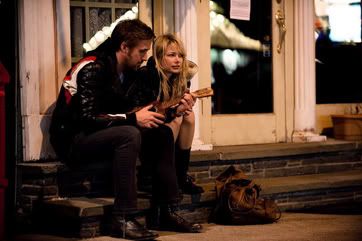
The other pivotal scene comes at the beginning of their courtship. Standing outside what looks to be a floral or bridal shop, Dean twangs a playful tune on his guitar and sings along as Cindy performs an impromptu tap dance for him. It is touching yet heartbreaking knowing how the couple ends up.

Director Derek Cianfrance leaps back and forth in time interspersing between showing the audience what brought Dean and Cindy together and what tore them apart. We watch Dean as a charming, funny and handsome young man with a scrappy sense of workman promise; we understand what Cindy sees in him. Jump ahead to Dean as a 30-year-old with a receding hairline, thick-rimmed glasses and a misconstrued mustache. He works as a painter not bothering to wash his hands with a cigarette always dangling from his lips, but in the way he interacts with his daughter we see his kindness and why Cindy might still love him. Cindy begins as a shy and attractive young woman striving to become a doctor, but she eventually gains a little weight losing her vivacity and glow.

These physical transformations reveal a deeper inner shift of character, and the raw and brutal performances from Gosling and Williams portraying this should be, and most likely will be, nominated for Oscars. These two actors have the chemistry and understanding of the human condition to provide us with two characters who don't feel like characters at all but like real people of flesh and blood.

"Blue Valentine" asks the demanding questions of what we ask for in a spouse and what the meaning of true love is. As we watch Cindy and Dean, we wonder whether they should've been together. Were they right for each other, or was it something out of necessity? The filming is purposefully claustrophobic both in the way their relationship is told and the way shots are framed with the frequent use of close-ups on the two actors.

While a brave and ugly portrait of a marital decline, I couldn't help but think we weren't getting anything more than snapshots of Dean and Cindy's life together; the full picture felt missing. We aren't clear exactly how they got from point A to point B, but maybe the point is that even they don't know how.

Thursday, March 25, 2010


Archive: "Lars And The Real Girl" (2007)

A movie about a guy who falls in love with a sex doll could've gone completely wrong. It's a premise that could've lent itself to a movie much worse than what it wonderfully turned out to be, and that's what makes "Lars and the Real Girl" such a welcome surprise. There were so many opportunities for the movie to turn out badly, but it sidesteps all disaster and goes an unexpected route by treating a seemingly hollow premise with the utmost sincerity. All of this makes the poignant little comedy the sweetest, kindest, and most innocent movie around right now.

The movie is aided in no small part by Ryan Gosling who yet again proves himself worthy; here, he plays the quirky and overly shy Lars who is so timid that he can't even stand another person's touch. So few actors could've struck the correct balance the way Gosling does. His situation isn't the butt-end of bad laughs, but more so, a study of his character. He plays Lars with a genuine tone that carries throughout; his behavior is perfect and understandable, painful at times, but ultimately uplifting. Through Gosling's performance, we are given a glimpse into the loneliness and hope of Lars' world.

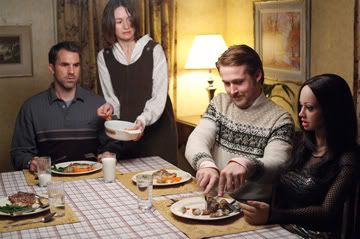
Lars' mother and father both died, and now he lives in a small cottage-like garage behind the house occupied by his older brother, Gus (Paul Schneider), and pregnant sister-in-law, Karin (Emily Mortimer). Karin desperately tries to get Lars involved in their life by inviting him to family meals, but Gus insists that it's just the way his brother is. Lars stays at home in complete solitude every evening. During the day, he goes to his office job where on one particular day his cubicle buddy shows him a website where you can create your very own sex doll. Jump ahead six weeks later when a large box is waiting for Lars when he comes home. Meet Bianca; she is a foreigner, a missionary, she's in a wheelchair, and Lars has all the reasons why she doesn't talk or eat.

When Lars introduces his new girlfriend to Gus and Karin, neither of them knows how to respond. Lars asks if Bianca can stay at their house and if she can borrow Karin's clothes. Realizing that the doll is there to stay, Karin accepts it while Gus is horrified and begins blaming himself for what has happened. They both visit a therapist, Dagmar (Patricia Clarkson), who tells them that the only way to deal with it is to go along with it. Dagmar begins bringing in Bianca for pretend treatment while actually treating Lars. She concludes that Bianca provides Lars with exactly what he needs: unconditional love. Yes, it is deduced that Bianca does indeed have a special "orifice," but Lars doesn't use her for sex; she is somebody nonthreatening to be with, somebody to talk to, a companion. He treats her with respect just like any person would want to be treated.

What's so endearing about the plot is that eventually the community reaches an unspoken agreement to treat Bianca like she's real. They play along because they love Lars, and they would never want to hurt such a sweet guy. And so, they get Bianca involved in as many volunteer activities as possible with the church and hospital. It's all very humorous, especially witnessing people's reactions to the sex doll, but most of all it is charming and immensely touching. During all of this, there is a girl from Lars' office who likes him, and she copes with Bianca just the same while inching closer to Lars. It all comes to a satisfying end, an ending that makes you realize that something truly remarkable has been achieved with this film. "Lars and the Real Girl" is about loving and supporting those around us. It will not only lift your spirit but will reaffirm your hope of the goodness in people.