Saturday, November 27, 2010


"Love & Other Drugs" (2010)

"Love & Other Drugs" needs medication for its own case of schizophrenia. The movie's distractingly abrupt tonal shifts aren't enough, though, to ruin the romantic couple at its center. It's a romantic comedy, but it's set to the backdrop of something more, a smart and zippy satire about the corporate pharmaceutical world. It's a movie in the hands of the capable director Edward Zwick ("Defiance," "Blood Diamond," "The Last Samurai") who is stuck working with sketchy writing. There's never a satisfactory balance of the two elements, the love and the drugs, but Zwick still manages to bring out key scenes and give them a necessary weight against bland placebos within the screenplay. These scenes are weighted on the side of love which sways the entire movie to drop the drugs side almost completely. Had it been the other way around, this would've been a very different movie.

It is 1996, and Jamie (Jake Gyllenhaal) casually slides into the career of a pharmaceutical rep when he gets fired from his job selling electronics. It's not much of a change for him because he carries his same charismatic, carefree attitude to both jobs. His charm works wonders as he works as a salesman for the drug company Pfizer selling samples of Zoloft. He slips into doctor's offices by talking up--and occasionally sleeping with--the female receptionists and befriending doctors to begin his domination with Zoloft over his adversary, Trey Hannigan (Gabriel Macht), whose drug of choice is Prozac. Cheered on by his supervisor Bruce Winston (Oliver Platt), Jamie paves his way through this business of bribes, gratuities and sleazy relationships between doctors and their reps.

Getting close with one doctor, Stan Knight (Hank Azaria), gives Jamie the opportunity to meet one of his patients, Maggie Murdock (Anne Hathaway), and not only that but also a peek at her breast. Maggie notices, follows Jamie out to the parking lot scolding him for allowing her to expose herself to him and from there, Jamie is immediately entranced by her cold bitterness, asks her to coffee and their story as a couple unfolds from there.

The movie is at its best when scorching the screen. At the start of their relationship, all Maggie and Jamie want and need from each other is sex. And so, they are naked a lot and having sex, well, a lot. In these instances, the movie becomes the ideal modern R-rated romance. It's hot and steamy with two delightfully attractive leads. We love when they're together, and the most memorable moments come when they're romping around in bed. All of this raunchiness is never gratuitous because these characters' bodies speak for themselves, and the sex and nudity has meaning to it; this is the way they communicate upon first meeting.

As Maggie, Anne Hathaway is great. Maggie is only 26-years-old and dealing with the early stages of Parkinson's disease. Her way of controlling it on her own is to not let anyone get too attached to her, which is why Jamie is such a good choice for empty sex. Hathaway presents a range of vulnerability and strength in Maggie that is authentic and a very fine performance. Gyllenhaal's Jamie is not as complete but effective nonetheless alongside Maggie. Also admirable is Hathaway's openness to the movie's blunt sexuality. This could be considered her first mainstream adult role, another role that truly launches her into the limelight.

By the third act of "Love & Other Drugs," it does fall victim to tired rom-com tropes. In spite of this, we care too much about the two leads to let it become too bothersome. What is bothersome, however, is the supporting character of Jamie's obnoxious younger brother (Josh Gad) who brings a whole baggage of unnecessary subplot and comic relief with slapstick that gets too gross and ends up belonging in a lesser buddy movie. And though the drugs take a backseat by the second half, the introduction of Pfizer's Viagra is a winning addition since this really is a movie all about sex and sexiness.

Wednesday, November 24, 2010


"127 Hours" (2010)

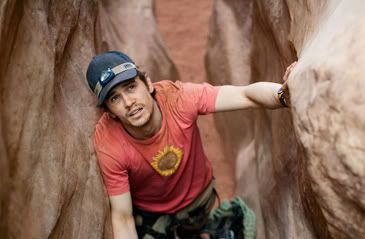
In April 2003, 27-year-old outdoors enthusiast Aron Ralston (James Franco) took a trip to indulge in his favorite activity of escaping miles and miles away from civilization. He traveled to the winding red rock formations of Blue John Canyon in Utah and failed to tell anyone where he was going. There, he fell and got himself trapped inside a small crevice with his arm crushed and wedged between a rock wall and a heavy boulder. How could the predicament of this man's entrapment and escape be made into a 90-minute film? Only through the visual genius of director Danny Boyle ("Slumdog Millionaire").

The film is both harrowing and entertaining, and from its very opening, it's also very much a Danny Boyle film. Our introduction to Aron serves also to introduce us to Boyle's keen visual style that will later be used to punctuate pivotal moments in Aron's struggle. Boyle sends us into the desert in a rush of flashy cinematography from the gifted Anthony Dod Mantle, who also worked on "Slumdog Millionaire," and Enrique Chediak. Also hailing from his work on "Slumdog Millionaire" is A.R. Rahman who returns with a driving score to fit the kinetic and breathless energy that Boyle pumps into each frame.

Boyle has a knack for bringing vivacity and life to dire and ugly situations. From heroin addiction in "Trainspotting" to poverty and violence in "Slumdog Millionaire," his films are exuberant and invigorating. His new film, "127 Hours," is perhaps the toughest challenge taking a story strictly confined to one man and one space and turning it into an experience that is completely visionary and transporting. Based on Aron Ralston's own memoir, "Between a Rock and a Hard Place" and adapted by writer Simon Beaufoy ("Slumdog Millionaire"), it's a film that is immediately compelling, a survival tale about psychological and physical endurance and desperation.

It helps that James Franco is such good company. This is his one man show, and he is astounding. From a cocky explorer to a helpless victim having to shed his pride, the transformation could not have been portrayed any better, and Franco disappears in the role and gives us his most demanding screen presence yet. Franco doesn't create a hero, either. He plays a man who was foolish enough to get himself trapped in a horrible situation but also intelligent enough to know how to get himself out.

The last people to see Aron are two attractive young hikers, Kristi (Kate Mara) and Megan (Amber Tamblyn), who appear to be lost. Aron takes the opportunity to boast about his knowledge of the area and offers to be their tour guide. He takes them to an underground hot spring, a temporary paradise. Aron's show-offish and reckless behavior here, however, is a tease for his avoidance of danger, a premonition and ironic forewarning of what's to come.

Once stuck, we soon get familiar with Aron's space. He sets his watch, rope, water bottle, camcorder, camera, other assorted items and, most importantly, that blunt knife of his on top of the boulder and fashions a pulley to keep himself hoisted up and keep pressure off his feet. There is a strip of sky above him where every morning around the same time a large bird flies past. He gets only 15 minutes of sunlight each day. He spends his time chipping away at the boulder with his knife and begins talking to himself on the camcorder.

Through imaginative storytelling, we also occasionally escape Aron's space. We enter into memories of his family, parents (Kate Burton and Treat Williams) and girlfriend (Clémence Poésy). We descend into fantasies and hallucinations, as well, such as a trippy montage of drinks as a vivid evocation of Aron's thirst, and these really embed us into his state of mind. At his core, Aron is a good-natured goofball. In one instance, he pretends to be on a talk show while recording himself, and he even includes audience response referring to his predicament as an "oops" moment. We all have those moments. Except this one could get him killed. Oops.

There are some gut-wrenching and intense scenes. Most notably the one the audience waits for in nervous suspense, the moment Aron decides to cut through his arm. It is a powerful scene and not gratuitous. The editor, Jon Harris, does an admirable job of showing us the procedure without actually showing us. What becomes the worst part is actually a sound rather than a sight. The scene communicates something larger than just a jolt of discomfort because at this point in the movie, we have lived vicariously through Aron and feel his pain.

Even more, "127 Hours" culminates to an inner monologue from Aron where he addresses the guilt of his selfishness. He thinks back realizing this rock had been waiting for him his entire life. All of his actions and choices had been leading up to this single moment. Cutting off an appendage was not only freeing himself physically but freeing himself spiritually in a moment of existential bravery and poignancy.

Friday, November 19, 2010


"Harry Potter and the Deathly Hallows: Part 1" (2010)

When I first heard that "Harry Potter and the Deathly Hallows," the conclusion to J.K. Rowling's modern literary classic, was going to be split into two movies, I was worried it was all about the money. It thankfully turns out, however, that it was really all about the story. The choice for a split in this final installment is an artistic one, and it seems only fitting now after having seen "Part 1." Director David Yates, who directed the fifth and sixth installments, has skillfully guided us through a string of "Harry Potter" films that are consistently excellent.

In this most emotionally and cinematically rewarding installment yet, there's a sense of melancholy for the impending end, which arrives next year with "Part 2," as Yates steers us into a more serious, elegant and meditative film about characters we have grown to love and care for, those we have watched since they were children and who are now intelligent young adults taking on the world outside the walls of Hogwarts School of Witchcraft and Wizardry.

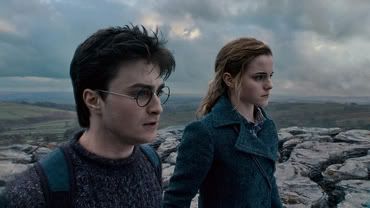
This is the furthest departure from any "Harry Potter" films that have come before. We receive but a glimpse of Hogwarts, and Harry (Daniel Radcliffe), Ron (Rupert Grint) and Hermoine (Emma Watson) are not there. There are no longer Quidditch matches, classes, uniforms, petty crushes or any sort of adult supervision or guidance--these are all things of the past for our trio. Cast out beyond the walls of Hogwarts, they are on their own separate mission to find the Horcruxes with which to destroy Lord Voldemort (Ralph Fiennes). Albus Dumbledore is dead and gone, and while the trio gets assistance early on from the likes of Hagrid (Robbie Coltrane) and Mad-Eye Moody (Brendan Gleeson), they mostly must remain on their own in order to ensure the safety of those close to them. Harry Potter is a human target with the Dark Lord's Death Eaters on the loose, so they decide it would be better to keep him in seclusion from others, which means traveling through vast wilderness and using Hermoine's endless resources to their advantage.

This drastic setting change is jarring at first but takes us to gorgeous landscapes that are captured by luscious cinematography from Eduardo Serra ("Girl with a Pearl Earring," "Blood Diamond"). The journey also takes them occasionally to the streets of London, which adds a shock of realism to what we've otherwise come to know as fantasy. The early portion of the movie wanders a bit, but it works considering the rather directionless nature of their journey at that point. We also wouldn't get some of the intimately detailed moments that we do if there wasn't this slight pause in the proceedings.

In one of the movie's most poignant moments, Ron has become fed up with waiting around for Horcruxes and storms off leaving Harry, and especially Hermoine, bewildered and lonely. In an effort to comfort Hermoine and lighten the mood, Harry wordlessly leads his friend in a dance inside their tent. This scene is not in the book, but it proves Yates has really come to understand not only these characters but the actors playing them, as well. A deviation from the text such as this comes as a welcome addition, an honestly tender and real moment marking the films and books as separate entities, but also a flourish of which Rowling would approve.

A lot of the older British cast is absent (Alan Rickman shows up only once as Severus Snape, and Helena Bonham Carter has one dastardly sequence as Bellatrix Lestrange), which leaves room for the three younger actors to really shine. Radcliffe, Grint and Watson all present their largest emotional range here than ever before. Their performances are accented with touchingly subtle nuances that were conspicuously absent before as the characters begin to struggle with each other as adults, and it's this elevation of feeling from them that makes this first part of the finale pack in the level of emotional grandeur that it does.

Tracking the adventure is the brilliant composer Alexandre Desplat, his first time working with "Harry Potter," whose score is haunting and bleak with touches of whimsy. This entry also uses stark silence to great effect most notably during both the opening and closing credits. A daunting chase sequence with Snatchers through the woods cuts out all music, too, as all we hear is the zapping of spells, the trampling of feet on the ground and heaving breaths.

Harry, Ron and Hermoine's infiltration into the Ministry of Magic is cleverly handled as is the telling of the story of the Deathly Hallows, which is presented with shadowy figures of animation that have a nice effect. The return of the house elf Dobby is also a welcome treat. Yates and screenwriter Steve Kloves have set their formula, which has become especially familiar to us since "Half-Blood Prince," to even greater effect here with a perfect blend of pathos and humor.

While each entry certainly has been darkening in tone and mood, things have now turned to pitch black. "Harry Potter and the Deathly Hallows: Part 1" is the slowest and saddest installment yet, beautiful and heartwrenching in its own right and a satisfying and standalone entry even when it ends at the midpoint acting as a stepping stone. "Part 1" braces its characters and its fans for the series' finish as we await with anxious suspense and a tinge of looming dread perhaps because we well know the next time is when we say goodbye.

Sunday, November 14, 2010


I haven't reviewed a movie since "Paranormal Activity 2," and yeah, there have been a lot more movies released since then. Here's a list of just a few of the movies I wish I had the time to see, the ones I had interest in and the ones I just didn't have the time to get to.

It's the movies I could be reviewing, but I'm not. At this point I figure I might as well just keep saving my energies for "Harry Potter and the Deathly Hallows: Part I," which I will be seeing this Thursday at midnight without question. It's going to be big, and I cannot wait. The most anticipated movie of the fall is finally here and will soon be followed by many award contenders as we dive deeper into Oscar season.

For Colored Girls

Tyler Perry's movie is remarkably split down the middle by critics. Some love it claiming Perry has finally lived up to his word and has made a movie that finally delivers while others find it abysmal calling it a putrid rendition of the original poem. I'm interested to weigh in and share my own opinion, but it will simply have to wait.

Due Date

I really didn't have an interest in seeing this one as it looked like it could easily be an underwhelming disappointment compared to Todd Phillips' "The Hangover," and I also figured that I might as well wait for "The Hangover 2" instead.

Megamind

I still want to see this one. With the voice talents of Tina Fey, Will Ferrell and Brad Pitt, it just looks like great, funny, 3-D animated fun. And, according to the critics, it really does prove that 3-D is only good for animated flicks like this.

Morning Glory

Frivolous and harmless, I feel like I definitely could've gone for this one. Rachel McAdams is just too sweet to pass up considering we haven't been graced with her presence for quite a few months, but alas, I'm passing her up.

Skyline

Critics have been panning this sci-fi alien invasion thriller as a steaming pile of special effects-laden crap. Meanwhile, I thought it looked pretty cool from the trailers. Ah well, guess I'm not missing out.

Unstoppable

This is perhaps the most important movie that has come out in the past few weeks in terms of potential and box office prowess. Starring Chris Pine and Denzel Washington, this is supposedly director Tony Scott's best film in years. I'm still itching to check this one out, so we'll see.