Friday, December 23, 2011

THE ARTIST Review


Writer and director Michel Havanavicius' "The Artist" was a risk, a bold one that immensely pays off. It's a tribute to black and white silent cinema while in itself being a black and white silent picture. And one starring two French actors, Jean Dujardin and Berenice Bejo, unknown to American audiences. Most of all, the movie is largely a gimmick. But you can't help but get swept up in the way both thematically and technically the movie is a rousing achievement -- its devoted love to the era and its celebration of all things cinema.

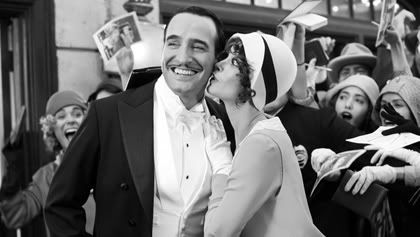
Jean Dujardin plays George Valentin, a prolific silent film actor in 1927. He has a dazzling smile with impeccable comic timing, control of his body language and dance moves perfect for silent picture performances. His time in the motion picture business is soon up, however, when the dawn of the talkie arrives. There are moments when people refer to George's refusal to talk, and it holds a double meaning in his stubbornness to let go and move forward. The times are changing and leaving him behind.

Meanwhile, a chance encounter between George and a young wannabe actress named Peppy Miller (Berenice Bejo) is pivotal. She was in the right place at the right time and gets in line for a straight shot to fame. And while it was George who got her there -- penciling in a beauty mark on her upper lip the fans adore -- and begins falling for her, they part ways. Watching the way Peppy and George's story unfolds calls back to "Singin' in the Rain" (1952) about a silent actress whose voice wasn't fit for talkies.

Dujardin and Bejo are lovely to watch. Consider the ways I described George Valentin's perfect silent movie performance -- both leads do the same for their characters. It's an astonishing modern acting feat that will provide both of them worthy nominations come Oscar time. Imagine giving a wide range of emotion without uttering a word. Certainly you have to accentuate every gesture. In part to their performances, along with Hazanavicius' smart direction, the film feels like a replica of what came out of the era. It feels genuine, something carefully preserved and drawn out of a time capsule.

Just when you think "The Artist" is about to roll you over with its unrelenting charm, it takes a step back and brings insight into what used to make the movies so appealing, and what might have been lost over the years. The director and two leads are very French yet there are two supporting actors, John Goodman and James Cromwell, who are American. And yet wordless, they have a universality about them making them seamless together. And in the same vein, it's easy to forget you're watching a black and white silent movie and can just appreciate and enjoy it for what it is: a movie. It's a universal movie that audiences might be surprised to find themselves thoroughly applauding.

Wednesday, December 21, 2011

THE GIRL WITH THE DRAGON TATTOO Review


David Fincher's "The Girl with the Dragon Tattoo" begins with an opening credit sequence that's a jolt to the senses. Karen O's menacing cover of Led Zeppelin's "Immigrant Song" plays to figures dripping in black, disturbing yet provocative images of evil, a psychedelic and haunting anthem for the film's start. This opening gives Fincher's adaptation of the first entry in Stieg Larsson's internationally bestselling "Millenium Trilogy" a signature mark from a master director -- the one detail the 2009 Swedish original from director Niels Arden Opev lacked.

Neither version is better than the other, but each one definitely has a different feel. Fincher has an artistic eye behind the camera, an apparent love for all things grunge and gritty. This marks the director's return to pulpy crime noir such as "Zodiac" and "Se7en" after the likes of "The Curious Case of Benjamin Button" and "The Social Network." And it's a clearly welcome return as Fincher infuses the already established story with his own style and cinematic flourishes. The movie is better looking than the Swedish original thanks to cinematographer Jeff Cronenweth who also worked on "The Social Network." But it's more than that -- Fincher and his screenwriter Steven Zaillian don't try to copy the original or reinvent it, and they certainly don't ignore it. They take an already established framework and add nuances both visually and emotionally.

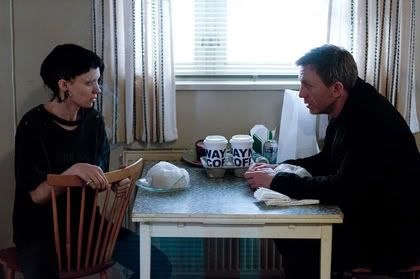
The biggest draw of this story is, of course, the ambisexual gothic super hacker Lisbeth Salander. She's played here by Rooney Mara, an actress who stands up to the challenge and exceeds expectation. For one, she has the look down. With short, choppy black hair, gaudy piercings, scar-like tattoos, a pale complexion accented by barely-there eyebrows and an expressionless glare, Mara nails it. She had some big shoes to fill following just a year behind Noomi Rapace, but she is perfectly comparable with subtle differences. Mara's Lisbeth is more a feral animal always looking out for predators. She can sink her teeth into something if necessary, but there's that added layer of fragility and vulnerability that Rapace's Lisbeth lacked. Mara manages to capture even more complexity and creates a Lisbeth Salander all her own.

Immediately following a defamatory article in Millenium magazine written by Mikael Blomkvist (Daniel Craig), he gets slammed for libel sending him into recluse. The timing couldn't be any better when he's contacted by a representative of Henrik Vanger (Christopher Plummer), the eldest of the large Vanger family clan. Mikael treks out to the secluded, wintry island owned by the Vanger family to hear about the disappearance and suspected murder of Henrik's 16-year-old niece. It's an unsolved case that has haunted Henrik for 40 years, and he hires Mikael to find Harriet's killer under the guise of writing his memoir. Henrik figures Mikael could use the time off from Millenium.

The procedural of uncovering new information on the cold case is a convoluted labyrinth as one could imagine, but Zaillian's script does the best job it can keeping everything straight. There was an accident on the bridge the day of Harriet's disappearance, so no one was able to enter or leave the island. This leaves only members of the Vanger family as suspects to Harriet's murder; however, all the research, newspaper clippings and old photographs seem to be leading Mikael to no conclusions. Isolated in his own chilly cottage provided by Henrik and gradually meeting each member of the Vanger clan, the looming dread becomes ever more apparent that Mikael is residing among a murderer. Even Henrik despises his family as some of them had (or still have) Nazi sentiments. Among the Vangers is an ominously cordial Stellan Skarsgard as Martin, Harriet's brother.

Running parallel to this is the plight of Lisbeth Salander dealing with a new guardian (Yorick van Wageningen). He is cruel, abuses her and is smug about thinking he can get away with it. In a scene staged with brutally naked violation, we are roused to side with Lisbeth solidifying her role as an avenging angel to the men who hate women. The film flickers back and forth between Mikael and Lisbeth until finally they're brought together working on the Harriet case. She joins him as a research assistant, and though they start off weary of each other -- Lisbeth by nature and Mikael because she did the extensive background check on him -- they generate an eccentric, downbeat chemistry. Daniel Craig as the scrappy left-wing journalist stands above Michael Nyqvist from the original with his confident charisma and sexuality although he doesn't attempt the Swedish accent as Mara does.

The film runs at 158 minutes and doesn't drag for a second. Also essential to Fincher's style is the return of Trent Reznor and Atticus Ross from "The Social Network" providing a musical score that seethes with white noise and creepy ambiance. There's always the question why did we need an English version of "The Girl with the Dragon Tattoo" immediately after the original was such a success? The answer is simple. We wouldn't have received another dark, riveting and complex piece of entertainment from David Fincher. He gives audiences a fresh new take, not a mere rehash. And it's filmmaking that benefits from the written words of Stieg Larsson at its core. It's a tale that plays with our terror and fascination of the unknown. It's about awaiting what human horrors will be uncovered next, what depravity in humanity exists and what is hidden behind closed doors.

Monday, December 19, 2011

MY WEEK WITH MARILYN Review


While watching "My Week with Marilyn," you might find yourself feeling as if you're caught under a spell, a certain magnetism that you can't quite explain. Except that it can be explained. Like Marilyn Monroe herself, Michelle Williams is utterly hypnotic as the iconic screen goddess. The blond bombshell actress -- the woman everyone wanted to either be or be with in the mid-1950s -- had a personality that nobody could figure out, and the performance from Williams doesn't try to. Instead she emanates everything Monroe was about and what it must've felt like for anyone to be in her presence. There's the fact alone that being her was an act itself. In one instance she says, "All people ever see is Marilyn Monroe." Williams deserves an Oscar for embodying the actress effortlessly -- her effervescence, aloofness, mystery, grief and insecurity. She'll most certainly receive a Best Actress nomination.

The film follows the backstage proceedings of filming "The Prince and the Showgirl" (1957) in Pinewood Studios, London. Starring alongside Marilyn Monroe in the picture is Laurence Olivier (Kenneth Branagh) who also served as director. One might think working with such a world-renowned celebrity would be a dream and the highest honor, but Olivier clashes with her almost immediately. He is all about proficiency and the technicality of filmmaking and has no patience for Marilyn. There's always a delay whether she's not feeling well, she's sick, hungover or too tired. She's never on time, and when she does arrive she trips over her lines and doesn't believe in the character she's playing. But when she finally gets it right, her screen presence sings.

Everyone working on the film fully knows Monroe is difficult, but only Olivier has the nerve and audacity to blow up about it to her face. Branagh gives an important performance here as a man who's a genius in the film industry but is hardly in love with it. And when forced to put up with Marilyn's behavior, this immovable object that everyone adores and loves -- he can't bear it. Paula Strasberg (Zoe Wanamaker) is Marilyn's personal acting coach she brings along who coddles her, boosts her self-esteem and counteracts Olivier's direction. There's also Dame Sybil Thorndike (Judi Dench) who understands the director's frustration but also knows how to delicately handle Marilyn's sensitivity.

The biggest focus, however, is on the relationship between Marilyn and the impressionable 23-year-old Colin Clark (Eddie Redmayne) who was the gofer on the project. The movie is based on his memoirs and gives the film a fascinating perspective. Colin landed in between the Olivier and Monroe camps taking note of everyone and letting the backstage pass experience soak in. This unique position also sparked Marilyn's interest in him to hear what everyone thought of her.

The film captures Marilyn's absolute allure, the light she radiated and what it must've been like for Colin when she kissed him and said she loved him -- even if she didn't mean it. Everyone warns Colin to not get himself involved, but instead of dating the nice wardrobe girl (Emma Watson's first role since playing Hermoine in the "Harry Potter" series), he becomes enraptured by Marilyn. Redmayne captures a naive awe that makes us feel what he must've felt in the era. The power of the film, and of course Williams' performance at its center, is the way it makes you believe this luminous woman's ability to have such a profound impact on people's lives.

Saturday, December 17, 2011

YOUNG ADULT Review


The re-teaming of screenwriter Diablo Cody and director Jason Reitman proves "Juno" was no fluke. Their collaboration with "Young Adult" is inspired, a scalding black comedy about the queen bitch in high school and everyone's worst nightmare -- except now she's 37 and returning to her hometown. The movie is cynical and goes down like a sour shot, but it's the year's most unexpected surprise by breaking every rule in conventional Hollywood storytelling.

Mavis Gary is played by Charlize Theron in a ferocious and raw performance. She is a protagonist that is completely unlikable and unsympathetic. She is unpleasant, cruel, condescending, delusional and fueled by a keen sense of self-destruction. Yet what's so remarkable is the way Theron ever so casually makes us -- with the help of Cody's fearless writing -- feel for Mavis.

She is relatively successful having moved out of her Midwest town now living in an apartment in Minneapolis. She writes young adult novels for a popular series but really is just a ghostwriter -- and the series is no longer selling. Her apartment is a pigpen, she spends every night slamming back bourbon, every morning chugging liters of Diet Coke to cure hangovers and is destined to be single forever. And while she moved away and feels superior to anyone back home, she still puts more thought into them than she lets on. Then she receives a mass email from her high school sweetheart, Buddy (Patrick Wilson), who recently had a baby with his wife. Mavis immediately becomes obsessed with the idea of going home and stealing Buddy back.

When Mavis first gets into town, she has a run-in with Matt (Patton Oswalt), a chubby geek from high school whose life was ruined from being the target of a hate crime. The media paid attention to it until they found out he wasn't actually gay, just mistaken for being gay. Patton Oswalt's Matt is pivotal to the movie's success. He is the cushion for all of Mavis' impossibly reckless behavior and provides a perspective we can agree with. Well knowing the hilarity and absurdity of Mavis' pitch black predicament with Buddy, he also sees she is just as miserable as him even if she fails to realize it. We recognize a sadness that she doesn't know is there. She can think the only reason she's hanging out with Matt is because he's the only one in town, but in fact they share a connection.

"Young Adult" plays out in a series of incidents that will have you crawling in your skin. Patrick Wilson has a tough job as Buddy playing a really nice, well-meaning guy who's desperately trying to not to offend or embarrass Mavis. It is, in some ways, a better movie than "Juno." It's more complicated and a whole lot harsher placing Diablo Cody not just as pop-savvy but a screenwriter of importance. In Mavis we're watching a humiliating train wreck, but one that is treated with honesty. In such we can't help but derive a bit of truth out of it, and more than a few laughs.