Showing posts with label steven spielberg. Show all posts

Friday, February 22, 2013

85th Annual Academy Award Winner Predictions


Sunday's telecast of the 85th Annual Academy Awards is guaranteed going to give us some surprises.

Could Ang Lee top Steven Spielberg for best director considering he took a novel widely considered to be unadaptable and turned it into an Oscar-nominated triumph?

Could best supporting actor go to Robert De Niro for a veteran actor who hasn't seen a good role in years?

The screenplay categories are also very much up in the air. In adapted, either David O. Russell for "Silver Linings Playbook" or Chris Terrio for "Argo" could grab the win away from assumed front-runner Tony Kushner for "Lincoln." And in original, don't be surprised if the love for "Amour" sneaks into a win out from under Quentin Tarantino's "Django Unchained."

And speaking of "Amour," there's always the possibility of votes for Jessica Chastain and Jennifer Lawrence canceling each other out allowing Emmanuelle Riva in for the win.

In spite of all the crazy dark horse possibilities, I've nailed down my final predictions below.

Best Picture: All signs point to "Argo."

Director: With Ben Affleck down for the count, looks like Steven Spielberg is the favorite to take it for "Lincoln."

Actor: Daniel Day-Lewis for "Lincoln"

Actress: Jennifer Lawrence for "Silver Linings Playbook"

Supporting Actor: Tough call between Christoph Waltz for "Django Unchained" (BAFTA win) and Tommy Lee Jones for "Lincoln" (SAG win), but I'm going with Waltz.

Supporting Actress: Anne Hathaway for "Les Miserables"

Animated Feature: Kind of open, but recent Annie wins say "Wreck-It Ralph."

Original Screenplay: Quentin Tarantino for "Django Unchained"

Adapted Screenplay: Tony Kushner for "Lincoln"

Sound Editing: "Skyfall" because respected action movies always take it.

Sound Mixing: "Skyfall" for the same reason.

Film Editing: "Argo" because it'll validate the best picture win.

Documentary Feature: "Searching for Sugar Man"

Foreign Language Film: "Amour"

Cinematography: Claudio Miranda for "Life of Pi"

Makeup & Hairstyling: "The Hobbit: An Unexpected Journey"

Costume Design: "Anna Karenina"

Visual Effects: "Life of Pi"

Original Song: "Skyfall" by Adele

Original Score: Mychael Danna for "Life of Pi"

Production Design: "Anna Karenina"

Documentary Short: "Inocente"

Live Action Short: "Curfew"

Animated Short: "The Paperman"

With only two wins, "Argo" will take the top prize of best picture along with best editing -- funny because it'll tie "Anna Karenina" for two wins. It will be topped by "Lincoln," which I predict will win three awards: best director, supporting actor and adapted screenplay. This also means "Skyfall" and "Life of Pi" will each land at three wins for technical awards.

Tune in to watch the telecast of the 85th Annual Academy Awards on Sunday, Feb. 24 at 8:30 p.m. on ABC.

Wednesday, November 28, 2012

LINCOLN Review


There's a point in watching Daniel Day-Lewis as our 16th president of the United States where you realize you're not just watching an actor portrayal. You are watching a man disappearing behind a historical figure, an icon of American history. You stop seeing Daniel Day-Lewis. You see Abraham Lincoln. Never again will an on-screen representation of him be so close, so real and so accurate. And it all starts with that voice. The voice Day-Lewis decided to inhabit the president with is nothing short of brilliant. The legend and lore of Lincoln brings to mind a deep, booming voice. History tells us otherwise, and the master method actor brings this richly to life. Before this film, Lincoln was a figure, a representation, an idea. Now, there's a man to go with it.

Instead of the painterly, picturesque puffery of last year's "War Horse," Steven Spielberg directs "Lincoln" with refined understatement. He allows the densely packed script from Tony Kushner ("Angels in America," "Munich") speak for itself, which was expertly crafted from Doris Kearns Goodwin's "Team of Rivals." Full of monologues, heated debates and strategic discussions, the movie documents the final months of Lincoln's presidency leading up to the passing of the thirteenth amendment and his tragic assassination at Ford's Theatre. The beauty in the collaboration is that it works like a time machine transporting audiences effortlessly to the 19th century, a time when the Civil War raged on and worry surrounded Lincoln's re-election.

Longtime Spielberg cinematographer Janusz Kaminski shoots "Lincoln" full of dark interiors and light spilling in through windows and curtains. Only a few shots are outside, and the only piece of battlefield action is in the film's first fleeting moments. For the majority of its two-and-a-half-hour running time, the film is a lesson in history -- and I mean that in the best way possible. It's smart, and you feel smart watching it. It can drag and does take a bit to get settled in with its vast cast of characters and familiar faces, but once we first enter that House of Representatives, the rewards for your attention and perseverance are immense.

The supporting crew is a laundry list of names and faces audiences will recognize. The main players are Joseph Gordon-Levitt as Lincoln's eldest son, Robert; David Straithairn as Secretary of State William H. Seward, Lincoln's right-hand man; Tommy Lee Jones as the hot-tempered radical liberal Thaddeus Stevens, a fervent advocate of black rights; and Sally Field as Lincoln's wife, Mary Todd. But that's only the beginning. James Spader, Hal Holbrook, John Hawkes, Jackie Earle Haley, Lee Pace, Jared Harris and  Michael Stuhlbarg among many other actors play strong supporting roles to give this moment in history real drama and life.

Casting Sally Field as the impassioned Mary Todd was inspired, as the veteran actress shows us the 16th president's wife as both indignant toward and admirable of her husband. Likewise, Tommy Lee Jones brings a weathered yet tough energy to Thaddeus Stevens whose private secret reveals his personal connection to Lincoln's cause. Both of these seasoned performances will be nominated alongside Day-Lewis.

All of this, all of "Lincoln," it all circles back to Day-Lewis. The scenes of him speaking to his Cabinet are captivating. He plays Lincoln with a quicksilver spirit that is ideal to the president's lore and how well-loved and appreciated he was by his party members. He has all the patience in the world, idling by and telling long stories -- but he also has his moments where he doesn't see what he knows needs to be done getting done. And when he slams that fist of his down on the table and asserts his power, you'll get chills. If nothing else, Steven Spielberg's "Lincoln" could likely restore your faith in American politics.

Thursday, January 5, 2012

WAR HORSE Review


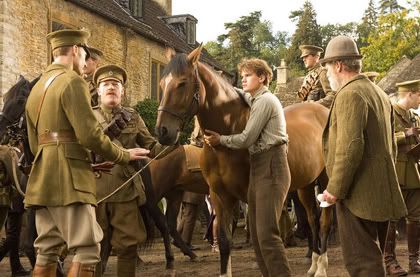
Steven Spielberg sure knows how to lay it on thick. "War Horse" is unabashedly old-fashioned filmmaking and makes a bold announcement of being such. It's a Spielbergian film through and through with no room for understatement. John Williams' bombastic score and Janusz Kaminski's lush cinematography know exactly what they're going for. Technically speaking, the movie is the epitome of perfection. Spielberg is a master of the craft and knows how to tug on the heartstrings and jerk some tears. I, however, don't like to be yanked on for an emotional response. Spielberg and his team certainly know how to solicit those responses, but they don't disguise their technique one bit. All of the components are there, but it's too obviously manufactured and labels the film as what it might really be -- Oscar-mongering.

Adapted from the London stage play, it's the tale of a boy who raises a horse, loses him in the dawn of World War I and yearns for his return. We begin on a quaint farm where a drunkard farmer (Peter Mullan) bid on a race horse he thought could be turned into a plow horse. He brings the horse home to his infuriated wife (Emily Watson) who believes because of her husband's stupid actions they'll lose everything. Their teenage son, Albert (Jeremy Irvine), however, has faith in the new horse. He raises the horse as his own, names him Joey and strives to protect him from harm. Desperate for money, Albert's father sells Joey to the war effort and so begins our episodic journey following this noble steed.

From its initial setup, the film is painterly, picturesque, and every shot is established like a fine portrait. This carries through into the war sequences which are eloquently shot against the carnage. Each sequence following Joey's departure into the war front plays out like an individual vignette giving the film a disjointed feeling with drastic tonal shifts. But two instances stand out among the rest. One is when a French farm girl (Celine Buckens) comes into possession of Joey with her elderly grandfather (Niels Arestrup), and the other is when an English and German soldier call a truce to help Joey who's entangled in barbed wire. Separate moments such as these work wonders but struggle in aiding to the cohesiveness of the picture as a whole.

A detachment occurs once Joey leaves the farm, a detachment from any central character to anchor the narrative -- no, the horse doesn't count. Even Jeremy Irvine as Albert is absent for too long to give us the emotional connection we need, the tether that keeps us rooting for Joey to find his way back to his beloved owner. But boy, Spielberg sure does try to make that connection in any way he can with overbearingly beautiful skies and landscapes, heroic angles and spot-on musical cues, all which still can't make up for a dramatic flatness.

And for all this negativity toward "War Horse," it's still fine entertainment. It's just all too obviously constructed and drenched in sentimentality using every aesthetic approach in the book. It's too bad the narrative isn't allowed to more openly and organically speak for itself instead of slamming us with trite schmaltz. The story instead lives behind a shielded coating of gloss not allowing us to become truly invested as much as Spielberg clearly thinks we should.

Friday, June 10, 2011

SUPER 8 Review


"Super 8" (2011)

Thank goodness for "Super 8." J.J. Abrams' ultra secret sci-fi thriler--one of the most highly anticipated movies of the summer--is this year's "Inception" not in terms of content or tone but simply in reminding and reaffirming what summer blockbusters are all about. This is a huge action flick, but you may not even recognize that at first; there is an absorbing human drama letting us never forget that among the enormous explosions and chaos, there are families, a group of friends and a small town to be concerned about.

Written and directed by Abrams, this is also a heartfelt throwback, a retro and nostalgic look back at what made old-fashioned summer blockbusters so appealing--those directed by the likes of Steven Spielberg. Produced by Spielberg, the film borrows heavily from the director's older movies such as "E.T.," "Close Encounters of the Third Kind" and even "Jaws." Abrams' borrowing isn't without reason, however, because his film is a love letter to the Spielbergian movies that inspired him. And, what more, it's a love letter to the classically American genre of the B-movie and to the pure joy of filmmaking and moviegoing.

The irresistible story takes place in 1979 and follows a group of middle school-aged boys making an 8mm zombie movie to be entered into a youth film festival. What makes this feel so authentic is that Abrams was 13 years old in 1979, so the details are all there. Just as Abrams is nodding to Spielberg, he's even more so reminiscing on his own childhood and the Super 8 monster movies he made as a boy. In watching a group of kids passionately make a zombie flick, we become aware that we're watching a movie created by a grown-up kid in the same spirit--one that is exquisitely well-made, thrilling and wonderful.

While filming a pivotal scene for their movie, the kids witness something terrifying and spectacular. A train unexpectedly derails right before their eyes in one of the most elaborate and magnificently colossal train crashes ever to grace the big screen. This accident creates a string of intrigue and mystery that gets a shady military presence involved. Strange occurrences threaten and overwhelm the small town, and it all escalates to a full-scale evacuation. The tropes of the sci-fi genre are there, but they're being played with in our favor.

Take for example when the demanding director of the young production played by Riley Griffiths--who is a great supporting player and acts like a pubescent Orson Welles--mentions how the hero of their movie needs a wife, so audiences will care if he dies. They recruit the elegant Alice (Elle Fanning) to play the role, and by the same token, we're given the extremely talented and divine Elle Fanning as the butterflies-in-your-stomach first love to Joe (15-year-old novice Joel Courtney). He is the sensitive yet strong lead of "Super 8" who is experiencing the grief of having lost his mother.

The young cast is the film's shining gem and brings with it a playful and gentle tone with perfect humor even when things get creepy and the atmosphere turns dark. The adult cast gives fine support, especially two prominent figures: the town's deputy played by Kyle Chandler who's also Joe's hard-loving father and Ron Eldard as Alice's conflicted and unstable father.

There is so much heart and so much fun contained in J.J. Abrams' "Super 8" with the type of innocent storytelling and eye-twinkling awe we rarely see anymore. And there's a beautiful message to boot telling us that--extraterrestrial or not--we all want a place to call home.