Showing posts with label joseph gordon-levitt. Show all posts

Tuesday, October 1, 2013

DON JON Review


Joseph Gordon-Levitt's "Don Jon" is not a romantic comedy, and it's not even a movie about porn addiction. And saying such is a testament to Gordon-Levitt as an emerging writer/director who has delivered a debut that is weird, funny, confident, intelligent and, most impressive, blasts onto the scene with something to say. What it is: a movie about finding human connection in a world where media has skewered our view of relationships and how we find meaning in each other. 

Jon (Joseph Gordon-Levitt) is the epitome of the modern day Don Juan. He's a beefed up New Jersey guy dedicated to what's most important in his life: his boys, his girls, his family, his church, his body, his ride and his pad. And then his porn. Even though he has no trouble landing a girl every time he goes out, his real sexual thrill is still at the click of a mouse. The way Jon dishes out why is a riot: the blow jobs, the positions, the money shot. It's graphic but never gratuitous, and the frenetic way porn clips are edited together shows absolute control over a highly slick and stylized production.

From the music to the camerawork, every directorial decision is apparent in Gordon-Levitt's vision, and that's without even mentioning Gordon-Levitt the actor. He's great. The film follows Jon as he goes about his days, very set in his routine. The repetition is blatant -- down to the detail of shots showing him walking to the gym and bounding up the church steps are exactly the same every time -- and a stylistic choice but also acts as a hindrance to the film's narrative which itself becomes repetitive. Even when Jon meets the bombshell Barbara (Scarlett Johansson) who he swears will change his life, he keeps up his routine, which includes rampant porn consumption.

His parents (Glenne Headly and Tony Danza) are thrilled that his boy is finally growing up, but silent sister Monica (Brie Larson) isn't convinced. Don't miss Larson in the fabulous "Short Term 12" because here she's only given the job of one line, but it's one ripe with truth and insight and drives home Jon's ultimate self-revelation. There's also an older night school classmate, Esther (Julianne Moore), breaking him out of his mold. At first she annoys him, but they gradually begin to bond. Their scenes are the movie's most naturalistic and moving and for good reason. Moore is outstanding as always but also feels slightly miscast. As "Don Jon" plugs along in its cyclical scenes of gym, church, porn, repeat, it's hard to decipher how Esther and his relationship fall into place. Just as you reach the brink of wondering what's the point, it hits you like a ton of bricks.

Wednesday, November 28, 2012

LINCOLN Review


There's a point in watching Daniel Day-Lewis as our 16th president of the United States where you realize you're not just watching an actor portrayal. You are watching a man disappearing behind a historical figure, an icon of American history. You stop seeing Daniel Day-Lewis. You see Abraham Lincoln. Never again will an on-screen representation of him be so close, so real and so accurate. And it all starts with that voice. The voice Day-Lewis decided to inhabit the president with is nothing short of brilliant. The legend and lore of Lincoln brings to mind a deep, booming voice. History tells us otherwise, and the master method actor brings this richly to life. Before this film, Lincoln was a figure, a representation, an idea. Now, there's a man to go with it.

Instead of the painterly, picturesque puffery of last year's "War Horse," Steven Spielberg directs "Lincoln" with refined understatement. He allows the densely packed script from Tony Kushner ("Angels in America," "Munich") speak for itself, which was expertly crafted from Doris Kearns Goodwin's "Team of Rivals." Full of monologues, heated debates and strategic discussions, the movie documents the final months of Lincoln's presidency leading up to the passing of the thirteenth amendment and his tragic assassination at Ford's Theatre. The beauty in the collaboration is that it works like a time machine transporting audiences effortlessly to the 19th century, a time when the Civil War raged on and worry surrounded Lincoln's re-election.

Longtime Spielberg cinematographer Janusz Kaminski shoots "Lincoln" full of dark interiors and light spilling in through windows and curtains. Only a few shots are outside, and the only piece of battlefield action is in the film's first fleeting moments. For the majority of its two-and-a-half-hour running time, the film is a lesson in history -- and I mean that in the best way possible. It's smart, and you feel smart watching it. It can drag and does take a bit to get settled in with its vast cast of characters and familiar faces, but once we first enter that House of Representatives, the rewards for your attention and perseverance are immense.

The supporting crew is a laundry list of names and faces audiences will recognize. The main players are Joseph Gordon-Levitt as Lincoln's eldest son, Robert; David Straithairn as Secretary of State William H. Seward, Lincoln's right-hand man; Tommy Lee Jones as the hot-tempered radical liberal Thaddeus Stevens, a fervent advocate of black rights; and Sally Field as Lincoln's wife, Mary Todd. But that's only the beginning. James Spader, Hal Holbrook, John Hawkes, Jackie Earle Haley, Lee Pace, Jared Harris and  Michael Stuhlbarg among many other actors play strong supporting roles to give this moment in history real drama and life.

Casting Sally Field as the impassioned Mary Todd was inspired, as the veteran actress shows us the 16th president's wife as both indignant toward and admirable of her husband. Likewise, Tommy Lee Jones brings a weathered yet tough energy to Thaddeus Stevens whose private secret reveals his personal connection to Lincoln's cause. Both of these seasoned performances will be nominated alongside Day-Lewis.

All of this, all of "Lincoln," it all circles back to Day-Lewis. The scenes of him speaking to his Cabinet are captivating. He plays Lincoln with a quicksilver spirit that is ideal to the president's lore and how well-loved and appreciated he was by his party members. He has all the patience in the world, idling by and telling long stories -- but he also has his moments where he doesn't see what he knows needs to be done getting done. And when he slams that fist of his down on the table and asserts his power, you'll get chills. If nothing else, Steven Spielberg's "Lincoln" could likely restore your faith in American politics.

Friday, October 5, 2012

LOOPER Review


Rian Johnson's "Looper" has the distinct feeling of being a classic even as you're watching it. It's set in a dystopian future -- two, in fact -- one that is 32 years in the future and another 30 years beyond that. In the way it unfolds two parallel universes recalls Christopher Nolan's labyrinthine "Inception," and the vividly detailed portrayal of a dysmal future brings to mind the gritty detail evoked by Alfonso Cuaron's "Children of Men." And in its characters, themes and brooding tale of justice and morality through a sci-fi neo-noir landscape, it's hard to not call it a new version of "The Matrix" and "Blade Runner" for this generation. Best of all is that in capturing the essence of each of these films, Johnson's "Looper" triumphs in being something wholly original and breathtaking that would be a shame if it didn't get remembered for awards season.

Joseph Gordon-Levitt plays Joe, a man who was hired as a looper for the mob. He lives in the year 2044 when time travel hasn't been invented yet. Thirty years later, however, it will be, and it's only used by an illegal crime syndicate. They kidnap, throw a hood over their victim and send them back in time to be assassinated and disposed of. In this fully-realized universe, loopers carry a weapon called a blunderbuss which looks like a streamlined shotgun. Loopers have their blunderbuss while the Gat Men carry a long-barreled revolver called a gat which they cherish. The Gat Men are mafia-types who skulk around in trench coats and are led by a haggard crime boss named Abe (Jeff Daniels).

In the future, drug use has simplified to using eye drops to get a fix, and some citizens have been affected with the power of telekinesis, referred to as TK. Those who have the power, however, only twirl coins in the air and use it as a pick-up line. The exception is a man called the Rainmaker who in the future, year 2074, is apparently using his power toward evil. He's doing what's called "closing the loop," which is when the older version of a looper is sent back in time to be executed by none other than himself. A friend of Joe's, a reckless man named Seth (Paul Dano), realizes he's about to close his loop and lets his future self go, a selfish act that Abe cannot let stand.

As if foreshadowing Joe's own predicament to come, he comes face-to-face with a thirty-year-older version of himself, played by Bruce Willis. It's interesting to note how Gordon-Levitt doesn't look like himself -- thanks to subtle makeup work, his face is ever so slightly transformed to resemble Willis'. The younger actor deadpans, smirks and scowls just like his veteran counterpart, too. And playing the older Joe gives Willis his best performance in years. There's a scene where the seemingly impossible happens. Joe sits at a rural diner sitting across from himself, thirty years in the future. Having a conversation with yourself opens a door of endless possibilities, and Johnson is smart to only focus on what's immediately important to the characters' dire situation. He leaves all else the scene implies for us to decipher and question on our own.

Also artful and intelligent is the way Johnson's screenplay employs the use of time travel. It isn't so much the forefront of action but instead a backdrop to create unexpected thematic intricacies. The ingenuity of Johnson's writing really shines when young Joe finds himself on a desolate farm. It's a stirring contrast between the grime of the city where either the mob or destitute vagrants reside. On this farm Joe meets Sara (Emily Blunt), a tough single mother who doesn't shy away fending off late night intruders with a shotgun. Her son, Cid (Pierce Gagnon), becomes an extremely important element to the well-being of both young and old Joe alike.

In sci-fi action blockbusters, women characters are generally used for sexual intrigue and eye candy. In the case of both farm girl Sara and old Joe's loving wife (Summer Qing) with whom he spends a new life in China, "Looper" has elements of a rather profound love story, something that may come as an added surprise. That again speaks to Rian Johnson's finesse as a filmmaker. In 2005, he debuted with "Brick" giving us a high school noir narrated by a newly re-branded Joseph Gordon Levitt. After an underwhelming second feature, "The Brothers Bloom," Johnson is back announcing himself firmly as a new commanding presence in the industry worth recognizing.

Saturday, July 21, 2012

THE DARK KNIGHT RISES Review


While Christopher Nolan's "The Dark Knight Rises" may not be the tightly constructed masterwork its predecessor was, it's a fully rewarding and all encompassing closing chapter to the director's truly accomplished Batman trilogy. It is a dark, brooding and uncompromising piece of filmmaking that asks bold questions about morality weaving in broader social and cultural relevance that is shocking. No superhero movie has gone to such levels of depravity and hopelessness. Nolan and his team take us there and manage to make "The Avengers" look like child's play. Pummeling its audience at a whopping 164 minutes full of doom and gloom with only a small circle of light at the end of the tunnel, this grandiose spectacle doesn't forget its obligation to thrilling comic book entertainment. It delivers. Recalling to mind not only "The Dark Knight" but also "Inception," the most anticipated movie of the year is the anti-blockbuster blockbuster of our time.

It's been eight years since the death of Harvey Dent, and the caped crusader Batman has been in recluse ever since. The billionaire behind the mask, Bruce Wayne (Christian Bale), has been mostly absent, as well. Hiding within the walls of his mansion, Wayne lives in permanent bachelorhood with his lifelong butler, Alfred (Michael Caine). The faithful butler is thankful Wayne has decided to end his Batman days but also longs for him to move on with a new life. There's been no need for Batman due to his public blame for Dent's death but also because organized crime in Gotham has nearly been eradicated. That, of course, can only last for so long.

Enter Bane (Tom Hardy), a muscled villainous man forced to wear a muzzle-like mask, whose only desire is to watch Gotham destroy itself and turn to ashes. There were sound issues with Bane's altered voice, and while new sound mixing makes him easier to understand, it's not perfect. Because the mask doesn't allow you to see his mouth move, his booming and bass-filled voice feels almost disembodied. And yet, this strange  phenomenon works to emphasize Bane's notion of representing a threat greater than himself. Tom Hardy's performance here is limited to physical gestures and expression through his eyes, both of which he puts to great effect. The voice he creates, too, is haunting with pseudo-sophisticated inflection and a Darth Vader-esque artificiality.

Now, Heath Ledger's Joker can't be beat. His villainous reign of chaos and anarchy in 2008's "The Dark Knight" echoed the times of post-9/11 and terrorist threats. Bane, however, represents something more abstract: vague references to the occupy Wall Street movement and the financial crisis. For the first time, the city of Manhattan is used to represent Gotham, further eliciting scary topical relevance that Nolan masterfully draws out of the comic book lore. Bane's plan for Gotham includes two terror-filled set pieces involving an assault on the Stock Exchange and a series of explosions that not only trap the city's law enforcement underground but cut off Gotham from any outside aid.

There are a handful of new characters with Bane and, of course, returning ones including Lucius Fox (Morgan Freeman), Wayne's go-to for all updated Batman gadgetry and vehicles, and Commissioner Gordon (Gary Oldman) who's always been at the forefront of support for Batman. After Bane crashes the stock market, Wayne Enterprises consequently goes bankrupt. This introduces a wealthy board member named Miranda Tate (Marion Cotillard) to take the reigns. She must protect what once was a reactor meant to be used as a clean energy source for the city against Bane who seeks to turn it into an unstable, mobile nuclear bomb.

Initially luring Bruce Wayne out of seclusion is the sly, sexy thief Selina Kyle (Anne Hathaway) who slinks into Wayne's mansion to steal his late mother's pearl necklace, along with his fingerprints. The moral ambiguity of Hathaway's Catwoman -- never actually referred to as Catwoman in the film -- is intriguing, and the actress plays it up with sinister glee. Christopher Nolan and his brother Jonathan wrote the script based on the story from the director and David S. Goyer (who penned the upcoming "Man of Steel"), and they cleverly weave Selina Kyle's character into the story. She becomes an integral part of the concluding saga both helping and thwarting Batman. Seeing these two together in action sequences is also a real show.

An unexpectedly solid new character is Joseph Gordon-Levitt's street cop John Blake. He's fully aware of Batman's existence, knows Bruce Wayne is behind the mask and is a resourceful product of the Wayne Foundation's orphanage for boys. There's a sort of kinship there, and a lot of screen time is granted to Blake and the likes of Commissioner Gordon when Batman is imprisoned by Bane in a literal hell hole beneath the earth. After a blood-curdling fist brawl between the two masked figures, Batman's heroic frailty surfaces. The fact that a majority of the second act is void of Batman makes his triumphant return to the screen all the more visceral, powerful and emotionally potent also thanks to Hans Zimmer's continuously pounding score.

With his "The Dark Knight Rises," Christopher Nolan gives humanity to the superhero and delivers thrills that have substance, depth and implications of a harsh reality. Yes, it's bloated and exhausting, but it's hugely ambitious and accomplished, making a solid claim for this Batman trilogy to stand tall among the best film trilogies in history.

Friday, July 16, 2010


"Inception" (2010)

"Inception" is the film that will finally give Christopher Nolan the Oscar nominations for Best Picture and Best Director he has for so long deserved. Or at least it should be. This is a supremely intelligent work of art delving into the dreams of reality and the reality of dreams like no other movie in recent memory. And it comes from Nolan, one of the most talented storytellers working in cinema today, in the form of the biggest movie event of the summer. As a combination of "The Matrix," Charlie Kaufman's "Synecdoche, New York" and James Bond, the movie has the narrative puzzlement of "Memento" with the grand, epic scale of "The Dark Knight." Nolan dreams larger than life, and best of all, he succeeds.

Consider the feeling you get after jolting awake from an intense dream that feels all too real. That's how leaving "Inception" feels with your heart racing, head spinning and nerves jangled. Fitting, then, that the movie is about understanding dreams and the process of creating a reality within them. This concept opens up a labyrinth of possibilities, and Nolan navigates these possibilities with complete control through a screenplay that supposedly took him 10 years to complete. The film is impervious to spoilers because it's almost impossible to describe in words, and any details that might give anything away would not and elicit confusion instead.

If there's any movie out there that needs to be seen to be believed, this is it. With an ending so powerful prompting one of the most diverse audience reactions I've experienced, you will need to take a moment to set yourself back in the real world once the credits roll. There is no possible way to fully comprehend it upon a first viewing, but you can immediately appreciate its grandeur warranting multiple viewings. Prepare to have your mind twisted, turned inside out and then completely blown because this 148 minutes is more than worth the effort.

Cobb (Leonardo DiCaprio) describes how an idea is the most resilient parasite and that an idea planted in the mind is a seed that can grow to change the course of a life. He is a skilled professional hired by corporations to infiltrate the subconscious of others to steal their ideas, a practice known as extraction. Cobb, though, is hired by a wealthy corporate man, Saito (Ken Watanabe), to do just the opposite. The job requires Cobb to perform an experimental procedure called inception where he will plant an idea deep into the mind of a young billionaire, Robert Fischer Jr. (Cillian Murphy), an idea that will eradicate a corporation that rivals Saito's. All Cobb wants to do is to be able to go back home as a free man. After a terrible accident he was forced to remove himself from his family, but completing this job would allow him to return. It's a job he can't refuse and a job he vows will be his last.

A meeting with his father-in-law, Miles (Michael Caine), leads Cobb to discover his new architect for the job, Ariadne (Ellen Page), who is a smart and promising student and a genius when it comes to building and replicating spaces. As a test of her ability, Cobb has her sketch a maze in under a minute, but what Ariadne will sketch for the job is much more elaborate and fully realized. She must create a space within Fischer's dreams that is a deceptive maze, and this is all described to her by Cobb as they sit at an outdoor café in Paris. His discussion with her about fabricating environments within a dream while navigating and manipulating them is Nolan's way of teaching the audience how to follow along. In one of the film's most impressive sequences, the interior of a dream is introduced as the environment around Cobb and Ariadne starts dismantling itself and shattering all around them in a gorgeous slow motion effect. The cityscape lifts into the sky and literally folds onto itself.

They assemble a team to begin the infiltration process which includes Cobb's close associate, Arthur (Joseph Gordon-Levitt), a disguise master named Eames (Tom Hardy) and Yusuf (Dileep Rao) whose concoction of a sedative will allow the participants to stay asleep during their extensive inception. You see, they eventually dive into four levels of dreaming which means the plot is at one point simultaneously dealing with five layers of reality. You heard that right. Five layers. Yet it never becomes muddled or too disorienting--of course it has to be disorienting at least a little bit--as it progresses with a forward momentum that reaches the breaking point of intensity. It is accented with a pounding and brassy musical score by Hans Zimmer echoing that of "The Dark Knight."

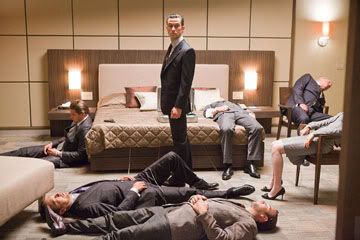
Physics and time are altered as they descend deeper into the layers. Seconds in the first layer of a dream are minutes in the following layer which then descend to what could be hours, days or even weeks. This allows for visual flourishes that are downright awe-inspiring in many instances. When a van carrying our heroes tumbles down an incline, this places the second layer Arthur in the midst of a gunfire showdown in a rotating hotel hallway. When this same van gets launched off the edge of a bridge, gravity in this second layer ceases to be.

The special effects have a mind-bending effect not only in looking great but also in making sense with the circumstances of the dreams. Scenes from the movie's trailers which seemed illogical make wondrous sense once in context such as sceneries tilting and shifting right before your eyes, a freight train barreling down a busy street and crumbling buildings in a dilapidated state of limbo, the result of death in a dream while under Yusuf's strong sedative.

All of the performances in "Inception" are superb. Leo DiCaprio is impressive carrying a brooding weight with his role of Cobb who, unbeknown to his colleagues, has performed inception once before with devastating results. Marion Cotillard is fantastic as always playing Cobb's tender yet sorrowfully vicious wife, Mal, who perpetually invades whatever dream Cobb occupies because guilt from his past keeps her locked in his subconscious like a prisoner. Cotillard's presence has a saddening love that lingers in the scenes between Mal and Cobb.

As Ellen Page's first adult role, she fits in seamlessly, and I can't help but hope this is the start of a new trend for her because it's refreshing to witness. Also notable is Joseph Gordon-Levitt whose shining moment arrives when he solely wrestles with a batch of floating sleeping bodies.

The brilliance of "Inception" is the way it fits huge metaphysical ambition reflecting one's own sense of a dreamscape into an action Hollywood blockbuster structure without one hiccup. It makes the chase sequences and other conventions of the action genre feel like something wholly original all over again. With "The Dark Knight," Nolan reinvented the superhero movie. I think now he may have just reinvented, well, the standards of explosive commercial entertainment. He said his film is what Hollywood blockbusters should all strive to be. I couldn't agree more.

Friday, July 24, 2009

She Doesn't Love You

(500) Days of Summer


"(500) Days of Summer" insists on it being not your typical love story. In fact, it's not a love story at all. Boy meets girl. Boy falls in love with girl. Girl doesn't. First-time director Marc Webb provides a strong debut feature with this charming look at failed romance. It's a romantic comedy that sees relationships for what they really are. It's a fresh outlook that grasps at certain subtleties that other movies of the genre would gloss right over. What lies in between the initial meeting and the bitter breakup? Well, a slew of indescribably messy emotions that this inventive film manages to capture wonderfully. Sometimes in a romance we only believe what we want to believe, and then we get blindsided by what really is. Here is exactly what that looks like.

Enter Tom (Joseph Gordon-Levitt) who wanted to be an architect but ends up spending his time in L.A. working as a greeting card writer in an office. Enter the new assistant in the office, Summer (Zooey Deschanel), who Tom falls in love with upon a first glance. And so begins the 500 days that are presented in a non-sequential fashion jumping back and forth between the high and low points of their relationship. Each scene of the movie opens up with a time card presenting labels such as "Day 3" and "Day 260." While it may seem gimmicky at first, this storytelling strategy actually works to the movie's advantage. By beginning the movie on Day 488, we see how it ends and have to backtrack from there. This style works like a scrapbook of memories, the only way a relationship such as the one Tom finds himself in could possibly be remembered.

The movie is greatly assisted by its two main leads who strike a perfect balance and never overshadow each other. Joseph Gordon-Levitt is utterly charming as Tom, a guy who can just as easily be cool and casual as he can be devastatingly disappointed and crushed. He's a likable hero to the romance story gone awry and a believable hero, too. Zooey Deschanel plays Summer as a mysterious figure, a girl who is maddening with her alluring qualities while never letting anyone fully into her world. She plays the part perfectly, and while we never fully understand Summer, there's something about her that allows viewers to agree with Tom's attraction to her. These two gifted actors share chemistry with each other even when they have their angry breakup.

Alongside a self-consciously hip soundtrack are some clever and quirky visuals, especially during the morning after Tom and Summer spend their first night together. Tom saunters around town suddenly engulfed in a musical number scored to "You Make My Dreams" complete with choreographed dancing and an animated blue bird. Other creatively original moments include when the scenery fades into a blurred sketch around a depressed Tom and a sequence of split-screen where the dream of expectations clashes with the harshness of reality. Along with being witty and laugh-out-loud funny, the movie boasts several insightful moments, specifically when Summer provides her dissertation on the frivolity of love and when Tom bashes the foundation of greeting cards.

The title of "(500) Days of Summer" sounds like it's referring to the season until you find out the girl's name is Summer. For Tom, she is not only a love but also a season, one of changing colors and moods and one full of moments of bliss and moments of suffering. And so it's only fitting that his next infatuation would be named Autumn.